

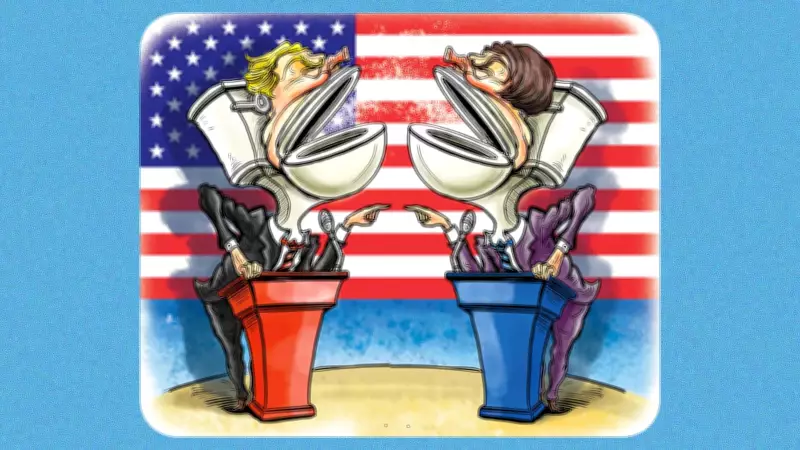
Once upon a time, American presidents spoke in polished paragraphs written by Ivy League speechwriters, with the occasional 'my fellow Americans' tossed in for moral uplift. Today, its political discourse increasingly resembles the comment section under a viral wrestling video. This week, the phrase 'Tuck Frump', a spoonerism emblazoned on T-shirts and other merchandise, trended on X, the platform currently functioning as America's national sewage pit.
The Rise of Spoonerisms in Politics
Spoonerism is a literary device where the speaker accidentally — or in this case, wilfully and provocatively — swaps the initial sounds of two words. It is the linguistic equivalent of wearing your pants backward, except with more bile. 'Tuck Frump' joined a growing bipartisan dictionary of political obscenities that now stretches from 'Let's Go Brandon' (aimed at Biden) to 'Fuck ICE,' from 'MAGAts' to 'libtards', proving that in modern America, the First Amendment has apparently entered its potty-mouthed phase.
From Polished Paragraphs to Profanity
The shift from eloquent speeches to crude slogans reflects a broader cultural change. Political figures and their supporters increasingly use vulgar language to express dissent or rally their base. This trend is not limited to one party; both sides have embraced obscenities as tools of political expression. The phrase 'Let's Go Brandon,' a euphemism for an insult aimed at President Joe Biden, gained notoriety after a NASCAR interview. Similarly, 'Tuck Frump' targets former President Donald Trump, using a spoonerism to mock his name while avoiding direct profanity.

The Impact on Public Discourse
This potty-mouth politics has significant implications. It lowers the tone of public debate, making it harder to engage in civil discourse. It also reflects a growing polarization, where insults and vulgarity replace reasoned arguments. Social media platforms amplify these trends, as provocative content often garners more attention. The First Amendment protects such speech, but the question remains whether this shift is healthy for democracy. As America moves forward, the challenge will be to balance free expression with the need for respectful dialogue.






