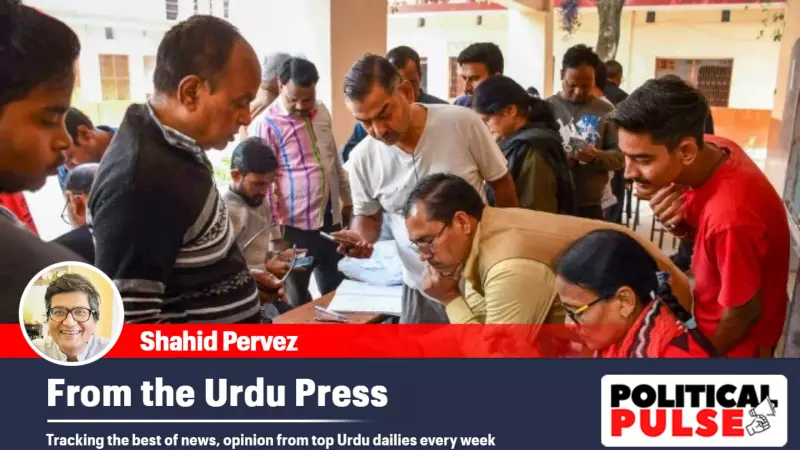
The Winter Session of Parliament commenced on Monday, December 2, 2025, under the shadow of a major political storm. This turmoil was triggered by the Election Commission's (EC) ongoing Special Intensive Revision (SIR) of electoral rolls, a move that has dominated headlines and sparked fierce debate. Urdu newspapers have provided extensive coverage of this issue, alongside poignant local stories that reflect the nation's social fabric.
Election Commission's SIR Exercise and the Human Cost
In its editorial dated December 2, 2025, the Hyderabad-based daily Siasat addressed the intense controversy surrounding the EC's SIR. The exercise, covering nine states and three Union Territories, has faced vehement opposition from political parties. However, the poll body has remained steadfast in its implementation.
The editorial underscored the monumental scale of the task, which involves revising voter lists for crores of citizens. The EC delegated this massive responsibility to Booth Level Officers (BLOs), who are often government staff like teachers, imposing a stringent deadline for completion. This has resulted in severe work overload and extreme pressure on the BLOs.

A tragic consequence of this rushed process has been the reported deaths and alleged suicides of several BLOs across India. The Siasat editorial raised a critical question: who will be held accountable for these deaths that have devastated numerous families? The daily noted that neither the Election Commission nor the Central government has broken their silence on this grave matter.
Furthermore, the newspaper questioned the EC's methodology and the lack of a clear, publicly stated rationale for conducting such a pan-India SIR in a hurried manner. While acknowledging the necessity of cleansing electoral rolls of discrepancies and bogus entries, the edit argued that such a vast exercise involving hundreds of millions cannot be rushed through in a few weeks without being counter-productive. The manner of implementation has also sown seeds of suspicion about the EC's motives. The editorial called for introspection from the constitutional body, urging it to create a conducive atmosphere and realistic timeline for the BLOs to work.
A Gesture of Harmony in Jammu Defies Divisive Narratives
Amidst the political discord, the Mumbai-based Urdu Times highlighted a heartening story of communal harmony from Jammu in its November 29 leader. The editorial recounted an incident where the Jammu Development Authority (JDA) demolished the house of Ghulam Qadir Daing, a 72-year-old man who had built the property 40 years ago, during an anti-encroachment drive.
As the elderly man sat amidst the rubble, his Hindu neighbour, Kuldeep Sharma, stepped forward with an extraordinary offer. Sharma offered to gift his own land to the Daing family. The Urdu Times celebrated this act, stating that while recent times have seen attempts to create a Hindu-Muslim divide and fuel distrust, the "idea of India" is powerfully reflected in Sharma's humanity and generosity.
The editorial emphasized that such shining instances of communal amity deal a blow to bigoted forces and uphold India's pluralistic culture, defined by unity in diversity. It credited the country's foundational ethos of love, propagated by saints and sufis, for nurturing such bonds that withstand attempts to vitiate the social fabric.
Karnataka Congress Navigates Leadership Transition
Turning to state politics, Siasat, in its November 30 editorial, analyzed the truce in Karnataka between Chief Minister Siddaramaiah and his deputy, D.K. Shivakumar. The two leaders held a breakfast meeting at the CM's residence following intervention from the Congress high command, effectively hitting the pause button on their public power struggle.
The daily pointed out that while the Congress has never officially confirmed a "rotational chief minister" deal for 2.5 years each, this understanding is widely believed in political circles since the government was formed in May 2023. The tension peaked as the Siddaramaiah government completed roughly 2.5 years in office, causing fresh disquiet within the party.

After the meeting, both leaders publicly reaffirmed their commitment to the party's interest and agreed to abide by the high command's decisions. The editorial indicated that it is becoming increasingly clear that D.K. Shivakumar may assume the chief minister's office by the end of March or early April 2026. The Congress leadership is now expected to chart a formal roadmap for this transition, having instructed both leaders to focus on governance and avoid public comments on the issue.
The edit acknowledged Siddaramaiah's stature as a mass leader but also noted Shivakumar's pivotal role as state Congress chief in securing the party's resounding victory in the 2023 assembly polls. With an eye on the 2028 elections, the Congress considers its governments in Karnataka and Telangana as critical, even as it aims to return to power in Kerala in 2026.