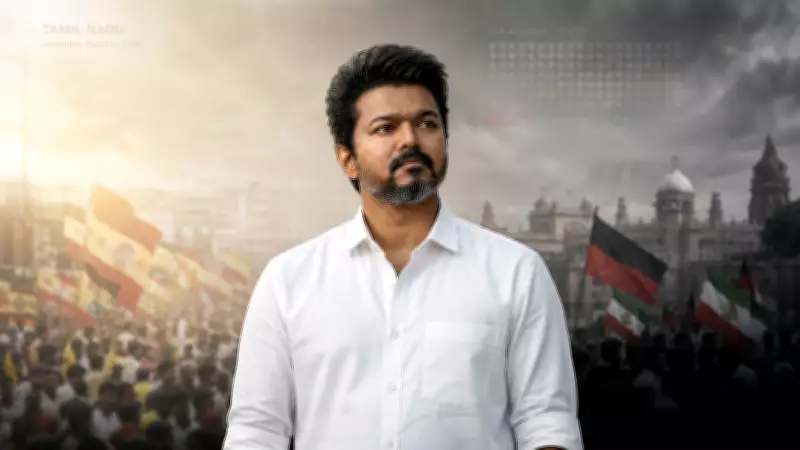
Actor-politician Vijay’s dramatic emergence as a central force in Tamil Nadu’s election has become a flashpoint in a political landscape long dominated by the DMK and the AIADMK. As counting trends point to a fractured verdict — and a possible reordering of established vote banks — the scale of Vijay’s performance marks a shift that neither pre-poll arithmetic nor conventional political reading had fully captured.
The Surprise of Vijay’s Reach
In this Q&A, veteran journalist Nirupama Subramanian reads the mandate as both a surprise and a warning. The surprise lies in Vijay’s reach: not just among young fans, but across regions and communities, including areas where the DMK and AIADMK had long held firm. His ability to cut into both major parties' traditional vote banks has reshaped the electoral arithmetic, leaving no constituency untouched. Subramanian notes that Vijay’s campaign effectively mobilized first-time voters and disaffected sections, creating a new political bloc that neither the DMK nor the AIADMK could ignore.
The Warning of Uncertainty
The warning, however, lies in what remains unclear about Vijay’s role as kingmaker. While the actor-turned-politician has called the DMK his political rival and the BJP his ideological rival, his larger politics — on governance, welfare, federalism, language, and development — is still not fully known. This ambiguity leaves voters and analysts guessing about his future alliances and policy directions. Subramanian emphasizes that Vijay’s success in winning seats does not automatically translate into a clear governing vision, raising questions about stability and coalition dynamics in the state.

Impact on Traditional Parties
The DMK and AIADMK, which have alternated power for decades, now face an existential challenge. Vijay’s vote share, estimated at over 20% in several regions, has eroded their dominance, forcing both parties to reconsider their strategies. The fractured verdict suggests that no single party can form a government without support, making Vijay a potential kingmaker. However, his political inexperience and unclear policy stances could complicate negotiations.
Redefining Tamil Nadu Politics
Vijay’s rise also signals a broader shift in Tamil Nadu’s political culture, moving away from Dravidian identity politics toward a more personality-driven, celebrity-led movement. His appeal transcends caste and community lines, tapping into youth aspirations and anti-incumbency sentiments. Whether this translates into a lasting political force or a temporary phenomenon remains to be seen, but the 2026 election has undoubtedly marked a turning point.
As counting continues, all eyes are on Vijay’s next move. His decision to ally with or oppose major parties will determine the shape of the next government. For now, his entry has upended traditional vote banks, leaving the DMK and AIADMK scrambling to adapt. The full implications of this shift will unfold in the coming weeks, but one thing is clear: Tamil Nadu’s political landscape has changed forever.