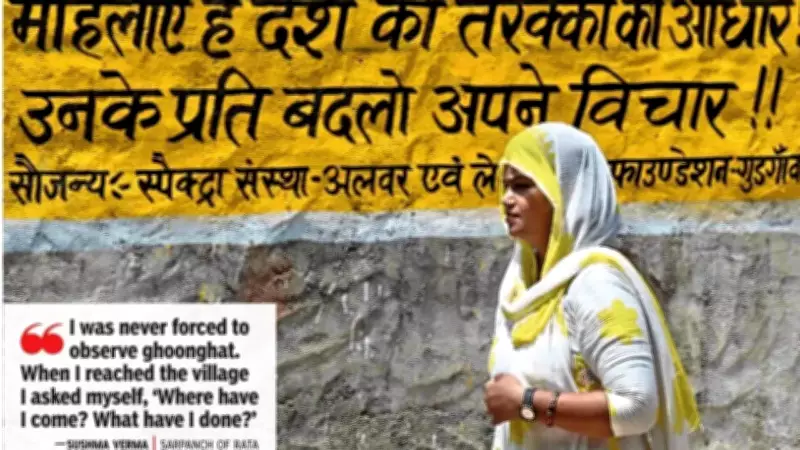
For Sushma Verma, a 30-year-old business administration graduate from Rajasthan's Alwar, life took an unexpected turn. In 2017, she was married into a family in Rata Khurd village, just 24 kilometers away but feeling like light years apart. Among the first shocks was the expectation to cover her face with a traditional ghoonghat in the presence of elders—a practice completely alien to her. Unspoken rules, such as not sitting or speaking when elders were around, added to her dismay. 'I was never forced to observe these practices, but I had a sinking feeling when I came to Rata Khurd. I asked myself, 'Where have I come? What have I done?'' she recalls.
However, Verma's self-doubt faded in 2020 when the village panchayat seat was reserved for women. Encouraged by her husband and in-laws, she ran for office despite initial reluctance. 'I could not imagine standing in front of people and speaking,' she says. But she won. Over the next few years, she focused on repairing village roads, extending the local school from Class 10 to Class 12, and lobbying for a college to save students from traveling to Alwar or Khairtal for higher education.
Three Tiers, Three Decades
Verma's entry into local governance was made possible by the 73rd and 74th Constitutional Amendments of 1992, which introduced a three-tier system of gram panchayat, panchayat samiti, and zilla parishad. These amendments mandated at least one-third (33%) of seats in all rural panchayats be reserved for women. Over three decades, over 20 states have increased the quota to 50%. A recent RBI report estimates India has over 1.4 million women representatives in local bodies.

Shashi Bala, sarpanch of Bhiduki maha gram panchayat in Haryana's Palwal district, is one such representative. Coming from a family of sarpanches and district judges, she was not considered a candidate until the seat was reserved. 'I was busy as a college lecturer and with my satsangs,' she says. 'But once I won the seat in 2022, I understood the power of the election. It was tough, because there were 14 women in the fray.' For Bala, who had unsuccessfully contested an MLA election earlier, this victory was a vindication.
Yet, these hard-won battles seem to lose their shine when it comes to higher office. Bala watched last month's Parliament debate on the 131st Constitutional Amendment Bill with disappointment, realizing she may never again get the chance to fight for an MLA seat. 'Had they wanted to pass the amendment, they would have done it. But they didn't,' she says.
Why Does Political Empowerment Stop for Women?
The recent state polls saw heated debate over the women's vote bank but little discussion on the minuscule number of women legislators who won. Out of 7,829 candidates, only 1,019 were women, and merely 8% of them won. Women sarpanches bristle at the failure of the Women's Reservation Bill, passed in 2023 but made horizontal, contingent on increasing the size of the Lok Sabha after a fresh census and delimitation. Last month, the government attempted and failed to advance delimitation, casting doubt on the aspirations of women in local bodies.
Tara Krishnaswamy, co-founder of Political Shakti, a volunteer collective working to increase women's political participation, says the bill failed because no party or government is willing to share power. 'Women could be given reservation off the bat, without the conditions. Just as political parties give tickets to OBC candidates in areas where OBCs are in the majority, they could give women tickets. Women form 50% of the demographic. Yet, no party thinks it is necessary to give tickets to women candidates, beyond the usual tokenism,' she says.
Krishnaswamy believes there is 'no doubt' that deserving women candidates exist, but there is no space for growth. 'There are plenty of women who would do no worse than men if they were given MLA tickets, because they have already fought and won local elections. And yet, they are not picked.'

Glass Ceiling in Uttar Pradesh
A study of women's representation in Uttar Pradesh reveals the pervasiveness of this glass ceiling. Between 2015 and 2021, women's representation increased from 45% to 53.7% among gram pradhans, from 33% to 54.2% among block pramukhs, and from 33% to 56% among zilla panchayat chairpersons. However, representation among members stagnated at around 24-25%. The study concludes: 'Reservation has enhanced women's visibility and empowerment in local governance, though structural and social barriers persist at the grassroots.'
Rekha Jadhav, sarpanch of Herwad gram panchayat in Maharashtra's Kolhapur, another reluctant entrant into politics, had high hopes for the bill. She worked with a local activist to stop the ostracization of widows. 'Before the gram panchayat resolution, widows were segregated and treated badly, not allowed to wear jewellery, kept away from weddings and auspicious events,' she says. Her interventions became a model for other villages. But after fighting and winning polls, many women ask whether there is a way ahead. 'We had high hopes from the (amendment) bill this time,' Jadhav says.
The Road Ahead
Had there not been reservation for ST women for the sarpanch post at Nadimi Thanda, a tribal hamlet in Telangana's Kamareddy district, Banoth Laxmi says she would never have thought of contesting. A school dropout who studied till Class 5, she credits her husband's reputation as a former upasarpanch for her win. 'If not for the reservation, my husband would have contested,' the 33-year-old says. 'But that doesn't mean I am not interested in politics. I have got the opportunity now.' She now aims to contest the mandal parishad territorial constituency elections—a step up from the gram panchayat.
In Jangaon district, Ellandula Thirupathamma, 50, was elected sarpanch of Chinnapendyala after the post was reserved for an SC woman. She feels not many women can become leaders at the national level without reservation. 'That is the situation, unfortunately. Many major parties do not give tickets to women. But having 33% reservation will force them to do so, and more women will reach the assembly,' she says. She concedes that repeating her independent victory at the assembly or Lok Sabha level would be difficult.
In Haryana, Shashi Bala walks down the village road—newly laid and paved, thanks to her. 'I can build roads,' she sighs, 'but I cannot see the way ahead.'