

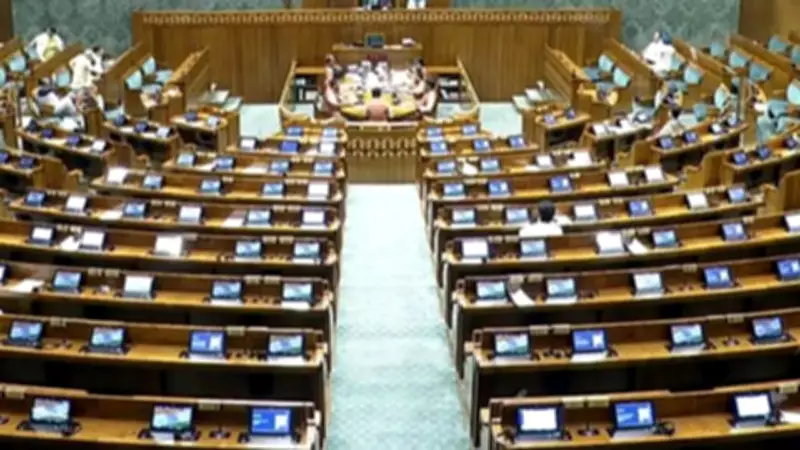
Historic Women's Quota Bill Moves Forward in Parliament's Special Session
The Nari Shakti Vandan Adhiniyam, a landmark legislative proposal aiming to establish a 33 per cent reservation for women in India's legislatures, is set to be introduced by the Central government during the ongoing special session of Parliament. This constitutional amendment bill represents a pivotal step toward enhancing female representation in the nation's highest democratic bodies.
Prime Minister Modi Hails a Historic Leap for Women's Empowerment
Ahead of the parliamentary proceedings, Prime Minister Narendra Modi emphasized the significance of this initiative. In a social media post, he stated, "Starting today, in the special session of Parliament, our country is all set to take a historic step towards women's empowerment. The respect for our mothers and sisters is the respect for the nation, and with this very spirit, we are moving forward resolutely in this direction." His remarks underscore the government's commitment to advancing gender equality through legislative action.
Understanding the Women's Reservation Bill and Its Implications
Formally designated as the Nari Shakti Vandan Adhiniyam, the Women's Reservation Bill seeks to constitutionally mandate the reservation of one-third of seats in both the Lok Sabha and state legislative assemblies for women. If enacted, this measure would fundamentally transform the composition of India's Parliament, both in terms of size and demographic representation.

The Lok Sabha is projected to expand substantially from its current strength of 543 seats to approximately 850 seats. Within this enlarged House, around 283 seats—constituting one-third—would be exclusively reserved for women, marking the inaugural implementation of such a quota at the national level. Although the Bill was passed in 2023 within the new Parliament building, its enforcement is contingent upon the completion of a delimitation exercise based on the 2027 Census. Consequently, the reservation is not anticipated to take effect before 2034 under the existing legal framework.
The Crucial Role of Delimitation in Implementation
To facilitate this process, the Centre has concurrently introduced a Delimitation Bill. Delimitation involves the redrawing of parliamentary and assembly constituencies based on population data, as mandated by Article 82 of the Constitution following each census. The government aims to reserve 33% of seats for women from the 2029 general elections onward, without altering the proportional allocation of seats among states.
Historically, delimitation exercises were conducted regularly until the 42nd Constitutional Amendment in 1976 suspended revisions until after the 2001 Census, freezing the number of Lok Sabha seats at 543. The proposed Bill envisions establishing a Delimitation Commission, to be chaired by a former Supreme Court judge and including the Chief Election Commissioner or a nominee as a member, to oversee this critical task.
Opposition Resistance and Concerns Over Delimitation
Despite expressing support for the women's quota in principle, the opposition has raised strong objections to linking its implementation with delimitation ahead of the 2029 Lok Sabha elections. Congress MP Jairam Ramesh articulated these concerns, stating, "Three Bills are being taken up in the Lok Sabha. The packaging and marketing is women's reservation, but the fundamentals have to do with delimitation."
Ramesh further argued that the delimitation proposals could disproportionately benefit populous states where the BJP currently holds strength, potentially diminishing the relative representation of other states. He cited examples from Assam and Jammu and Kashmir to illustrate apprehensions about the process. The opposition advocates for reserving one-third of the existing 543 Lok Sabha seats for women, inclusive of quotas for women from SC, ST, and OBC communities, viewing this as a more democratic and constitutionally aligned approach.
The issue has also ignited a north-south divide, with Tamil Nadu Chief Minister MK Stalin staging protests, including burning a copy of the Delimitation Bill, over fears that southern states might see reduced representation. This regional tension adds another layer of complexity to the legislative debate.

Government's Stance and Assurance on the Bills
In response, the government has defended the Women's Reservation Bill as a balanced initiative that fulfills the aspirations of all states, communities, and regions. Union Parliamentary Affairs Minister Kiren Rijiju criticized the opposition for spreading misinformation regarding delimitation, asserting, "But after giving 33% reservation, history will be made. India will set an example for the entire world on how big a step we are taking for women, and there should be no opposition to this."
Rijiju emphasized that no harm is intended through delimitation and clarified that detailed discussions would occur in Parliament to address any concerns. He urged against the propagation of misleading messages, particularly in South India, to ensure a constructive dialogue on the matter.
Parliamentary Numbers and Political Dynamics
The passage of the constitutional amendment Bills requires a special majority of two-thirds of those present and voting. In the Lok Sabha, with an effective strength of 537, the threshold stands at 360 votes. The ruling NDA, with 293 members, currently falls short by 67 seats. Similarly, in the Rajya Sabha, the magic number is 163, while the NDA's strength of approximately 142 members leaves it 21 seats short.
Compounding the government's challenges, parties such as the Biju Janata Dal and Bharat Rashtra Samithi, which previously offered issue-based support, have now adopted a firmer stance against the delimitation aspects. Despite these hurdles, the government remains confident in its numerical support. Rijiju reiterated, "I am not going into the politics of which party is saying what. No party is opposing the women's reservation in Parliament and assemblies. In principle and in spirit, everybody is together."
As the special session progresses, the interplay between women's empowerment, delimitation logistics, and regional equities will shape the outcome of this historic legislative endeavor, with far-reaching implications for India's democratic fabric.





