

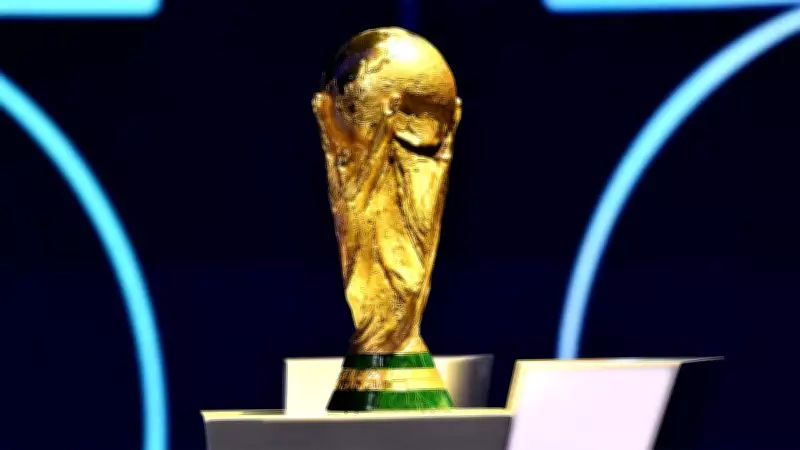
Iran Announces Boycott of 2026 FIFA World Cup Following US Killing of Supreme Leader
In a dramatic development, Iran's sports minister Ahmad Donyamali has declared that the country will not participate in the 2026 FIFA World Cup. This decision comes in response to the United States' assassination of Iran's Supreme Leader Ali Khamenei, as reported by Al Jazeera citing Reuters.
Official Statement on World Cup Withdrawal
Ahmad Donyamali made the announcement during an appearance on state television on Wednesday. He stated unequivocally, "Considering that this corrupt regime [the US] has assassinated our leader, under no circumstances can we participate in the World Cup."
The minister elaborated on the reasoning behind this decision, emphasizing the security concerns and political climate. "Our children are not safe and, fundamentally, such conditions for participation do not exist," Donyamali explained. He further noted that the United States has "forced two wars on us over eight or nine months and has killed and martyred thousands of our people."

Background of the Conflict
The current round of hostilities between Israel and the United States on one side and Iran on the other began on February 28. This West Asia conflict has significantly disrupted global energy supply chains, adding to the geopolitical tensions.
The 2026 FIFA World Cup presents a particular challenge for Iran, as all of their group-stage matches are scheduled to be played in American cities, including Los Angeles and Seattle. The tournament, co-hosted by the United States, Canada, and Mexico, will feature 104 matches starting at Estadio Azteca in Mexico City on June 11 and concluding at MetLife Stadium in East Rutherford, New Jersey, on July 19.
FIFA's Response and Iranian Football Federation's Concerns
This announcement follows remarks from FIFA President Gianni Infantino, who posted on Instagram that Iran's participation would be welcomed by US President Donald Trump. "President Trump reiterated that the Iranian team is, of course, welcome to compete in the tournament in the United States," Infantino stated.
However, Iranian football officials have expressed serious reservations. Mehdi Taj, president of the Football Federation of the Islamic Republic of Iran (FFIRI), questioned how the country could approach the competition optimistically after recent attacks. "After this attack [on Iran], we cannot be expected to look forward to the World Cup with hope," Taj said on Iranian state television. "If the World Cup is like this, who in their right mind would send their national team to a place like this?"
Broader Implications
The boycott decision highlights how geopolitical conflicts are increasingly impacting international sports events. Iran's withdrawal from one of the world's most prestigious sporting competitions underscores the deepening rift between Tehran and Washington.
This development comes as the Middle East war enters its twelfth day, with the United States and Israel unleashing what observers describe as their heaviest strikes on Iran. Tehran has ruled out any ceasefire, indicating that tensions are likely to persist.
The Iranian sports minister's statement represents a significant escalation in using sports as a political tool, potentially setting a precedent for how nations might respond to geopolitical conflicts through international sporting participation.

