

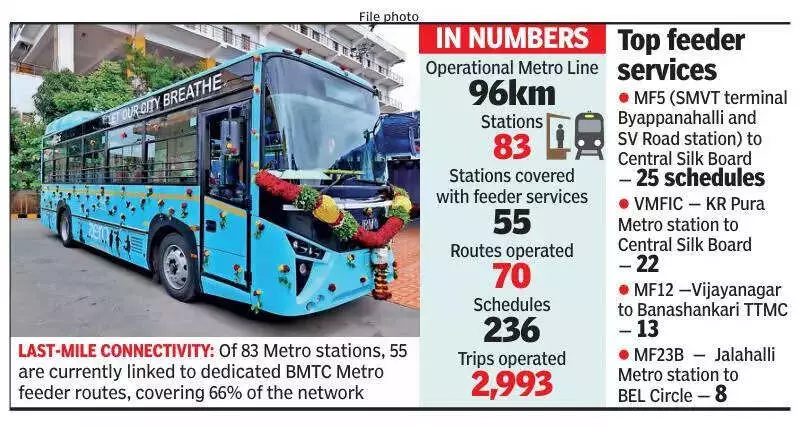
Bengaluru's push for seamless public transport is seeing significant traction, with dedicated metro feeder bus services operated by the Bangalore Metropolitan Transport Corporation (BMTC) witnessing a remarkable surge in ridership. As the Namma Metro network expands, the demand for reliable first and last-mile connectivity has driven daily commuter numbers on these special services to 1.5 lakh, marking an increase of nearly 50,000 riders from the previous year.
Expanding Network Meets Operational Hurdles
To cater to this growing demand, BMTC has expanded its dedicated feeder fleet to 236 buses from 180. These buses now link 55 of the city's 83 metro stations, covering approximately 66% of the operational network. The services are primarily aligned with stations on the Purple and Green Lines. Among the most utilized routes is the MF-5 connecting Sir M Visvesvaraya Terminal (SMVT) and SV Road Metro station to Silk Board, operating 25 schedules daily.
However, the corporation faces persistent challenges. A senior BMTC official explained that 28 metro stations remain unconnected by dedicated feeders. Reasons include a lack of parking bays for buses, unsuitable approach roads, and the fact that many stations in the Central Business District (CBD) are already well-served by regular BMTC routes. The official noted that services would be introduced if station-specific demand emerges. Furthermore, long-standing plans to deploy mini-buses for such connectivity are yet to be realized.

Funding Shortfall and Technology Delays
A critical issue plaguing the feeder service expansion is the lack of financial support. BMTC has long sought viability gap funding from the Bangalore Metro Rail Corporation Limited (BMRCL) to offset operational losses, as most feeder routes run at a deficit. Although BMRCL had indicated that the matter would be addressed at the state government level, especially during the metro fare hike discussions in February 2025, no concrete financial support has materialized thus far.
Adding to commuter inconvenience is the delayed technological integration. Over two and a half years after the launch of the National Common Mobility Card (NCMC) on Namma Metro, BMTC buses still do not accept NCMC payments. This absence of a unified payment platform undermines incentives for multimodal public transport use. An official stated that NCMC functionality will only be possible after BMTC upgrades to new electronic ticketing machines (ETMs), a process that remains pending.
By The Numbers: Bengaluru's Metro Feeder Network
Operational Metro Network: 96 km with 83 stations.
Stations with Feeder Service: 55.
Dedicated Feeder Routes Operated: 70.
Daily Trips Operated: 2,993.
Top Performing Routes:
- MF5 (SMVT/Byappanahalli/SV Road to Silk Board): 25 schedules
- VMFIC (KR Pura Metro to Silk Board): 22 schedules
- MF12 (Vijayanagar to Banashankari TTMC): 13 schedules
- Jalahalli Metro to BEL Circle: 8 schedules
While the rising ridership underscores the essential role of integrated transit in Bengaluru, the path forward requires addressing the twin challenges of sustainable funding and timely technological modernization to build a truly seamless urban mobility ecosystem.






