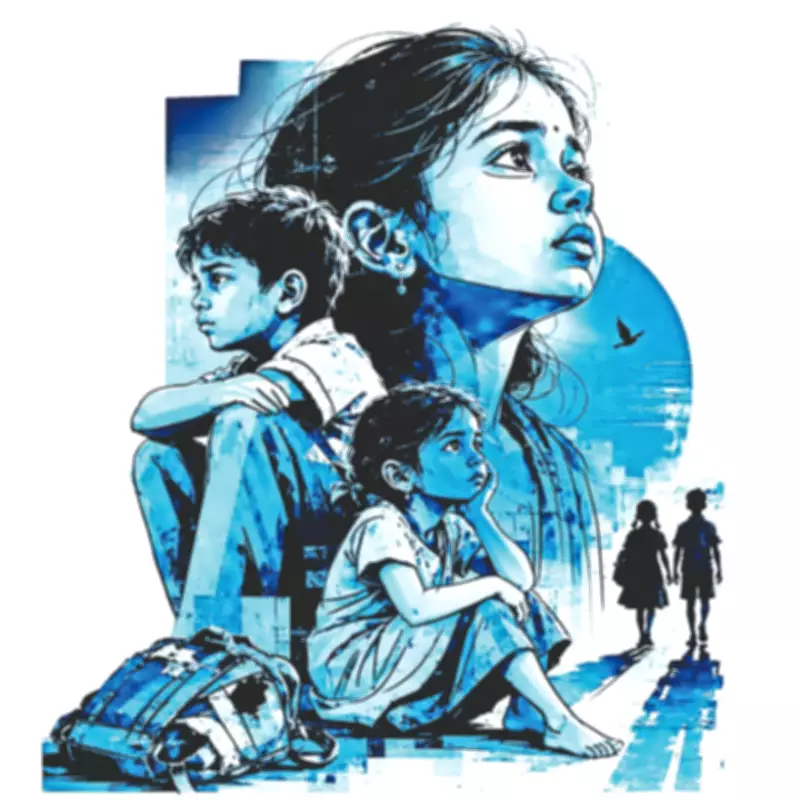
In a village near Andipatti, Meenakshi, who irons clothes for a living, pauses between customers to take medicines for a chronic respiratory infection. She watches her five-year-old granddaughter play outside. The child's father is serving life imprisonment, her mother died five years ago, and her elder sister died in an accident three months ago along with Meenakshi's younger son.
"Inside, my son is serving his sentence. Outside, we are also serving it," says the 47-year-old. "He wants this child to study somehow. But I do not know how long I can manage."
Unseen Punishment
Across Tamil Nadu, families of prisoners suffer a punishment no court has ordered. When a parent is convicted, children often lose not just a parent but also school fees, food security, social standing, and access to credit. These stories remain untold as crime and conviction make headlines, but the families left behind move into a different life, often carrying both stigma and debt.

In Devakottai, Selvi has raised two children since her husband was sentenced to life imprisonment in 2013 for a double murder committed during an argument. Her daughter scored 80% in Class XII after studying in a Madurai hostel with help from Global Network for Equality (GNE), an organization supporting 200 such children in Tamil Nadu. Now she wants to study nursing, but the first year alone may cost about 1 lakh rupees.
"My daughter studied well. She wants to become a nurse. But when admission time comes, we have no money," says the 43-year-old. "Banks ask for property. We have nothing to pledge." She borrowed 60,000 rupees through a women's self-help group and cannot get another loan until she repays it. Her husband's side offers little support because the murders happened within the family.
Struggling for Daily Wages
Selvi works wherever she finds wages: farm labor, MGNREGA work, and now a beer-bottle washing unit near Devakottai for about 300 rupees a day. Earlier, her husband worked in an envelope-making unit in Madurai prison and sent small amounts home, but prison industry work has slowed after an alleged scam.
"Every time I speak to him, he says, 'Bring me out. I will work and look after the children,'" she says.
Psychological Toll
Psychologist Meera Krishnan says such families live in prolonged stress. "Children of prisoners tend to internalize shame for an act they did not commit. When education stops, the risk of child labor, early marriage, and exploitation rises," she explains.
K Shankar, Director General of Police, Prisons, says in Tamil Nadu, released prisoners are provided grants ranging from 50,000 to 1 lakh rupees from the prisoners' welfare fund to help them restart their lives. "About 750 former inmates were assisted last year to start small businesses, and we plan to continue the scheme. As for interest-free loans or advances to inmates' families, possibilities are being explored," he states.
Model from Telangana
Activists say Telangana's prison welfare loan scheme is a model Tamil Nadu could study. Advocate K R Raja from GNE says the issue should be seen as a social and rehabilitation concern, not merely humanitarian support. "We try to ensure these children do not drop out. But scholarship support alone is not enough when families face college fees, medical treatment, or wedding expenses. A structured interest-free loan system can prevent one conviction from destroying an entire generation," he argues.
Telangana's prison department offers interest-free advances of up to 1 lakh rupees for education, medical emergencies, and weddings, with the amount later recovered gradually from prisoners' wages. Tamil Nadu has the infrastructure to attempt this: in 2024, its prison industries generated 70.4 crore rupees through production and sale of goods, ranking second in India after Kerala. The average production value per inmate was 34,496 rupees.
Prison Industries in Tamil Nadu
Prisons in the state produce uniforms, shoes, belts, raincoats, mosquito nets, soap, textiles, file pads, iron cots, barricades, and lockers for government departments. They also run units in weaving, tailoring, carpentry, baking, bookbinding, boot making, handmade paper, fly ash bricks, agriculture, and compost production. Nine petrol bunks are operated with Indian Oil Corporation Limited.

Prisoners are paid 300 rupees a day for skilled work and 270 rupees for semi-skilled work. Activists say a small portion of prison industry earnings can be earmarked for recoverable, interest-free family loans.
Hope for Dignity
Former prison officer R Sivaraman says such a model would strengthen rehabilitation. "A prisoner who helps educate his child through his own labor remains connected to responsibility. It also reduces the desperation that can push inmates towards risky influences inside prisons, while giving them hope that they can return to society with dignity. Prison reform cannot end at the prison gate. It must also reduce the collapse waiting outside," he emphasizes.
The families of the incarcerated say they want a system that recognizes that children should not inherit the sentence of their parents. A loan, repaid from prison wages, may not erase the crime, but it can help a child stay in school, get a roof repaired, make a surgery possible, and keep a family away from moneylenders. "That's all we are asking," says Meenakshi.