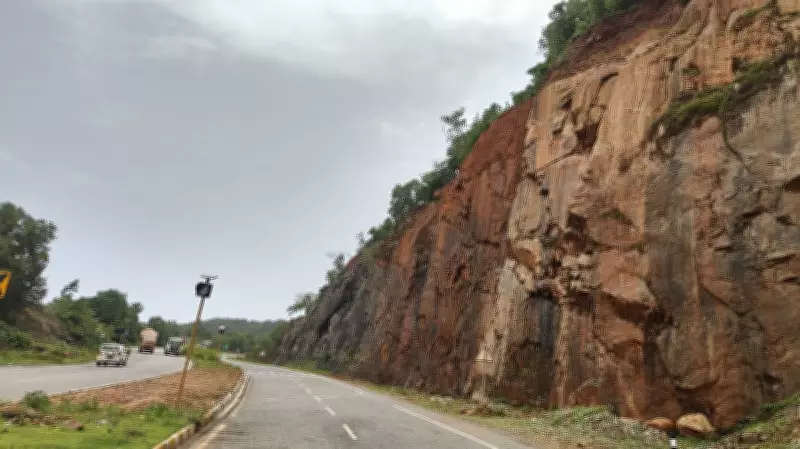
Experts from the Geological Survey of India (GSI) had warned three years ago that road excavations along National Highways in Uttara Kannada district had increased the risk of landslides. Despite this, safety measures remain lagging, heightening fears among locals and commuters.
GSI Warning Ignored for Three Years
The GSI report, submitted to the state government in 2023, identified several stretches along NH-66 and NH-69 where cutting of slopes for road widening had destabilised the terrain. The report specifically mentioned areas near Yellapur, Sirsi, and Kumta as high-risk zones. According to the experts, the excavations removed natural support for hillsides, making them prone to collapse during heavy rains.
“The GSI had clearly stated that these excavations would lead to slope instability,” said a senior official from the Karnataka State Natural Disaster Monitoring Centre (KSNDMC) on condition of anonymity. “But no concrete action has been taken to reinforce the slopes or install early warning systems.”

Current Situation and Recent Incidents
In the past month alone, three minor landslides have been reported on NH-66 near Kumta, blocking traffic for several hours. No casualties occurred, but locals fear a major disaster during the ongoing monsoon season. The district has received 40% excess rainfall this year compared to the average, according to the India Meteorological Department.
“Every time it rains heavily, we are scared to drive on these roads,” said Ramesh Naik, a resident of Yellapur who frequently travels on NH-66. “The authorities should have acted on the GSI warning long ago.”
Government Response and Measures Taken
The National Highways Authority of India (NHAI) stated that it has undertaken some mitigation measures, including the installation of wire mesh and drainage systems at critical points. However, local officials admit that these are insufficient. “We have requested additional funds from the central government for retaining walls and slope stabilisation,” said the Deputy Commissioner of Uttara Kannada, speaking to reporters on Tuesday. “But the process is slow.”
NHAI officials said that a detailed project report for comprehensive landslide mitigation along NH-66 is being prepared, but it will take at least another year to implement. Meanwhile, the monsoon continues, and the risk remains high.
Impact on Daily Life and Economy
The threat of landslides has disrupted daily life in Uttara Kannada, a district known for its dense forests and hilly terrain. Frequent road blockages affect the transport of agricultural produce, including areca nut and spices, which are major cash crops. Commuters face delays of up to two hours during heavy rain.
“If a major landslide occurs, it could cut off entire talukas from the rest of the district,” warned a local journalist who tracks infrastructure issues. “The authorities need to act now, not wait for a tragedy.”
The GSI had also recommended regular monitoring of slopes using sensors and drones, but no such system has been deployed. The KSNDMC has offered to assist with real-time monitoring, but the proposal has not been approved.
Call for Urgent Action
Environmental activists have criticised the delay, pointing out that similar warnings in the Western Ghats have been ignored in the past, leading to devastating landslides in 2019 and 2021 in neighbouring districts. “Uttara Kannada is sitting on a time bomb,” said a member of the local environmental group Sahyadri Sanchaya. “The government must prioritise safety over development.”
The district administration has now formed a task force to review the GSI report and expedite safety works. However, with the monsoon at its peak, residents remain anxious. As one local put it, “We hope it doesn’t take a disaster for them to act.”