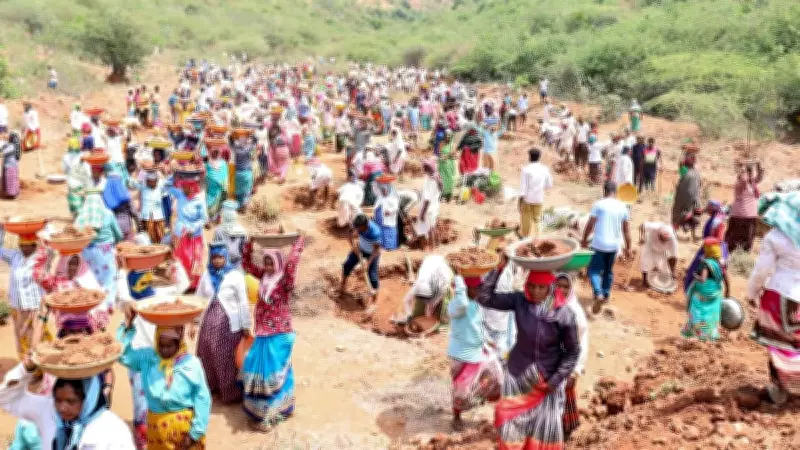
A proposed new rural employment law could fundamentally alter the financial structure of India's flagship job guarantee scheme, MGNREGA, by shifting the bulk of funding from the central government to the states. Under the current MGNREGA framework, the Union government covers the entire wage cost for workers, while states contribute 25% of material costs. This arrangement means that nearly 90% of total MGNREGA expenditure is met by the Centre.
Key Financial Shift in Proposed Legislation
The new law, if enacted, would require states to bear a larger share of the wage component as well, potentially reducing the Centre's contribution to around 50%. This marks a dramatic departure from the existing safety net, which has been credited with providing a critical income floor for rural households during lean agricultural seasons and economic shocks.
According to economist Dipa Sinha, the change could undermine the scheme's effectiveness as a universal safety net. "The central government's near-total funding of wages has been the backbone of MGNREGA's success," Sinha said. "Shifting this burden to states may lead to uneven implementation, with wealthier states able to maintain the program while poorer ones struggle."

Impact on Rural Households and State Budgets
MGNREGA guarantees 100 days of wage employment per year to every rural household whose adult members volunteer for unskilled manual work. In the financial year 2024-25, the scheme provided employment to over 15 crore households, with a total expenditure of approximately ₹1.1 lakh crore, of which the Centre contributed about ₹99,000 crore.
If the new law reduces central funding to 50%, states would need to find an additional ₹55,000 crore annually. This could strain state finances, particularly in poorer states like Bihar, Uttar Pradesh, and Odisha, where MGNREGA demand is highest. In 2024-25, Bihar alone accounted for over 2 crore households, with a wage bill of nearly ₹15,000 crore.
Potential for Unequal Access
Critics argue that the proposed law could create a two-tier system, where richer states expand the program while poorer states cut back. This would contradict the original objective of MGNREGA as a national safety net. The scheme's legal guarantee of employment could become meaningless if states lack the funds to provide work.
Data from the Ministry of Rural Development shows that in 2024-25, the average days of employment provided per household was 48, well below the guaranteed 100 days. With reduced central funding, this figure could fall further, especially in states with limited fiscal capacity.
Political and Legal Challenges Ahead
The proposed law has sparked debate in Parliament and among civil society groups. Opposition parties argue that it violates the spirit of MGNREGA, which was designed as a central responsibility to ensure uniform implementation across the country. Some have called for a constitutional challenge if the law is passed.
The government, however, maintains that the change is necessary to give states more flexibility and to reduce the Centre's fiscal burden. "States are closer to the ground and can better tailor the scheme to local needs," a senior government official said on condition of anonymity. The official added that the Centre would continue to provide support to weaker states through a special fund.
Looking Ahead
As the debate continues, the fate of MGNREGA's safety net hangs in the balance. The scheme has been a lifeline for millions of rural poor, especially women and marginalized communities. Any dilution of central funding could have far-reaching consequences for rural livelihoods and poverty alleviation in India.