The Punjab government's recent passage of the Jaagat Jot Sri Guru Granth Sahib Satkar (Amendment) Act, 2026, has sparked a significant constitutional debate over the intersection of faith and state authority. The legislation, enacted during a special session of the Vidhan Sabha on April 13, was intended to address long-standing grievances within the Sikh community regarding sacrilege incidents. However, it has drawn sharp criticism from the Akal Takht, the highest temporal authority in Sikhism, and the Shiromani Gurdwara Parbandhak Committee (SGPC).
Background and Intent of the Act
The Act was framed by Chief Minister Bhagwant Mann as a historic correction to a decade of unresolved sacrilege cases that have caused profound anguish among Sikhs. Key incidents include the Bargari desecrations, the police firing at Behbal Kalan, the theft of a saroop from Burj Jawahar Singh Wala (all in 2015), and the Golden Temple incident in 2021, whose perpetrators were never publicly identified. These events are not politically fabricated but represent open wounds for the community.
The legislation prescribes severe penalties, including imprisonment of not less than seven years, extendable to 20 years, and fines up to Rs 10 lakh. In cases involving conspiracy to disturb communal harmony, life imprisonment can be awarded. The Act expands the definition of sacrilege to cover spoken, written, symbolic, and electronic expression that intentionally hurts Sikh religious feelings. All offences are classified as cognisable, non-bailable, and non-compoundable.

Akal Takht's Objections
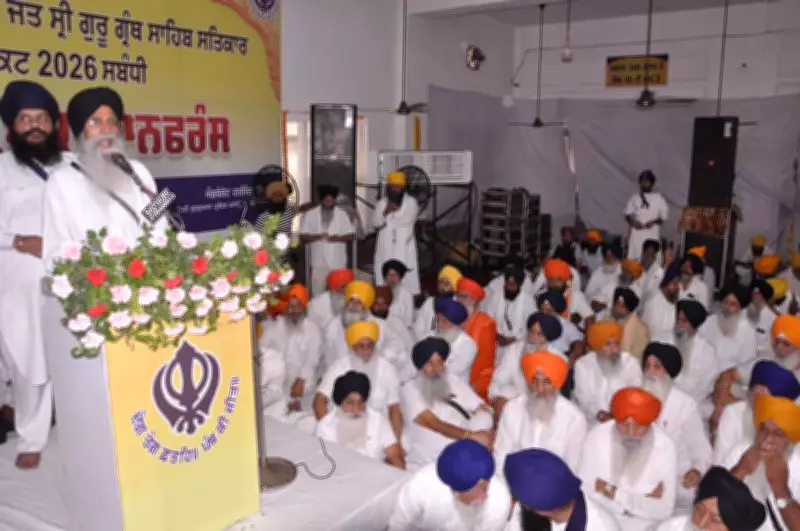
Despite the government's intention to protect Sikh religious sentiments, the Akal Takht's response was not one of celebration but objection. Within weeks of the law receiving the Punjab Governor's assent on April 17, the Akal Takht's officiating Jathedar, Giani Kuldip Singh Gargaj, and SGPC president Harjinder Singh Dhami met Governor Gulab Chand Kataria to submit a list of objections and demand a review. Chief Minister Mann ruled out any review and instead launched a statewide Shukrana Yatra to celebrate the Act's passage, an irony that appears lost on him.
Conflation of Institutions
To understand the objections, it is essential to distinguish between two institutions that the Act has fatally conflated. The Akal Takht was historically conceived as the sovereign, spiritual, and temporal authority of the Sikh Panth, independent of political power. The SGPC was created through the colonial-era Sikh Gurdwara Act of 1925 as a statutory body for gurdwara management, answerable to elections and party politics. Over time, these institutions became entangled through the dominance of the Shiromani Akali Dal, which has historically controlled both. The 2026 Act gives this conflation the force of criminal law.
Quasi-Regulatory Role of SGPC
The Act assigns the SGPC a sweeping quasi-regulatory role over the physical existence of the Guru Granth Sahib. The SGPC must maintain a central register of all saroops in Punjab, assign each a unique identification number, and record details of printing, storage, distribution, location, and custodianship. Statutory duties are imposed on custodians, including granthis, gurdwara management committees, and ordinary devotees, to ensure safe custody, observe the Sikh Rehat Maryada, prevent misuse or damage, and report any suspected sacrilege to police and management bodies.
The Rehat Maryada, Sikhism's code of religious conduct, has thus been incorporated by legislative reference into a criminal statute. Failure to observe it or report a suspected breach is no longer a matter of religious discipline but becomes a police matter.
Constitutional and Religious Concerns
Religious norms must emerge organically within the spiritual community, not through coercive state legislation backed by imprisonment. An elected political-religious institution cannot become the legal custodian of faith. The Act obliterates the distinction between moral authority, institutional guidance, and criminal coercion. The first two belong to the religious community; the third belongs to the state. Once fused, the state does not merely administer religion but replaces it.

Voices associated with the Akal Takht have warned that the terminology of custodian may expose granthis, devotees, and gurdwara committees to criminal prosecution for accidental lapses or legitimate internal theological disagreements. The law thus invites systematic police intrusion into the daily conduct of religious life. Moreover, the Panth was not adequately consulted before the statute was passed in a hurried two-day special session. The initial welcome from the SGPC and Akal Takht, followed by rapid reversal, indicates how poorly thought through the Act was.
Legal Challenges
Legal challenges have already begun. A petition before the Punjab and Haryana High Court seeks to quash the Act on constitutional grounds, arguing that a penal framework singling out one religion's scripture for special protection while leaving others unaddressed fails the basic test of equality before law under Article 14. The secular state that legislates reverence for one faith's holy book, however sincerely motivated, must answer this challenge.
India's constitutional framework anticipated this danger. The secular republic was designed as a state that maintains principled distance from all faiths, preventing both the capture of religion by political authority and vice versa. The 2026 Act violates that distance in both directions, allowing the state to enter theological territory it has no competence to adjudicate while handing a politically entangled religious institution coercive power it has no democratic mandate to wield.
The Akal Takht understood this. It is an irony that the legislature did not. The Guru Granth Sahib has survived not by sheltering behind state power but because its authority rests on freely given devotion. To convert that scripture into a protected zone patrolled by police and enforced by courts is not to honour the tradition but to betray it.