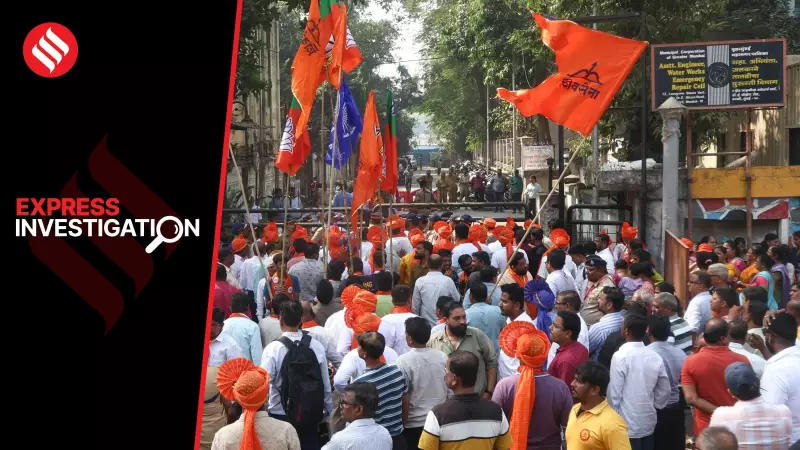
As Mumbai prepares for crucial Brihanmumbai Municipal Corporation (BMC) elections on January 15, a stark reality has emerged regarding the allocation of civic development funds. An investigation based on Right to Information (RTI) records reveals a massive imbalance, with over 99% of funds sanctioned in the past three years directed towards wards represented by legislators of the ruling Mahayuti alliance.
The Staggering Disparity in Numbers
Records obtained by The Indian Express show that between February 2023 and October 2025, the BMC sanctioned a total of Rs 1,490.66 crore for local development works. These funds were meant for essential upgrades like road repairs, drainage systems, health facilities, and neighbourhood beautification projects across India's financial capital.
However, the distribution tells a different story. A staggering Rs 1,476.92 crore of this amount was allocated to areas under MLAs, MLCs, and MPs from the ruling coalition, which includes the Bharatiya Janata Party (BJP), the Ajit Pawar-led Nationalist Congress Party (NCP), and the Eknath Shinde-led Shiv Sena. The BJP lawmakers received the lion's share at Rs 1,076.7 crore, followed by Shinde Sena legislators who got Rs 372.7 crore.

In sharp contrast, the Opposition received a mere Rs 13.74 crore, which constitutes less than 1% of the total funds. This minuscule allocation went to only one legislator, Congress's Amin Patel, who represents the Mumbadevi constituency in South Mumbai. Ten MLAs from the Shiv Sena (UBT), two other Congress legislators, and one from the Samajwadi Party received no funds at all during this period.
A Pattern of Exclusion and Political Messaging
This imbalance is not a one-off occurrence. It continues a pattern first exposed in January 2024, when initial RTI data showed the entire Rs 500 crore disbursed under a temporary policy went exclusively to ruling-party MLAs. The policy itself was introduced in February 2023 after the BMC's elected body of corporators was dissolved and the civic body placed under a state-appointed administrator.
In the absence of corporators, MLAs and MPs were authorised to propose development works for Mumbai's 227 wards. However, the power to approve these funds was concentrated in the hands of the city's Guardian Ministers. From 2023-24, these were Shiv Sena’s Deepak Kesarkar (City) and BJP’s Mangal Prabhat Lodha (Suburban). From January 2025, the authority shifted to Deputy Chief Minister Eknath Shinde (City) and BJP’s Ashish Shelar (Suburban).
The timing of the allocations raises further questions about their intent. In the months leading up to the 2024 Lok Sabha and Assembly elections, records show over Rs 467 crore was released to ruling-party incumbents. A significant surge occurred just weeks before the model code of conduct was imposed in October 2024. Between August and September that year, 23 ruling alliance MLAs received a total of Rs 357.3 crore.
Top Recipients and the Opposition's Plight
Among individual beneficiaries, BJP's Ram Kadam, MLA from Ghatkopar West, emerged as the top recipient with Rs 70 crore in civic funds across three financial years. He was followed by party colleagues Yogesh Sagar (Charkop) with Rs 67.47 crore and Atul Bhatkhalkar (Kandivali East) with Rs 66.06 crore.
Opposition legislators have voiced their frustration, stating that behind every pending proposal are thousands of citizens waiting for basic services. Congress's Amin Patel, the sole opposition beneficiary, called his allocation "too little to fix even urgent work" and more of a formality. He urged the government to stop discriminating between constituencies based on party lines.
Other opposition figures, like Shiv Sena (UBT) MLC Sachin Ahir and NCP (SP) MLC Sunil Shinde, confirmed they had sought funding for civic development but their requests were ignored. Ruling-party leaders have attributed the imbalance to "incomplete proposals" from the opposition, a claim vehemently denied by opposition MLAs who say their proposals were repeatedly submitted and stalled at the approval stage.

Governance Questions Ahead of Crucial Polls
These findings cast a long shadow over governance in India's richest municipal corporation, which boasts an annual budget exceeding Rs 74,000 crore. With the BMC elections just days away, the issue of equitable development has taken centre stage.
Urban policy experts point out that infrastructure is a critical component of pre-poll political messaging. Upgraded public spaces like repaired roads, new parks, and better street lighting serve as tangible demonstrations of governance, directly reinforcing the visibility and electoral advantage of ruling-party legislators.
When contacted by The Indian Express, Guardian Minister Ashish Shelar defended the allocations, stating, "All fund allocations have been carried out strictly in accordance with BMC norms, and there is no question of any bias." Deputy Chief Minister Eknath Shinde did not respond to requests for comment.
As Mumbai voters head to the polls, the investigation underscores a critical debate: should development funds, especially in a democracy, be used as a tool for political patronage, or should they be allocated based on the genuine needs of all constituencies, irrespective of their political representation?