

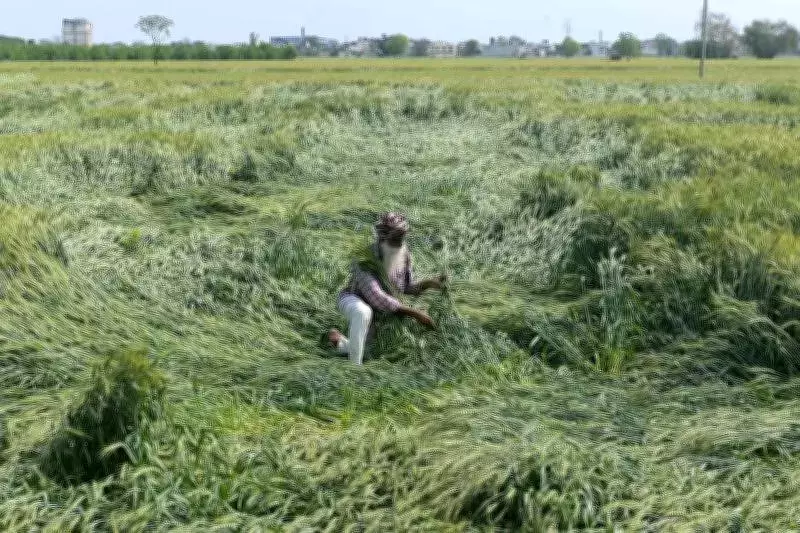
Unseasonal Storm Devastates Wheat Crops in Ajnala Region
Farmers in Ajnala and several nearby villages faced a severe setback on Thursday morning as strong winds, unseasonal rain, and a hailstorm flattened fully ripened wheat crops across multiple locations. The sudden weather event has intensified worries among the agricultural community, with fears mounting over substantial financial losses due to the extensive damage inflicted on the standing crop.
Farmers Describe Months of Hard Work Ruined
Baljinder Singh, a local farmer, reported that the wheat crop had already matured and harvesting was anticipated to commence within a few days. "The sudden storm and hailstorm in the early hours today ruined our months of hard work, as the standing crop is now lying flat in the fields at several places," he lamented. Singh added that this situation will not only make harvesting more challenging but is also likely to directly impact the overall yield, exacerbating the distress for farmers.
Estimated Production Losses and Financial Struggles
Farmers in the region have estimated that the damage could lead to a reduction in production by approximately 2-3 quintals per acre. Balkar Singh, another farmer, highlighted the ongoing financial difficulties faced by the agricultural community, citing past floods and other natural calamities. "The cost of farming has been continuously rising, and the unseasonal rain has worsened our situation," he stated. He further expressed concern that if such adverse weather conditions persist, the quality of the wheat may also be compromised, adding another layer of hardship.

Mixed Reports on Damage Extent and Calls for Government Action
While farmer leader Satnam Singh Ajnala noted that the strong winds and hail had flattened the crops but did not cause extensive damage, with earlier-sown crops suffering some impact while others remained relatively unaffected, affected farmers are calling for immediate government intervention. Partap Singh, one of the impacted farmers, urged the government to dispatch teams to villages for conducting girdawari (crop damage assessment) to evaluate the losses accurately. "Eventually, farmers like me suffered losses, and it is the duty of the government to compensate us at the earliest, so that we could recover from the financial setback caused by natural disasters one after another," he emphasized.
Broader Implications for Agricultural Sustainability
The incident underscores the vulnerability of farmers to unpredictable weather patterns and the urgent need for robust support mechanisms. As the community grapples with the aftermath of the storm, the focus shifts to recovery efforts and potential compensation to mitigate the financial blow. The event serves as a stark reminder of the challenges in agricultural sustainability amid increasing climate variability.






