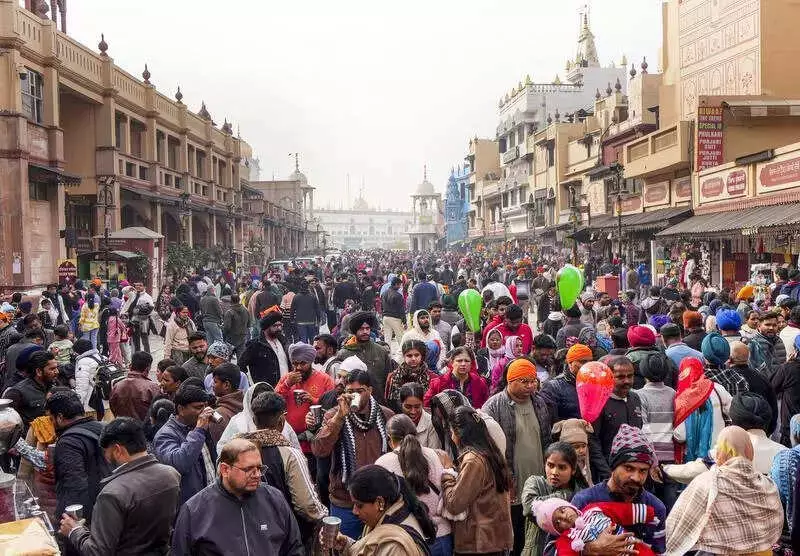
The Punjab government's recent prohibition on the sale and consumption of liquor, meat, tobacco, and other intoxicants within the historic walled city of Amritsar has ignited a fierce debate. The move, aimed at preserving the sanctity of the area surrounding the Golden Temple, is being challenged by residents and traders who see it as an infringement on personal liberties and a threat to thousands of livelihoods.
Residents Grapple with Anxiety and Uncertainty
For families living in neighborhoods like Guru Bazar and Shakti Nagar, the ban has created a cloud of confusion and fear. The restriction extends beyond public sale to seemingly impact private consumption within homes, leaving many questioning the limits of the new rules.
"We initially thought only the meat shops would have to shut down. We planned to buy from outside and cook at home," said Mohinder Kaur, a resident of Guru Bazar who cooks chicken regularly. "But now there is deep uncertainty. If we bring meat into our own homes, could it be considered a crime? Can the government punish us for what we eat with our families?" Her concerns highlight the personal dimension of the policy.

Long-time resident Ashok Kumar echoed similar worries, questioning the logic behind regulating habits practiced in private spaces. "I have smoked at home for years. Will that now make me an offender? What about something as basic as eggs? An omelette is our daily breakfast staple. What are we supposed to do now?" he asked, pointing to the practical difficulties the ban imposes on daily life.
Traders Mobilize, Call Decision "Politically Motivated"
As residents seek clarity, the business community has begun organizing formal opposition. Meat and tobacco sellers within the walled city have formed associations like the Amritsar Non-Veg Shop Association and the Tobacco Shop Association to collectively fight the decision and prepare for potential legal action.
Manmohan Singh, who runs a chicken shop inside B K Dutt Gate, revealed that a memorandum outlining their demands was submitted to the deputy commissioner's office on a Tuesday, with a meeting scheduled for the following Wednesday. He criticized the policy as a hasty and ill-conceived move.
"This is not a well-thought-out policy but appears to be politically motivated," Singh stated. "Similar restrictions already exist in the galliara (aisle) around the Golden Temple. The government should have limited it to that specific area." He warned that extending the ban across the entire walled city would devastate the livelihoods of thousands of traders and their employees. Singh also confirmed that they have sought a direct meeting with Chief Minister Bhagwant Mann to discuss the issue.
Political and Moral Hypocrisy Questioned
The ban has also drawn sharp criticism from political figures. Former minister and president of the Durgiana Temple Trust, Laxmi Kanta Chawla, challenged the government's definition of a "holy city" and the moral basis of the ban.
"Will the government now expel people who consume meat, liquor, or tobacco from the walled city?" she asked. Chawla pointed out the apparent contradiction in the policy's geographical scope. "Is only the walled city sacred? Has the entire area outside it suddenly become impure?"
She highlighted that outside the walled city's boundaries, hotels, restaurants, liquor shops, and slaughterhouses continue to operate openly. "If the true objective is to respect religious sentiments, then the ban should be implemented across the entire city of Amritsar. Enforcing it in a limited area is nothing but a discriminatory and hypocritical policy," the former minister added.
The situation remains tense as stakeholders await further government clarification. The core conflict pits the aim of maintaining religious sanctity against the rights to personal choice, cultural practices, and economic survival, setting the stage for a prolonged civic and legal battle in the historic city.