

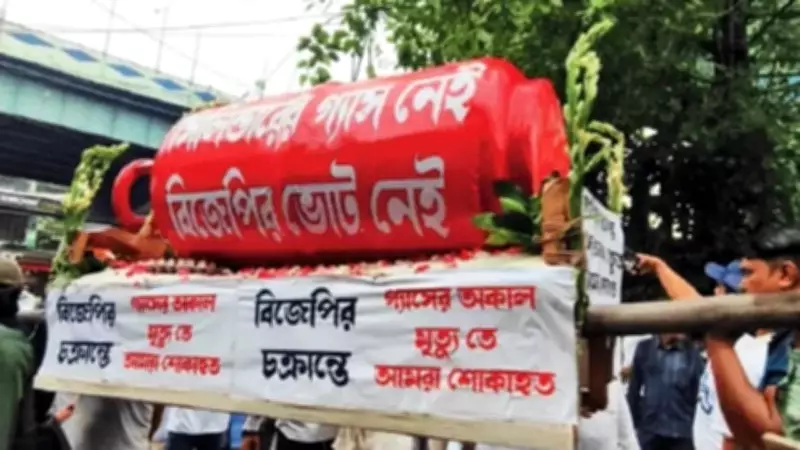
Visual Props Take Center Stage in West Bengal's Political Theater
In the vibrant and fiercely contested theater of West Bengal's assembly elections, a fascinating array of symbolic props has emerged as central characters on the campaign stage. From replica LPG cylinders and cricket bats to humble bicycles and sacks of potatoes, these carefully chosen objects are being deployed by candidates across parties to cut through the noise of traditional political rhetoric, trigger emotional responses, and sharpen their attacks against opponents.
Household Burdens and Sporting Identities
Across constituencies, the symbolism is both direct and deeply personal. In south Kolkata's Kasba constituency, Trinamool Congress candidate Javed Khan has been leading rallies flanked by replicas of gas cylinders and LPG fuel dispensers. This visual protest against rising cooking gas prices speaks directly to household economic concerns, transforming abstract inflation statistics into tangible, relatable burdens.
A local Trinamool worker explained the strategy succinctly: "People may not always follow lengthy election speeches or digest complex party manifestos, but everyone immediately understands what a gas cylinder represents in their daily lives. It's something every family relates to right now."

Meanwhile, in north Bengal's Tufanganj, former cricketer-turned-Trinamool candidate Shib Shankar Paul has been campaigning with cricket bat and ball in hand. This prop serves multiple purposes: establishing his sporting identity, appealing to youth sentiment, and leveraging cricket's emotional resonance in Bengal.
"Cricket is pure emotion in Bengal," explained a campaign supporter. "Since he's relatively new to politics, when people see him walking with a bat, they recognize him instantly. It creates an immediate connection that makes our outreach much more effective."
Beyond Conventional Campaigning
The cricket bat has proven to be a versatile political tool, appearing in campaigns across the political spectrum. Kunal Ghosh (TMC candidate from Beleghata), Vijay Ojha (BJP candidate from Jorasanko), and even Chief Minister Mamata Banerjee herself have all been photographed swinging bats during their campaign events.
Young voters are being courted through other innovative symbolic acts as well. In Keshiary, Trinamool's Ramjiban Mandi made a powerful statement by running the entire 12-kilometer distance to attend a rally addressed by Abhishek Banerjee. While not a physical prop, this act of endurance served as a potent symbol of stamina, dedication, and commitment.
"It sends a clear message that he's one of us, willing to go the distance literally and figuratively," explained a party worker managing his campaign.
Accessibility and Agricultural Solidarity
In neighboring Narayangarh, candidate Pratibha Rani Maity has returned to grassroots campaigning by using a bicycle to access remote villages. The humble cycle serves dual purposes: as a practical transportation tool and as a powerful symbol of accessibility, bridging the perceived distance between political leaders on their stages and ordinary voters in their communities.
BJP candidates have also embraced prop-driven campaigning, often linking objects with economic or cultural narratives. In Malda, Gopal Chandra Saha was photographed stepping into muddy fields, harvesting potatoes alongside farmers, and carrying sacks on his shoulders. This carefully crafted imagery projects solidarity with agricultural communities and foregrounds issues of agrarian distress.
"It's about demonstrating that we understand their struggles and share their pain," explained a BJP functionary involved in the campaign.
Cultural References and High-Energy Campaigns
Some of the most sophisticated prop usage was visible during Prime Minister Narendra Modi's rally at Kolkata's Brigade Parade Grounds on March 14, where the dais featured a detailed cutout of the revered Dakshineswar Kali temple as its backdrop.

In a particularly symbolic gesture, BJP's Rakesh Singh carried a photograph of 19th-century educator and social reformer Ishwar Chandra Vidyasagar while submitting his nomination from the Kolkata Port constituency. Singh, who had been arrested in 2019 in connection with vandalizing a Vidyasagar bust during an Amit Shah rally, explained: "I carried the photograph as a mark of respect and to communicate that I had been falsely accused in that case."
Meanwhile, former state BJP chief Dilip Ghosh, contesting from Kharagpur, has opted for high-visibility motorcycle rallies. These loud, mobile, and energetic campaigns are designed to project organizational strength and political momentum through sheer visual and auditory impact.
The Psychology Behind Political Props
Political analysts observe that this widespread use of props reflects a broader shift in campaign strategy, where political communication is becoming increasingly visual, immediate, and symbolic.
Political analyst Udayan Bandyopadhyay notes: "Elections are as much about imagery as they are about ideology. Props function as cognitive shortcuts for voters. While they might not remember complex policy speeches, they're likely to remember vivid images like a candidate walking with a potato sack on their shoulder. The advent of social media has dramatically amplified this visual behavior."
Mixed Reactions from Voters
Voters themselves remain divided on the effectiveness of these symbolic tactics. In south Kolkata's Golpark area, 28-year-old marketing executive Riya Sengupta appreciates the creativity: "These props catch your eye. You stop, you watch, you sometimes even take photos. But ultimately, I want to know what concrete plans they have for creating jobs and improving livelihoods."
Others express skepticism about the approach. College student Oishi Banerjee commented: "Sometimes all this feels like political theater or overacting. Carrying props is fine as attention-grabbers, but actual governance requires substance beyond symbolism."
The Digital Dimension
Campaign strategists defend the approach by emphasizing its digital dimension. Many prop-driven moments are specifically designed for social media amplification, where candidates perform not just for physically present crowds but for potentially much larger online audiences.
The digital media campaign manager for a three-time Kolkata MLA provided perhaps the most succinct explanation: "In today's social media age, compelling visuals travel faster and farther than words ever could. A single strong image can define an entire campaign narrative in ways that paragraphs of text simply cannot achieve."
As West Bengal's political drama unfolds, these symbolic props continue to play starring roles, transforming abstract political messages into tangible, memorable, and shareable visual stories that resonate across both physical constituencies and digital platforms.





