

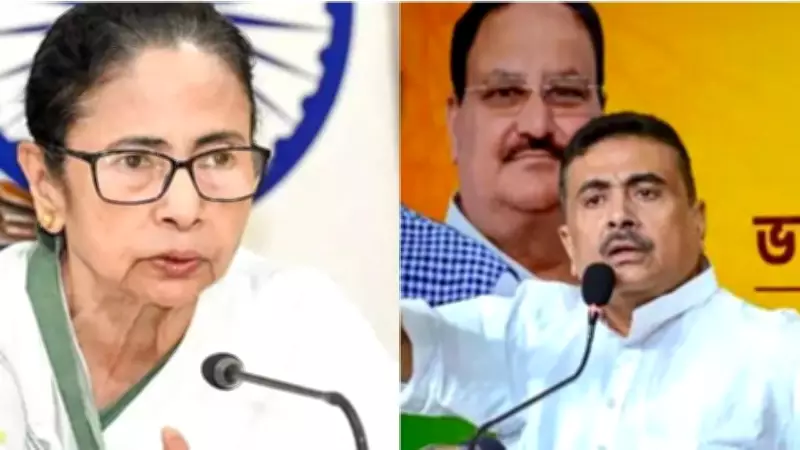
Kolkata: Battleground Bengal's defining contest is playing out in south Kolkata's Bhowanipore, where Chief Minister Mamata Banerjee faces one-time aide Suvendu Adhikari of the Bharatiya Janata Party in what is an electoral rematch of far greater consequence than when she narrowly lost to him in Nandigram in 2021.
For the Trinamool Congress, retaining Bhowanipore is not just about securing Mamata's fortress and preserving the aura of invincibility around her. In many ways, the constituency represents the party's conflict with the BJP over the larger issues of identity, ideology, and governance. A BJP breach of Mamata's citadel would deal a psychological blow to Trinamool even if the saffron party fails to win Bengal.
The constituency's social mix makes it an unusually sensitive poll pocket. It includes the so-called Bengali bhadralok households, Marwari and Gujarati business families, Sikh and Jain residents, settlers from Bihar and Odisha, and a sizeable Muslim electorate.

Diversity as a Political Laboratory
"This diversity has turned the seat into a laboratory of competing political methods," said Trinamool's ward 70 councillor Ashim Bose, whose challenge is to convert last year's Lok Sabha deficit in his ward into a lead for Mamata.
Numbers explain why both sides are oozing confidence in Bhowanipore. Mamata won the 2021 byelection there by a record margin of 59,000 votes. But in the 2024 Lok Sabha election, Trinamool's lead in the assembly segment shrank to a little over 8,000. The BJP led in five of the eight wards, suggesting that while Trinamool retained emotional capital, the saffron party gained territorial depth.
One Seat, Many Challenges
Mamata's goal is to stop Bhowanipore from turning into a fragmented social contest. Her party's strategy rests on familiarity and emotional ownership. Its "ghorer meye" (daughter of the house) pitch seeks to reduce the election from a verdict on governance to a neighbourhood show of loyalty.
"Had there been any other contestant from the seat, it would have been extremely challenging for us," Trinamool worker Subhankar Roychowdhury said. That approach suits a constituency where coexistence has often mattered as much as ideological mobilisation.
In mixed wards where Bengali Hindus, non-Bengali traders, and Muslims live in proximity, Trinamool's emphasis on continuity and emotional belonging is designed to reassure rather than provoke. Mamata's appeal in such areas has long rested on welfare delivery, symbolic accessibility, and the perception that she protects a plural urban social order.
BJP's Counter-Strategy
The BJP's strategy is the opposite. Adhikari's poll managers have tried to break the constituency into its constituent communities and convert each into a manageable electoral bloc. During the campaign, this was noticeable in wards 63, 70, 71, 72, and 74, where the BJP's recent gains suggest growing receptivity among non-Bengali traders and sections of the Hindu middle class.
Muslim voters also remain central to the arithmetic. They account for a quarter of the electorate, and cohesive minority voting in a close urban seat can offset fragmentation among Hindu groups. That is why reported deletions and scrutiny in the electoral rolls matter. BJP worker Jayanta Ghosh said the 11,000-odd Muslim voters struck off the rolls in Ward 77 during the Special Identity Register could loosen Trinamool's grip.
"Bhowanipore encapsulates the X factor in Bengal's electoral calculus, going beyond a battle for prestige. Ours is a constituency where the mixed population in each ward forces both parties to test the limits of emotion, arithmetic, and polarisation," said Rajan Majumdar, an octogenarian Left Front supporter.






