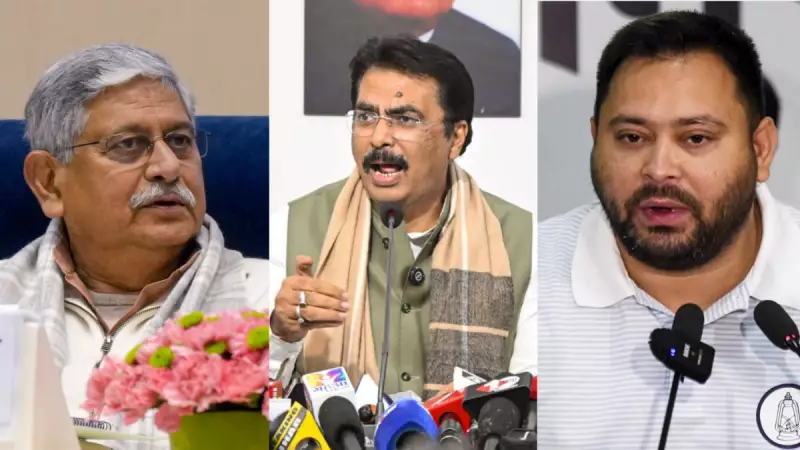
Major Security Overhaul in Bihar: BJP Leaders Upgraded, Tejashwi Yadav Downgraded
In a significant development concerning the security apparatus of Bihar, the state government has executed a substantial reshuffle in the protection details of prominent political figures. This move, which reflects a reassessment of threat perceptions and political dynamics, has seen two Bharatiya Janata Party (BJP) leaders receive enhanced security cover, while a key opposition leader has experienced a downgrade.
Enhanced Protection for BJP Stalwarts
The most notable upgrade has been conferred upon Lalan Singh, a senior BJP leader and former Union Minister. Singh has been granted the prestigious Z-category security cover. This high-level protection entails a comprehensive security detail, including armed commandos for close protection, escort vehicles, and residential security. The decision underscores the perceived threat level to Singh, who remains a influential figure in Bihar's political landscape.
Similarly, Sanjay Saraogi, another prominent BJP leader and a Member of Parliament, has also been awarded the Z-category security. Saraogi, known for his active role in state politics, will now benefit from the same rigorous protective measures. The simultaneous upgrade for these two BJP leaders signals a concerted move to bolster the security of the party's key functionaries in the region.

Downgrade for RJD's Tejashwi Yadav
In a contrasting decision, the security detail for Tejashwi Yadav, the Leader of the Opposition in the Bihar Legislative Assembly and a senior Rashtriya Janata Dal (RJD) leader, has been revised. Yadav, who previously enjoyed Z-category security, has now been downgraded to the Y-plus category.
The Y-plus category, while still a significant security provision, offers a reduced scale of protection compared to the Z-category. It typically includes a smaller team of personal security officers and limited escort cover. This reduction marks a notable shift in the security assessment for one of Bihar's most visible opposition figures.
Context and Implications
Security categorizations for politicians in India are determined by state and central agencies based on continuous threat assessments. These evaluations consider intelligence inputs, the individual's public profile, and the prevailing political climate. The Z-category is among the highest levels of security, often reserved for individuals facing severe threats.
The recent adjustments in Bihar are likely the result of a periodic review conducted by the state's security establishment. Such reviews are standard procedure to ensure that security resources are allocated efficiently and in line with the latest intelligence. The upgrades for Lalan Singh and Sanjay Saraogi suggest that the authorities have identified credible threats to their safety, warranting the highest level of state protection.
Conversely, the downgrade for Tejashwi Yadav may indicate a reassessment that the threat level to him has diminished or is now manageable with a slightly scaled-back security detail. However, security decisions of this nature are often scrutinized through a political lens, especially in a charged environment like Bihar.
This security reshuffle comes at a time when political activities in Bihar are intensifying, with parties gearing up for future electoral battles. The changes will undoubtedly be a topic of discussion in political circles, with interpretations varying across party lines. The state government has not issued an official statement detailing the specific reasons behind each change, maintaining that these are routine decisions based on professional security audits.
The implementation of these new security protocols is expected to be immediate, with the respective security agencies tasked with reconfiguring the protection details for the affected leaders. The move highlights the ongoing importance of security management for public figures in India's vibrant and sometimes volatile political arena.