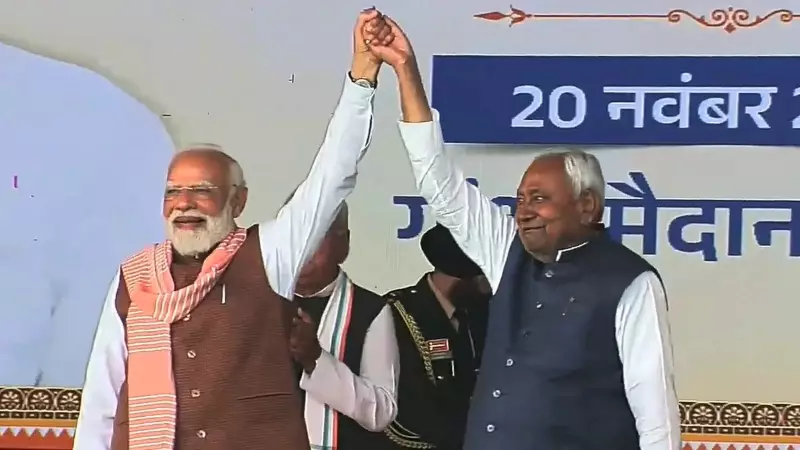
Bihar stands at a crucial development crossroads following the National Democratic Alliance's landslide victory in recent state elections. As Nitish Kumar begins his new term as Chief Minister, the state faces the monumental challenge of transforming ambitious promises into tangible economic progress.
Investment Momentum vs Employment Reality
The state demonstrated significant potential in 2024 when it hosted the Business Connect Summit, attracting investment proposals worth Rs 1.81 lakh crore from major industrial players including the Adani Group and Sun Petrochemicals. This achievement represents the kind of credible development strategy that focuses on incentivizing private investment rather than expanding the already strained public payroll.
However, the employment scenario presents a stark contrast. The Labour Force Participation Rate for Bihar's youth aged 15-29 stands at just 34.6 percent, significantly below India's national average of 46.5 percent according to PLFS 2023-24 data. The NDA manifesto's promise of creating 1 crore government jobs appears fiscally challenging, with estimated annual costs of Rs 1.8-2.4 lakh crore against the state's total budget of Rs 3.17 lakh crore.
Women Empowerment Schemes: Doles or Sustainable Livelihood?
The Mukhyamantri Mahila Rojgar Yojana has been widely credited with consolidating the NDA's women vote bank. The scheme began with direct transfers of Rs 10,000 to 75 lakh women in Jeevika Self-Help Groups, expanding to cover 1.5 crore women with a fiscal outlay touching Rs 15,000 crore. The program continues to accept enrollments until December, with promises of additional assistance up to Rs 2 lakh after six-month assessments.
While politically significant, serious questions remain about whether such transfers can create sustainable livelihoods rather than functioning as temporary doles. The fundamental challenge lies in transforming one-time financial assistance into viable income generation models that empower women economically in the long term.
Comparative Development: Bihar vs Bengal
The political significance of Bihar's development model extends beyond state borders, with Prime Minister Narendra Modi suggesting that the victory wave would flow like the Ganga from Bihar to West Bengal, where assembly elections are scheduled for March 2026.
Statistical comparisons reveal intriguing patterns. Between 2011-12 and 2024-25, Bihar recorded 6.5 percent average annual GDP growth compared to Bengal's 4.8 percent. In agriculture, Bihar grew at 4 percent against Bengal's 2.9 percent. Despite these growth advantages, Bengal achieved more substantial poverty reduction, cutting multidimensional poverty from 58 percent in 2005-06 to 8.6 percent in 2022-23 - an 85 percent reduction. Bihar's poverty declined from 78 percent to 27 percent during the same period, representing a 65 percent drop.
Demographic factors significantly explain this divergence. Bihar's population grows at 1.43 percent annually compared to Bengal's 0.5 percent and India's 0.9 percent. With a fertility rate of 3 against India's 2 and Bengal's 1.6, Bihar's faster GDP growth doesn't translate into better per capita income due to population pressure.
Agricultural Diversification: Key to Sustainable Growth
Agricultural sector analysis reveals critical differences in development approaches. Bihar employs 54 percent of its workforce in agriculture with average landholding size of just 0.39 hectares. Bengal engages only 38 percent of its workforce in agriculture with larger average holdings of 0.76 hectares.
More importantly, Bengal demonstrates superior agricultural intensification and diversification. The state's cropping intensity stands at 193 percent - the second highest in India - while Bihar remains at 148 percent. Nearly 18 percent of Bengal's gross cropped area is under high-value horticulture compared to Bihar's 7 percent. Fisheries contribute 15 percent to Bengal's agricultural output value against Bihar's 8 percent.
Path Forward: Industrial Promotion and Sustainable Strategy
The Industrial Investment Promotion Package 2025 offers promising direction with employment-linked incentives including Rs 5,000 per employee monthly for textiles with substantial ESI/EPF support, and Rs 2,000 for other units. This approach represents the kind of job creation strategy the state should emphasize rather than fiscally challenging schemes.
As Bihar moves forward, the state requires a balanced development approach that leverages private investment while creating sustainable employment opportunities. The foundation exists with improved electricity access, better highway connectivity, and somewhat improved law and order. Building on this foundation with focused industrial promotion, agricultural diversification, and skill development could potentially transform Bihar's economic landscape.
The coming years will determine whether Bihar can translate Prime Minister Modi's call for "Vikas, vikas, aur sirf vikas" into measurable progress that moves the state from its bottom rankings in social and economic indicators toward a more prosperous future for its citizens.