Recent internal discussions within the Uttar Pradesh unit of the Bharatiya Janata Party (BJP) regarding caste representation have sparked a significant debate. A close examination of the party's organisational hierarchy and the state council of ministers reveals a complex picture of caste-based distribution, challenging narratives of systematic marginalisation of certain communities.
Organisational Heft and Cabinet Presence: The Numbers Speak
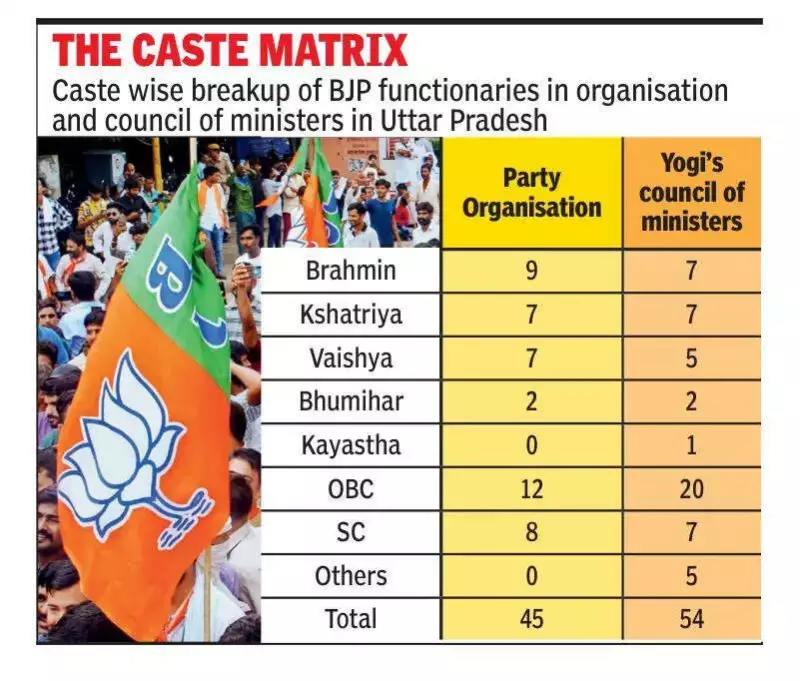
The data from the UP BJP's organisational list is telling. Out of 45 key functionaries, which include the president, general secretaries, secretaries, treasurer, and co-treasurer, nine are from the Brahmin community. This constitutes a substantial 20% of the top organisational leadership. This figure is notably almost three times the estimated Brahmin population in Uttar Pradesh, which stands at around 7%.
This prominence extends to the state government as well. In the 54-member council of ministers led by Chief Minister Yogi Adityanath, seven ministers are Brahmins, making up approximately 13% of the total strength. Analysts point out that these numbers significantly weaken the argument, often heard after electoral setbacks or during internal churn, that Brahmins have been sidelined under CM Yogi's leadership. The community has been a dominant force in the BJP's political optics since the peak of the Ram Temple movement in the early 1990s.

The Delicate Upper-Caste Balance and Rising OBC Core
The recent controversy stemmed from a meeting called by BJP Brahmin MLA P.N. Pathak, attended by dozens of MLAs from the same community. The meeting, explicitly criticised by the newly appointed UP BJP chief Pankaj Chaudhary (a Kurmi leader), highlighted the rising aspirations of Brahmins within the party. This sentiment was further amplified following separate meetings convened by Thakur and OBC functionaries.
The data shows a careful balancing act between the two key upper-caste pillars. Thakurs hold seven out of the 45 organisational posts (15%) and an equal number of ministerial berths (seven) as Brahmins in the cabinet. In raw numbers, Thakurs do not outnumber Brahmins in either sphere. Experts view this near-parity as a deliberate strategy to prevent the alienation of either community, both of which are intrinsic to the party's dynamics in the state.
Other upper castes are also represented. The Vaishya community has seven organisational functionaries and five ministers, while Bhumihars have two representatives in both the organisation and the cabinet.
However, a perceptible shift is visible towards an OBC-led organisational command. The state unit boasts 12 OBC leaders in key positions. This includes State President Pankaj Chaudhary and the influential General Secretary (Organisation) Dharam Pal Singh. This dual presence from the OBC community lends institutional depth to their dominance, beyond mere numerical weight. In the Yogi Adityanath cabinet, OBCs have the largest share with 20 ministers, accounting for a significant 37% representation, aligning with their sizable population in the state.
Dalit Representation and the Broader Political Calculus
The Dalit community finds representation through eight leaders in the UP BJP's organisational setup, translating to nearly 18% of the posts. While this is slightly less than their 21% population share in Uttar Pradesh, analysts note that the visible presence of Dalit leaders helps the BJP project an image of social justice and outreach, particularly to non-Jatav Dalit sub-castes. In the state cabinet, the community is represented by seven ministers, making up about 13% of the total strength.
The overall numbers underscore a decisive move by the BJP towards cementing an OBC-led organisational core in Uttar Pradesh. Simultaneously, the party appears to be meticulously managing upper-caste representation to maintain social balance and political cohesion. This intricate caste calculus is central to the BJP's strategy of consolidating a broad-based social coalition in India's most politically crucial state.