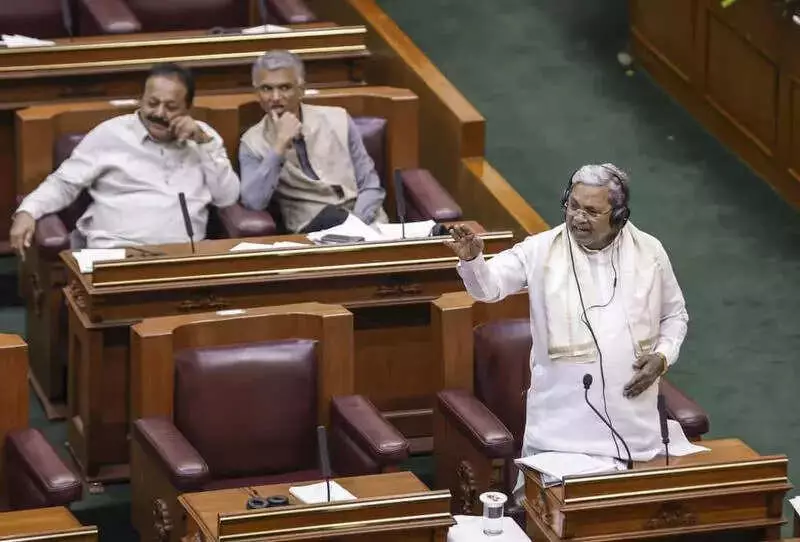
In a marathon reply that stretched over four hours in the legislative assembly, Karnataka Chief Minister Siddaramaiah on Friday committed his government to a mission of reducing the stark regional disparities in the state. He specifically promised to significantly narrow the vast per capita income (PCI) gap between the more prosperous south and the less developed north Karnataka.
A Four-Hour Reply and a Walkout
The final day of the winter session in Belagavi was marked by intense debate and political drama. While Siddaramaiah delivered one of the lengthiest legislative replies in recent memory, summing up a two-week discussion on North Karnataka issues, the opposition BJP legislators staged a walkout. They expressed dissatisfaction over the lack of an immediate announcement for a special development package for the northern region.
The Chief Minister presented a data-driven case, highlighting the severe economic imbalance. The per capita income in Bengaluru Urban stands at a staggering Rs 7.4 lakh, while in districts like Kalaburagi in the north, it plummets to around Rs 1.2 lakh. "The gap of Rs 6 lakh will be reduced to at least Rs 2 lakh," Siddaramaiah asserted, outlining his government's primary target.

Blueprint for Equitable Development
To address this deep-seated inequality, the Chief Minister laid out a multi-pronged strategy. He revealed that the government has appointed noted economist M Govinda Rao to conduct a detailed study on the regional imbalance, with a report expected in January 2024. The state has pledged to implement the recommendations from this report.
Furthermore, Siddaramaiah promised to roll out the suggestions of the Chaya Devana Gaonkar Commission, which recently submitted its report on reforming the education sector. He also stated that a proposal seeking Rs 500 crore for the development of the Kittur Karnataka region, modelled on the Kalayana Karnataka package, would be considered after the Govinda Rao committee submits its findings.
The core of the government's approach is to allocate benefits based on demographic and geographic fairness. Siddaramaiah provided key statistics to justify this:
- North Karnataka's 14 districts house 42% (nearly 3 crore) of the state's 6.9 crore population.
- These districts occupy over half (1 lakh sq km) of Karnataka's total geographical area of 1.9 lakh sq km.
- The region has 97 out of 224 (43%) of the state's assembly constituencies.
"Therefore, it is our intention that 42-43% of benefits of government welfare schemes should be allocated to this region," the CM declared. He provided evidence of this allocation already in motion, stating that of the Rs 1.06 lakh crore spent on the government's guarantee schemes, Rs 46,277 crore (46%) has been directed to North Karnataka.
Opposition Critique and Accusations Against Centre
Despite the detailed presentation, the opposition remained unimpressed. Leader of the Opposition R Ashoka criticized the Chief Minister, saying, "We expected Siddaramaiah to show us the way, but he led us into the woods." He demanded a white paper on funds allocated during the UPA regime and claimed his questions on promises like a textile park in Raichur were not answered.
The walkout was triggered by Siddaramaiah's non-committal response to the demand for an immediate special package announcement. However, he assured the House that a white paper would be presented and invited BJP members to join a Congress delegation to lobby the Union government.
In his address, Siddaramaiah also reiterated allegations of financial neglect by the Centre, claiming Karnataka is yet to receive:
- Rs 13,000 crore under the Jal Jeevan Mission.
- Rs 11,000 crore in tax devolution.
- Rs 5,300 crore for the Upper Bhadra project.
The winter session concluded with the government outlining an ambitious, data-backed plan for regional balance, but with the political divide over the pace and method of execution remaining as wide as the economic gap it seeks to bridge.