The Fading Legacy of Congress in West Bengal
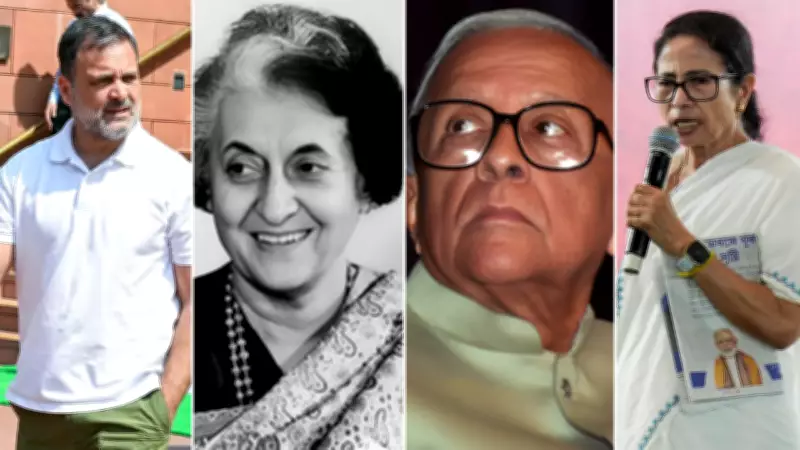
Nearly five decades have elapsed since the Congress party, under the leadership of Indira Gandhi, held sway in West Bengal with Siddhartha Shankar Ray as chief minister. His tenure concluded in 1977, paving the way for a profound communist wave spearheaded by the veteran Marxist Jyoti Basu, who would go on to become the state's longest-serving chief minister.
The Erosion of Congress Influence
The decades of Left Front dominance systematically dismantled the Congress's once-formidable influence in the region. The party, which once boasted iconic leaders like Bidhan Chandra Roy, has been pushed to such extreme margins that it now grapples to project itself as even a credible third force in Bengal's political arena.
The Left's extensive hegemony was ultimately shattered by the rise of Mamata Banerjee. Her political ascent relegated the communist forces to the sidelines, but in the most recent assembly elections held in 2021, it was the Bharatiya Janata Party (BJP) that emerged as the primary challenger to her Trinamool Congress (TMC). Amidst these seismic political shifts, the Congress's footprint has dwindled to a mere shadow of its former self as the next assembly polls approach.

Stark Decline from Historical Heights
The decline is particularly stark when contrasted with the 1972 elections, when the Congress secured a landslide victory with over 200 seats and nearly half of the total vote share. However, following the ascent of the CPM-led Left Front under Jyoti Basu, the party initiated a prolonged retreat from the center of power.
In the 1977 elections, the grand old party suffered a crushing defeat, eclipsed by the overwhelming CPM wave. This collapse was fueled in part by the widespread backlash against Indira Gandhi's Emergency, which also led to the Congress's first-ever defeat at the national level in the general election that same year. By 1977, the party had lost more than half of the vote share it held in 1972, and it never managed to return to a commanding position in the state.
The Rise of New Political Forces
While Congress remained a relevant opposition force for several years, the turn of the millennium witnessed its political space being seized by Mamata Banerjee. Having broken away to form the Trinamool Congress in 1998 under the "Jora Ghas Phul" symbol, Banerjee achieved power within 15 years, effectively filling the vacuum left by the declining Left and a stagnating Congress.
In many ways, the TMC managed to ascend to the top while the more than a century-old Congress languished in obscurity. Even as the national leadership transitioned from Indira Gandhi to Rahul Gandhi, West Bengal's electorate displayed little interest in returning to the Congress fold.
The Final Turning Point in 2021
The 2021 elections marked a definitive turning point for the Congress in West Bengal. The BJP surged to 77 seats, establishing itself as the principal opposition party. Although the BJP could not unseat Mamata Banerjee, its rise dealt a devastating blow to the Congress, which failed to win a single seat, thereby cementing its position as a distant third in the state's political hierarchy.
Congress's Uphill Battle for Relevance
Now, facing an uphill battle for relevance, the Congress is preparing to fight back in the upcoming elections. As the state gears up for polls across 294 seats, the party harbors hopes of transitioning from a faded memory to a renewed political force. The results of these elections will undoubtedly define the next chapter in Bengal's political narrative, determining whether the Congress can reclaim any semblance of its past glory or remain relegated to the margins.