

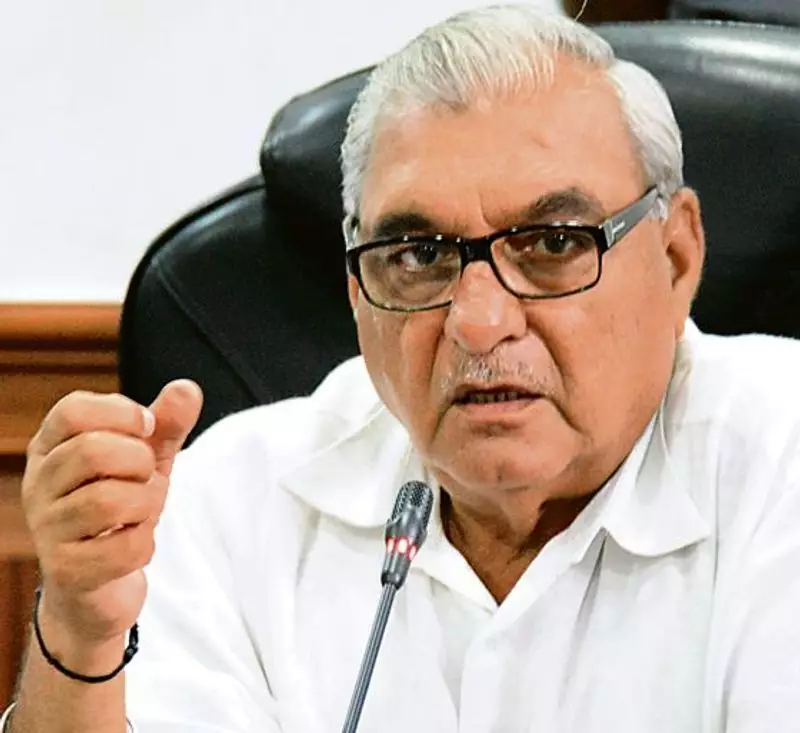
Former Haryana Chief Minister Bhupinder Singh Hooda Dismisses Budget Consultations with BJP Government as Meaningless
In a sharp critique of the ruling Bharatiya Janata Party (BJP) administration in Haryana, former Chief Minister and senior Congress leader Bhupinder Singh Hooda has declared that there is no point in providing budget inputs to the current government. His statement comes amid ongoing discussions about the state's financial planning and public consultations typically held before the annual budget presentation.
Hooda Accuses BJP of Ignoring Public Feedback in Governance
Bhupinder Singh Hooda, who served as the Chief Minister of Haryana from 2005 to 2014, expressed his frustration with the BJP-led government's approach to governance. He emphasized that despite formal processes for gathering suggestions from citizens and stakeholders, the administration consistently overlooks or disregards such feedback when formulating policies and budgets. This, according to Hooda, renders the entire consultation exercise futile and undermines democratic participation.
The former CM highlighted that during his tenure, the Congress government actively incorporated public opinions into budget-making to ensure it reflected the needs of Haryana's diverse population. In contrast, he alleges that the BJP government operates in a top-down manner, with decisions driven by political agendas rather than grassroots input. This criticism points to a broader issue of transparency and accountability in the state's financial management.

Context of Haryana's Economic Challenges and Political Rivalry
Hooda's remarks are set against the backdrop of Haryana facing several economic challenges, including:
- Rising debt levels and fiscal deficits that have strained public resources.
- Unemployment concerns, particularly among youth, which demand targeted budgetary allocations.
- Agricultural distress and the need for support schemes in rural areas.
- Infrastructure projects that require careful funding to boost development.
By dismissing the value of budget consultations, Hooda is not only questioning the BJP's governance style but also positioning the Congress party as a more responsive alternative. This political narrative is part of the ongoing rivalry between the two parties in Haryana, where budget discussions often become a battleground for contrasting ideologies and performance claims.
The BJP government, led by Chief Minister Manohar Lal Khattar until recently and now under Nayab Singh Saini, has previously defended its budget processes as inclusive and data-driven. However, Hooda's statement adds to a series of criticisms from opposition leaders about the administration's handling of state finances. It reflects deeper tensions in Haryana's political landscape, where economic policies are closely scrutinized ahead of elections and public debates.
Implications for Democratic Engagement and Future Budgets
Bhupinder Singh Hooda's assertion raises important questions about the role of public consultations in a democratic setup. If stakeholders perceive that their inputs are ignored, it could lead to:
- Decreased participation from citizens and civil society groups in future budget discussions.
- Erosion of trust in governmental institutions and processes.
- Potential backlash during elections, as voters may feel disconnected from decision-making.
For Haryana, this controversy underscores the need for greater transparency in how budget suggestions are collected, evaluated, and implemented. Hooda has called for a more genuine engagement model, where the government not only listens but also acts on feedback to address pressing issues like healthcare, education, and employment. As the state prepares for its next budget cycle, his comments are likely to fuel further debate on fiscal responsibility and public accountability.
In summary, Bhupinder Singh Hooda's criticism of the BJP government in Haryana highlights a perceived gap between public consultations and actual policy outcomes. By labeling budget inputs as pointless, he challenges the administration to prove its commitment to inclusive governance, while also rallying opposition support around issues of economic management and democratic representation in the state.






