

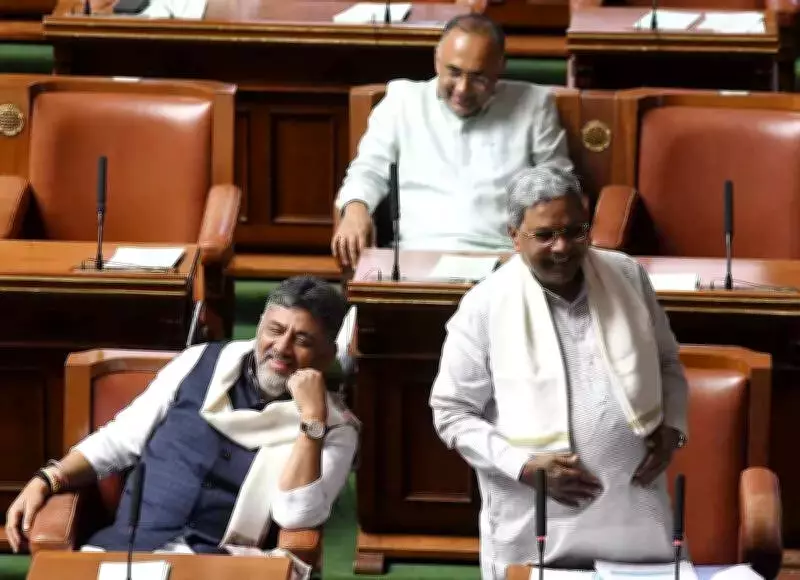
Karnataka Chief Minister Siddaramaiah Defends State's Fiscal Strategy Amid Budget Debate
In a robust defense of his government's financial management, Karnataka Chief Minister Siddaramaiah has firmly rejected allegations that the state is operating on unsustainable loans. Speaking during the assembly debate on Wednesday, he asserted that Karnataka's borrowing remains strictly within prescribed legal limits and stands favorably when compared to other states and the central government.
Budget Details and Fiscal Responsibility
The budget for 2026-27 projects total liabilities at Rs 8.2 lakh crore, which constitutes 24.9% of the Gross State Domestic Product (GSDP). This figure is just under the 25% cap mandated by the Karnataka Fiscal Responsibility Act, underscoring the government's adherence to fiscal discipline. Siddaramaiah emphasized that the deficit stands at 2.9%, a rate lower than most southern states, and total debt remains well within permissible boundaries.
He highlighted that borrowing is an inevitable component for driving development, stating, "I have never said loans should not be taken. All developed economies rely on borrowing. The key issue is whether these loans are utilized for public welfare." The Chief Minister pointed out that the budget size for 2026-27 is Rs 4,48,004 crore, marking a 9.4% increase from the previous year's Rs 4,09,549 crore. This growth rate surpasses the Centre's budget increase of 5.6%, reflecting Karnataka's proactive economic stance.

Economic Growth and Comparative Analysis
Siddaramaiah cited Karnataka's GSDP growth of 8.1%, which exceeds the national GDP growth of 7.4%, as evidence of the state's robust economic performance. He also referenced positive feedback from editorials and economists, who have described the budget as inclusive and focused on critical areas such as infrastructure, irrigation, employment, social security, education, healthcare, and investment support.
In a pointed comparison, he noted that the Union government's borrowings have risen from Rs 14.7 lakh crore in 2024-25 to Rs 16.9 lakh crore in 2026-27, with total debt projected to reach Rs 218.6 lakh crore by March 2027. He criticized the previous BJP government, alleging that they borrowed heavily but with limited investment, leaving behind an outstanding debt of Rs 5.5 lakh crore.
Spending Priorities and Opposition Critique
The Chief Minister detailed increased allocations under his administration, including Rs 20,200 crore earmarked for the Bruhat Bengaluru Mahanagara Palike (BBMP) over four years and Rs 72,386 crore allocated for education in 2026-27. He emphasized that Karnataka ranks second in GST collection and capital investment, with borrowings of Rs 1.3 lakh crore needing to be viewed in the context of the overall budget size.
On the guarantee schemes, Siddaramaiah reported that Rs 1.3 lakh crore has been spent so far, with allocations set to continue. He attributed the revenue deficit to reduced support from the Centre, explaining that GST rate cuts have lowered revenue growth from 10% to 4%, resulting in losses of Rs 10,000 crore earlier and an estimated Rs 15,000 crore in 2026-27. The government has allocated Rs 10,600 crore for social security schemes to mitigate these impacts.
Targeting the opposition, Siddaramaiah dismissed their criticism as lacking depth, using a metaphor: "No matter how much the opposition criticises, a mango cannot become a neem fruit. They called the budget 'empty', but Karnataka has been given a filled pot, not an empty one." He urged the opposition not to oppose the budget for political reasons, advocating instead for a focus on inclusive growth and demand-driven economic policies.
Conclusion and Broader Context
This budget presentation marks Siddaramaiah's 17th budget, with he noting that it is the first time 50 members, including 21 from the opposition, participated in discussions lasting 24 hours and 45 minutes. The debate underscores the ongoing political tensions and fiscal scrutiny in Karnataka's governance landscape.
As the state navigates economic challenges, the Chief Minister's defense highlights a commitment to balanced fiscal management and developmental priorities, setting the stage for continued discourse on public welfare and financial accountability.






