

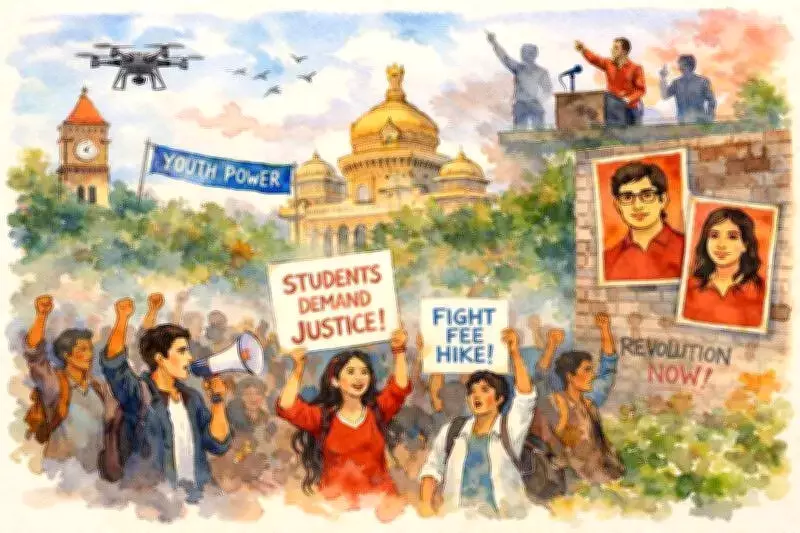
Karnataka Congress Government Plans to Revive Student Union Elections After 37-Year Ban
On a typical weekday afternoon at a government college in central Karnataka, the student notice board is densely packed with circulars concerning examinations, scholarships, and cultural events. Conspicuously absent, however, are the printed campaign posters, hand-written appeals for votes, and calls for passionate debates that once defined the vibrant campus life across the state. For nearly four decades, the corridors of Karnataka's colleges and universities have remained quiet, no longer echoing with the fervent chants of student communities rallying or protesting over myriad social and political causes.
Student union elections have remained prohibited across all higher education institutions in Karnataka since 1989. Many observers argue this prolonged ban has left campuses politically subdued compared to the dynamic decades that preceded it. That long silence may now be nearing its end. After nearly 37 years, the Congress government in Karnataka has announced its intention to revive student union elections throughout the state's colleges and universities, potentially reopening a chapter abruptly closed by a previous Congress administration.
The 1989 Ban and Its Aftermath
Faced with escalating concerns over campus violence, excessive politicization, and significant academic disruption, it was a Congress government led by then Chief Minister Veerendra Patil that originally instituted the ban. Initially presented as a temporary measure, the prohibition persisted indefinitely. Over time, nominated or advisory student councils replaced the 'politically' elected unions. While students could still raise issues related to fees, hostels, and examination delays, their formal representation and bargaining power weakened significantly.

The ban and its long-lasting consequences have sustained a complex debate touching on core democratic principles, institutional discipline, and the role of educational establishments in shaping future political leadership. It has also kept the spotlight firmly on the state's once-vibrant student movements, their subsequent decline, and the intricate political calculations now surrounding a potential revival.
A Push for Young Political Talent
The current Congress government's announcement, which surprised many political observers, was made at the behest of Rahul Gandhi, Leader of the Opposition in the Lok Sabha. Deputy Chief Minister D K Shivakumar articulated the rationale, stating, "We need to tap young political talent. It is possible with campus elections." For many in Karnataka, this move has stirred memories of a period when campuses served as lively incubators of democratic practice.
In a notable historical footnote, electronic voting machines (EVMs), then a novelty, were first tested on a pilot basis during a student union election at MES College in Bengaluru in 1982. A year later, EVMs were introduced in state assembly elections, marking a direct link between campus experimentation and broader electoral innovation.
Campus Politics as a Democratic Training Ground
During the 1970s and 1980s, universities like Mysore University, Karnatak University in Dharwad, and Bangalore University were renowned as hubs for intense debates on land reforms, linguistic identity, social justice, and reservation policies. Student unions functioned as legitimate representative bodies, elected through regular polls, and negotiated with administrations on critical issues including hostels, scholarships, transport, and exam reforms.
"Campus elections were our first lessons in democracy," recalls MLC and government chief whip in the Legislative Council, Saleem Ahmed, a former student leader. "We learnt how to campaign without money, how to speak to people and how to accept defeat."

For numerous prominent figures in contemporary Karnataka politics, campuses provided the essential launchpad. Deputy CM D K Shivakumar began his political education in the corridors of Sri Jagadguru Renukacharya College in the early 1980s as a visible leader with the National Students Union of India (NSUI). Similarly, former AICC general secretary B K Hariprasad and eight-time MLA and Transport Minister Ramalinga Reddy trace their political roots back to student activism. Their trajectories from campus politics to high-level government and party positions are now central to the renewed policy debate.
Examining Feasibility and Framework
To scrutinize the framework, feasibility, and implications of reintroducing campus polls, the government has constituted a high-level 11-member committee. Medical Education Minister Sharanprakash Patil serves as convener. The panel includes Higher Education Minister Dr M C Sudhakar, several MLAs and MLCs, and leaders from the Karnataka Youth Congress and NSUI. The committee has been directed to submit its report within 15 days.
Key questions before the committee include whether student elections should be conducted under political party banners or in a non-political format, and whether reservations should be extended to women, OBCs, SC/STs, and students with disabilities.
Arguments For and Against Revival
Retired academic Bandu Upadhya, who served as a college principal during the tumultuous years of active campus politics, recalls an atmosphere where candidates were openly sponsored by political parties, leading to sharp divisions, frequent arguments, and occasional clashes, with anti-social elements sometimes entering campuses. Academic calendars were frequently disrupted, and police presence during elections became routine.
Supporters of the long-standing ban argue it brought stability and predictability to academic schedules. "After the ban, there were fewer disruptions, and academic schedules became predictable," notes a former university administrator.
Critics, however, contend the silence came at a significant cost. "Banning student elections reflects a lack of trust in our youth," says Ravindra Reshme, a political commentator and former president of the Federation of Karnataka University and College Teachers' Association. "It denies students practical democratic training."
Student organizations remain divided. NSUI and AISF activists emphasize that elections provide crucial exposure to democracy, help identify leaders early, and offer a legitimate platform for marginalized students. In contrast, ABVP and SFI representatives express reservations, warning that without strict safeguards, reviving elections could lead to renewed disruptions, violence, external interference, and the undue politicization of academic spaces.
Political Calculations and Cautious Reactions
Political observers suggest the Congress government's move is also driven by organizational considerations. Unlike the BJP, which has the RSS as a pipeline for grassroots leadership, the Congress lacks similar institutional channels. Campus elections could offer a vital route to identify and groom future political talent.
Opposition parties have reacted cautiously. BJP leaders have warned against politicizing educational institutions, insisting that colleges should focus primarily on academics and that any revival must include strict safeguards. The JD(S) has taken a more nuanced position, acknowledging that student movements have shaped leaders across parties but cautioning that campuses should not become political battlegrounds.
As the high-level committee begins its work, Karnataka stands at a potential turning point, weighing the lessons of a turbulent past against the democratic promise of engaging a new generation of students in the foundational practices of political life.





