

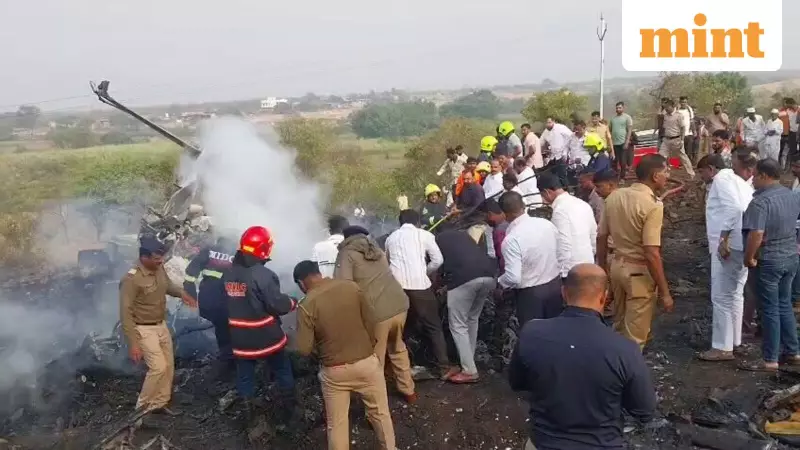
In a tragic development that has sent shockwaves across Maharashtra's political landscape, Deputy Chief Minister Ajit Pawar lost his life on Wednesday when the aircraft he was travelling in crashed during its landing attempt at Baramati airfield. The Nationalist Congress Party leader was scheduled to address four crucial political rallies ahead of the upcoming Zilla Parishad elections, making this incident particularly devastating for his party and supporters.
Official Confirmation of Fatalities
The civil aviation ministry confirmed the tragic outcome in an official release, stating: "There were a total of 05 persons on board including 02 crew members. The passengers included Deputy Chief Minister of Maharashtra Shri Ajit Pawar. All the occupants of the aircraft received fatal injuries." This statement has ended all speculation about possible survivors from the ill-fated flight.
Baramati Airfield Classification and Operation
The ministry provided crucial context about the airfield where the tragedy unfolded. Baramati is classified as an uncontrolled airfield, meaning air traffic information is typically shared by instructors or pilots from flying training organizations operating at the location, rather than through a full-fledged air traffic control unit. This classification has raised questions about safety protocols at such facilities.

Detailed Sequence of the Fatal Incident
Based on accounts from the official managing air traffic communication at the time, the ministry outlined the sequence of events that culminated in the fatal crash. On January 28, the aircraft VI-SSK first established contact with Baramati at 08.18 IST. Shortly afterwards, the crew made another call while 30 nautical miles inbound and were released by Pune approach. They were advised to descend under Visual Meteorological Conditions at the pilot's discretion.
The crew then sought information regarding wind conditions and visibility. They were informed that winds were calm and visibility was approximately 3,000 metres. During the first landing attempt on Runway 11, the crew reported that the runway was not visible and initiated a go-around procedure. Following this, they again reported being on final approach for Runway 11.
When asked to confirm whether the runway was in sight, the crew responded, "runway is currently not in sight, will call when runway is in sight." Moments later, they reported that the runway had come into view. The aircraft was cleared to land on Runway 11 at 08.43 IST, though no readback of the clearance was received.
At 08.44 IST, flames were observed near the threshold of the runway, prompting emergency services to rush to the scene. The wreckage was later found on the left side of the runway, abeam the threshold of Runway 11, indicating the final moments of the flight occurred just as landing was being attempted.
Investigation Handed Over to AAIB
The Aircraft Accident Investigation Bureau (AAIB) has taken charge of the comprehensive probe into this tragic incident. According to the official release, the Director General of the AAIB is travelling to the crash site personally, and further details will be shared as they become available through systematic investigation procedures.
Parallel Probe into Ahmedabad Crash
Interestingly, the AAIB is simultaneously investigating another recent aviation tragedy - the Air India crash in Ahmedabad, where a London-bound aircraft went down minutes after take-off. That separate incident claimed the lives of 241 passengers, with only one survivor reported. The dual investigations highlight the challenging workload facing India's aviation safety investigators during this period.
The loss of Ajit Pawar represents a significant blow to Maharashtra politics, particularly for the Nationalist Congress Party as it prepares for important local elections. As investigations continue, questions about airfield safety protocols, pilot decision-making in challenging visibility conditions, and overall aviation safety standards in regional airfields are likely to dominate discussions in the coming days and weeks.






