Mamata Banerjee Returns to Streets in Kolkata Over Voter Roll Controversy
West Bengal Chief Minister Mamata Banerjee is preparing for a significant street protest in Kolkata on Friday, targeting what she describes as the mass "deletion of voters" following the Election Commission's Special Intensive Revision (SIR) of electoral rolls. This demonstration comes just 48 hours before a full bench of the Election Commission is scheduled to arrive in Kolkata to assess the state's poll preparedness ahead of the crucial April assembly elections.
Protest Preparations and Historical Parallels
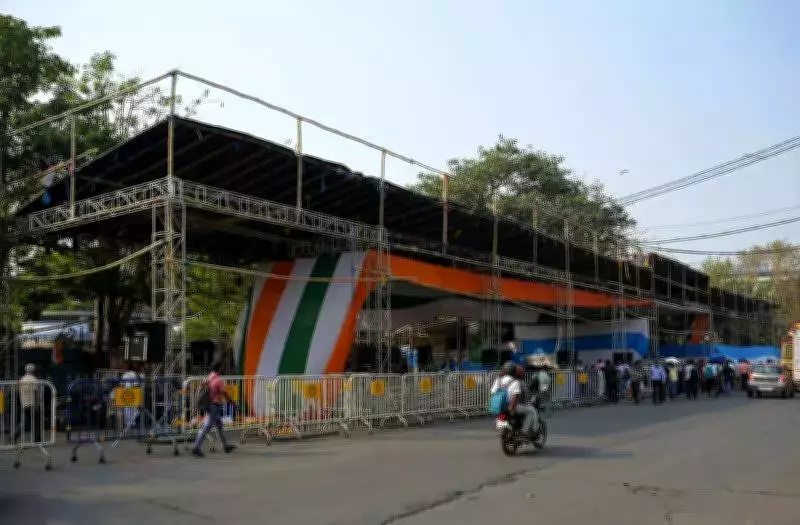
Construction of the protest stage began two days prior, with Trinamool Congress workers actively inspecting the grounds. The main protest is set to commence at 2 PM, though gatherings will start as early as 11 AM. On Thursday morning, Public Works Department officials and police officers conducted a thorough inspection of the site, accompanied by a sniffer dog for security purposes. During the afternoon, workers were seen painting railings on the median divider in the party's signature blue color.
Trinamool national general secretary Abhishek Banerjee announced the sit-in protest on Sunday, accusing the Election Commission of engaging in a politically motivated exercise designed to disenfranchise voters before the assembly elections. "She will announce our action from the venue. We oppose this SIR," he declared, setting the tone for what promises to be a heated confrontation.

Echoes of Past Agitations
For Mamata Banerjee, this return to street protests mirrors the political style that has defined her entire career. Before becoming chief minister in 2011, the Metro Channel served as the primary stage for her challenges against the long-ruling Left Front government. On December 4, 2006, she began her landmark 26-day fast at that very location over the controversial Tata Motors small car project in Singur. That agitation ultimately became a political milestone that contributed to ending 34 years of Left Front governance in West Bengal.
Since assuming power in 2011, Banerjee has occasionally resumed her protestor role. In February 2019, she held a dharna after the Central Bureau of Investigation sought to question the Kolkata Police commissioner. More recently in 2024, she protested on Red Road against the central government's withholding of funds to the state.
For longtime Trinamool supporters who arrived at the protest site a day early, the similarities between this demonstration and Banerjee's historic 26-day hunger strike at Esplanade's Metro Channel were unmistakable. That earlier protest aimed to stop the acquisition of 1,000 acres of land by Tata Motors in Singur, creating what many consider the foundation of Trinamool's political rise.
Grassroots Perspectives on the Movement
Zakir Karikar from Murshidabad, whose association with Trinamool began during the original Singur movement, traveled to Kolkata on Thursday to monitor preparations for the dharna. "I joined the protest the day Didi launched her hunger strike," he recalled. "The Singur movement protected agricultural land. But this current issue is even larger because citizens, particularly from minority communities, are facing harassment and the loss of their fundamental voting rights."
Sanjay Chakraborty, a Trinamool worker and booth level agent since 1998, described this as the "second movement" for human rights after Singur. "I was at Metro Channel when the party in office attempted to take farmers' land. As a booth level agent, I witness firsthand how voters are being deleted or marked under adjudication. We are demanding that the Election Commission review these questionable decisions," he explained.
Political Implications and Electoral Strategy
Political observers note that by personally leading this protest, Chief Minister Banerjee is sending a clear signal that voter roll integrity will be a central campaign issue for Trinamool Congress as the state approaches the April assembly elections. The timing of the protest—just before the Election Commission's visit—appears strategically calculated to maximize political impact and media attention.

The protest represents more than just another political demonstration; it symbolizes Banerjee's return to her roots as a street fighter while simultaneously addressing what her party claims are systematic attempts to undermine democratic processes in West Bengal. As preparations continue and supporters gather, all eyes remain on Kolkata to see how this latest chapter in Bengal's political drama will unfold.