Prime Minister Modi Launches NDA Campaign in Tamil Nadu, Predicts DMK's Exit
Prime Minister Narendra Modi delivered a powerful political address in Mathuranthakam near Chennai on Friday, officially launching the National Democratic Alliance's election campaign in Tamil Nadu. In his speech, Modi declared that the "countdown has begun" for the end of the Dravida Munnetra Kazhagam government in the state, asserting that Tamil Nadu is ready for a transformative political change.
Call for Double Engine Government and NDA Unity
Modi emphasized the need for a "double engine government" in Tamil Nadu, where an NDA dispensation at the state level would work in seamless coordination with the central government to accelerate development and attract substantial investments. "Tamil Nadu wants freedom from the rule of DMK. Tamil Nadu wants a BJP-led NDA government," the Prime Minister stated unequivocally during his public meeting.
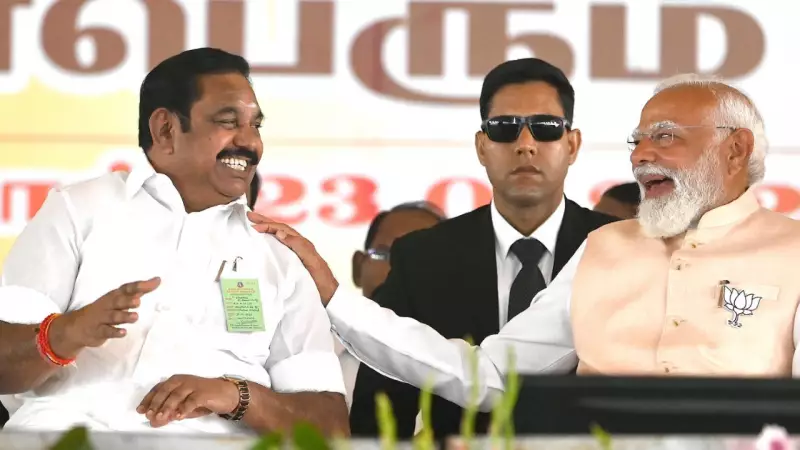
The event showcased significant political unity as Modi shared the stage with key NDA allies including AIADMK general secretary Edappadi K Palaniswami, AMMK general secretary T T V Dhinakaran, PMK president Anbumani Ramadoss, and TMC president G K Vasan. Modi highlighted that all alliance leaders have united with a common resolve to liberate Tamil Nadu from DMK's governance and transform it into a developed, secure, and corruption-free state.

Scathing Criticism of DMK Governance
While choosing not to name Chief Minister M K Stalin directly, Modi launched a comprehensive attack on the DMK government, accusing the ruling party of betraying public trust through unfulfilled promises. "They made many promises, but the delivery has been zero," he remarked, characterizing the regime as a "CMC government" that allegedly promotes corruption, mafia activities, and crime.
Modi invoked cultural issues to criticize the DMK, specifically mentioning the Thiruparankundram karthigai deepam controversy and accusing the party of being hostile to Tamil traditions. He also recalled that the traditional sport of jallikattu was banned during the Congress-DMK regime, noting that it was the NDA government that ultimately lifted the prohibition.
Invoking AIADMK Legacy and Development Claims
The Prime Minister paid tribute to AIADMK stalwarts M G Ramachandran and J Jayalalithaa, praising the late former chief ministers for their initiatives in women's safety and asserting that the NDA would carry forward this important legacy. This strategic acknowledgment served to bridge historical political achievements with current NDA aspirations in the state.
Modi presented substantial development figures to bolster his case for NDA governance, claiming that the central government has allocated Rs 3 lakh crore to Tamil Nadu over the past 11 years – three times more than what the previous UPA government provided. He highlighted specific infrastructure improvements including a sevenfold increase in railway funding, modernization of 80 stations, and the introduction of Vande Bharat trains to enhance connectivity.
Emphasis on Tamil Language and Personal Connection
The Prime Minister emphasized the NDA government's commitment to promoting the Tamil language, sharing his personal connection to Tamil literature. "Tamil always had a huge impact on me," Modi revealed, mentioning that he has gifted Thirukkural books to world leaders as cultural ambassadors of India's linguistic heritage.
Modi also addressed benefits extended to farmers and fishermen in Tamil Nadu through NDA policies, positioning the alliance as genuinely concerned with the welfare of all sections of Tamil society. His speech concluded with a touching moment when he noticed a young girl waving a photograph of his mother, prompting him to pause his address and personally acknowledge the gesture with warmth and appreciation.
The Prime Minister's comprehensive address sets the stage for an intense electoral battle in Tamil Nadu, with the NDA presenting itself as a united alternative to the current DMK administration, promising accelerated development, cultural preservation, and corruption-free governance through the double engine model of coordinated state and central leadership.