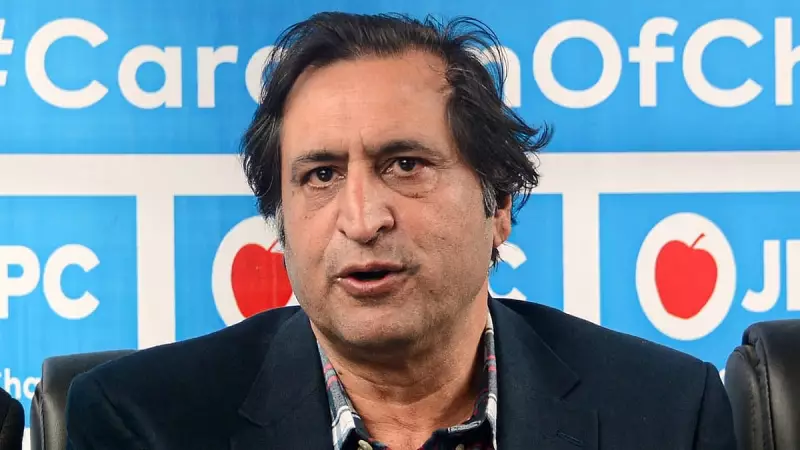
In a statement that has ignited a fresh political firestorm in Jammu and Kashmir, Sajad Lone, the chief of the Jammu and Kashmir People's Conference, has declared that he "prays" for the separation of Kashmir from Jammu. This provocative remark comes as a direct response to the Bharatiya Janata Party's (BJP) recent demand for the creation of a separate Jammu state within the union territory.
Context of BJP's Demand and Lone's Reaction
The BJP, a key political player in the region, has been vocal in advocating for Jammu to be granted statehood, arguing that it would address long-standing grievances and ensure better governance for the area. This demand has gained traction in recent months, with party leaders emphasizing the distinct cultural and administrative needs of Jammu compared to the Kashmir Valley.
Sajad Lone, a prominent political figure in Kashmir, countered this by expressing his personal wish for a split, framing it in religious or spiritual terms. His statement underscores the deep-seated regional tensions that have persisted in Jammu and Kashmir, even after its reorganization into a union territory in 2019.

Implications for Regional Politics and Unity
Lone's comments have drawn sharp criticism from various quarters, with opponents accusing him of fueling divisiveness at a time when efforts are being made to foster unity and development in the region. The BJP, in particular, has condemned the remarks, labeling them as irresponsible and detrimental to the peace process.
Analysts suggest that this exchange highlights the ongoing struggle over identity and autonomy in Jammu and Kashmir. The demand for separate statehood for Jammu reflects broader issues of representation and resource allocation, while Lone's response points to fears in Kashmir about being marginalized in any new administrative setup.
Historical and Current Divisions
Historically, Jammu and Kashmir have experienced periodic tensions due to differences in demographics, politics, and economic priorities. The BJP's push for a separate Jammu state is seen by some as an attempt to consolidate its support base in the region, where it has traditionally had stronger influence compared to the Kashmir Valley.
On the other hand, leaders like Sajad Lone, who represent Kashmiri interests, view such demands with suspicion, worrying that it could lead to further fragmentation and weaken the collective voice of the union territory. This dynamic is part of a larger narrative of political maneuvering in the wake of the abrogation of Article 370, which has reshaped the political landscape.
Public and Political Reactions
The public reaction to Lone's statement has been mixed, with some in Kashmir expressing solidarity with his sentiment, while others in Jammu have reiterated their support for statehood. Political parties across the spectrum are now grappling with how to address these competing aspirations without exacerbating divisions.
As the debate intensifies, it remains to be seen how the central government will respond to these demands. The issue of Jammu and Kashmir's administrative future continues to be a sensitive topic, with implications for national security and regional stability.
In summary, Sajad Lone's prayer for Kashmir's separation from Jammu has added a new layer of complexity to the ongoing discourse on statehood in the union territory. It serves as a stark reminder of the enduring challenges in achieving political harmony in this strategically important region.