Srirangam Constituency: The Historic Temple Seat at the Heart of Tamil Nadu Politics
The Srirangam assembly constituency, situated on the sacred banks of the Cauvery River, holds profound significance in Tamil Nadu's political landscape. For the AIADMK, this temple town constituency carries immense emotional weight as it was once represented by their revered late leader J Jayalalithaa. Conversely, the DMK views Srirangam as a strategic bellwether, with historical patterns suggesting that securing this seat often correlates with the party's likelihood of forming the state government.
A Direct Clash Between Experience and Strategy
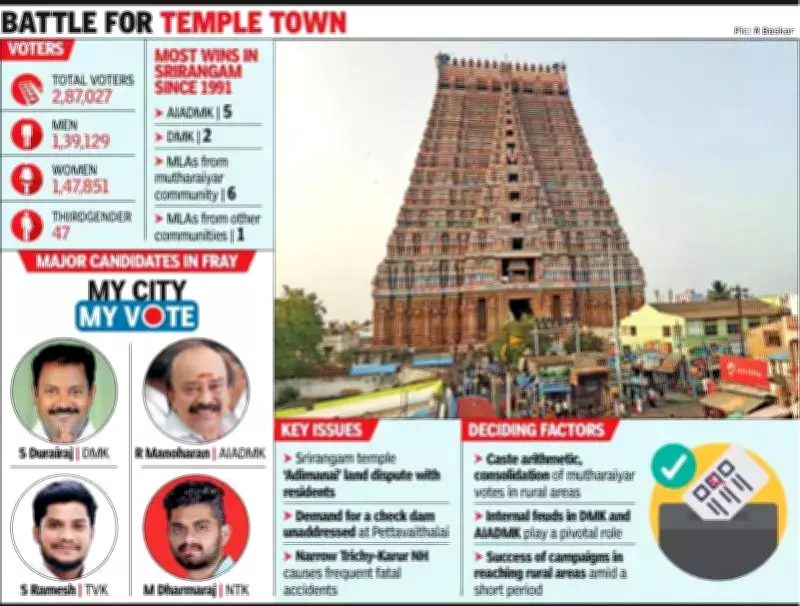
This election features a direct confrontation between seasoned AIADMK leader and former government whip R Manoharan and DMK's relatively fresh face S Durairaj. The AIADMK campaign heavily relies on Manoharan's established popularity and his previous role as constituency in-charge during Jayalalithaa's tenure as Chief Minister from 2011 to 2015. In contrast, the DMK has strategically deployed caste arithmetic as its primary weapon in this electoral battle.
Demographic Composition and Caste Dynamics
Geographically, Srirangam encompasses seven wards of the Trichy corporation, yet approximately 70% of the constituency consists of rural areas including Andanallur and Manikandam. The Muthuraiyar community dominates the demographic landscape, followed by Scheduled Castes and Vellalars. Historical voting patterns reveal that over the past 35 years, with the sole exception of Jayalalithaa, every elected MLA from Srirangam has hailed from the Muthuraiyar community, which has traditionally supported the AIADMK since the era of MGR.

The DMK's strategic fielding of Durairaj, a candidate from this dominant community, represents a calculated move to capitalize on this demographic reality. Meanwhile, AIADMK's Manoharan, though a native of Srirangam island, belongs to the Naidu community, which constitutes a minority within the constituency.
Minor Parties and Campaign Dynamics
While TVK and NTK have fielded young candidates S Ramesh (31) and M Dharmaraj (25) respectively, political observers consider them unlikely to significantly impact the primary DMK-AIADMK contest. The traditional tendency of rural Muthuraiyars to support candidates from their own community provides the DMK with considerable confidence. However, the AIADMK has mounted a proactive campaign, with Manoharan's seasoned political experience and personal voter connections representing strengths that the DMK currently lacks.
Internal Party Challenges and Candidate Selection
A significant development involves the DMK's decision to drop sitting MLA M Palaniyandi, who secured Srirangam with an approximately 20,000-vote margin in 2021. Sources cite strained relations with DMK strongman KN Nehru and the incumbent's alleged involvement in an assault case against television journalists at a stone quarry as contributing factors. Palaniyandi's absence from DMK campaign activities has emerged as a concern for the ruling party.
The AIADMK faces its own internal challenges, with discontent among some Muthuraiyar candidates who were denied party tickets. These internal dynamics add complexity to an already competitive electoral scenario.
Local Issues and Voter Concerns
Beyond political maneuvering, Srirangam residents continue to grapple with unresolved local issues. Suresh Venkatachalam, president of the Srirangam Nagara Nala Sangam, highlights persistent problems including the Adimanai land dispute between the Hindu Religious and Charitable Endowments Department and local residents, along with the absence of dedicated parking facilities for the renowned Srirangam temple.
Campaign Strategies and Historical Significance
As the AIADMK works to revive grassroots connections and reclaim what they consider their traditional bastion, the DMK has reintroduced the KMUT financial assistance scheme specifically targeting rural women voters. The 2026 election represents an experimental phase for both major parties in Srirangam, potentially producing two unprecedented outcomes: either a non-dominant community candidate would win for the first time since Jayalalithaa, or the DMK would secure the seat for consecutive terms, another historical first for this politically significant constituency.