

Maharashtra's Urban Districts Struggle in Voter Revision Exercise
Nagpur: In a concerning development for electoral preparedness, Maharashtra's largest urban districts have emerged as the weakest links during the ongoing pre-special intensive revision (SIR) exercise. Major metropolitan centers including Pune, Mumbai, Thane, and Nagpur are reporting alarmingly low coverage rates, despite collectively hosting a substantial portion of the state's electorate.
Stark Urban-Rural Divide in Coverage Statistics
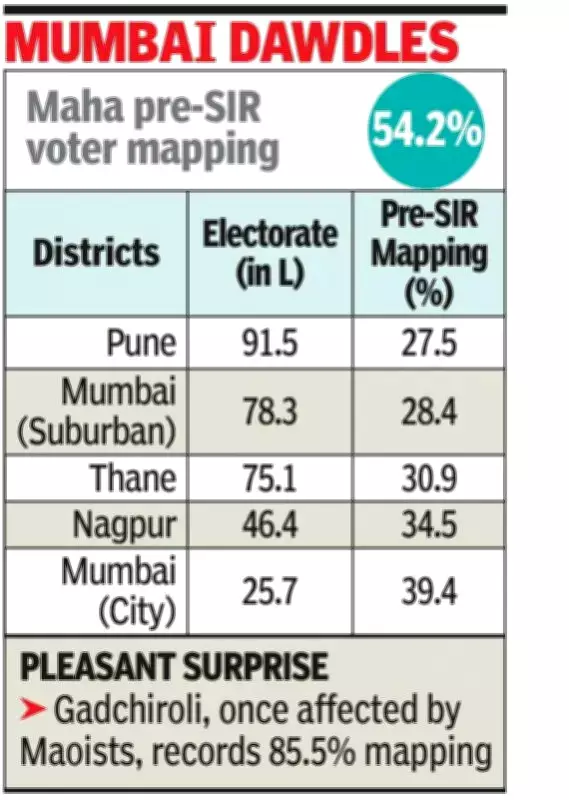
Official data reveals a significant disparity between urban and rural performance. While the statewide average stands at 54.15%, urban centers are dramatically behind schedule. Pune records just 27.47% coverage, followed by Mumbai Suburban at 28.35%, Thane at 30.92%, Nagpur at 34.49%, and Mumbai City at 39.36%.
This trend is particularly striking given these districts contain massive voter populations. Pune alone has more than 91.5 lakh electors, with Mumbai suburban following at 78.3 lakh, Thane at 75.1 lakh, Nagpur at 46.4 lakh, and Mumbai city with 25.72 lakh voters. The proportionally low number of voters mapped in these urban centers is significantly pulling down the overall pace of the statewide revision exercise.

Urban Challenges: Mobility and Engagement Issues
A senior election official explained that frequent population movement within cities and to other locations creates substantial difficulties for booth level officers (BLOs) attempting to trace voters. "In numerous instances, houses are found locked or previous occupants have relocated entirely," the official stated, highlighting the logistical complexities of urban voter verification.
The situation has exposed critical staffing shortages. In Nagpur district alone, of 4,610 assigned BLOs, more than 1,000 were initially not on duty, severely affecting early revision progress. Although absentee BLO numbers have since reduced to approximately 250, the initial gap created significant delays in ground-level operations.
Beyond logistical hurdles, low public engagement in urban areas has further hampered progress. Field staff consistently report that city residents are often reluctant to cooperate with verification efforts, frequently asking BLOs to return at later times or simply refusing participation altogether.
Rural Districts Excel in Voter Mapping
In stark contrast, predominantly rural districts are demonstrating exemplary performance. Gadchiroli, once a Maoist-affected region, has emerged among Maharashtra's top performers with an impressive 85.5% voter mapping rate—one of the highest percentages recorded statewide. This continues the district's established trend of strong electoral participation observed during previous voter turnout events.
Other Vidarbha districts have similarly outpaced their urban counterparts. Buldhana has achieved 80.9% coverage, followed by Amravati at 71.9%, Gondia at 71.2%, and Chandrapur at 68.1%. These rural areas benefit from more stable residential populations and more effective ground-level verification processes compared to constantly shifting urban environments.
Path Forward for Urban Improvement
Election officials have identified several critical measures needed to accelerate urban coverage. Improving BLO deployment strategies, simplifying documentation requirements for urban residents, and implementing comprehensive public awareness campaigns will be essential to bridge the current urban-rural divide in voter revision progress.
The contrasting performance between Maharashtra's bustling cities and its rural hinterlands underscores the unique challenges of maintaining accurate electoral rolls in rapidly changing urban landscapes while highlighting the relative stability and engagement found in more settled rural communities.






