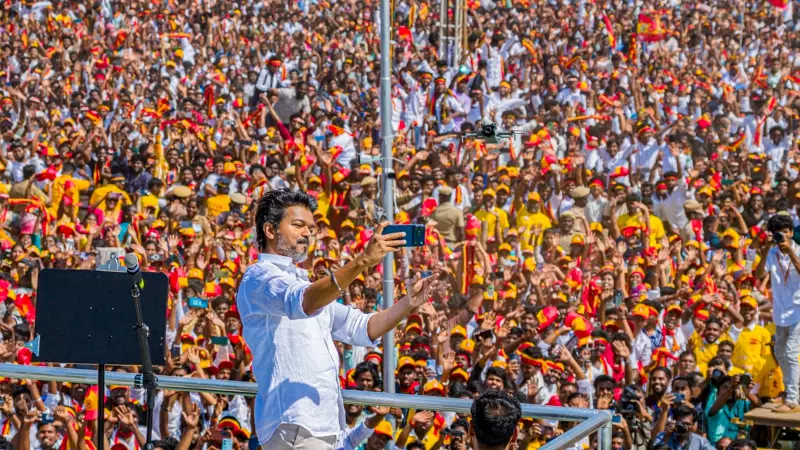
In a significant development that could redraw the battle lines in Tamil Nadu politics, actor Vijay's fledgling political party, the Tamilaga Vettri Kazhagam (TVK), is reportedly in advanced negotiations to bring two prominent former AIADMK leaders into its fold. The potential induction of former Chief Minister O. Panneerselvam and AMMK chief T.T.V. Dhinakaran is being seen as a major strategic move ahead of the crucial 2026 State Assembly elections.
A Strategic Consolidation for the Newcomer
According to senior functionaries from both TVK and the Amma Makkal Munneetra Kazhagam (AMMK), the talks have reached an advanced stage. This development follows TVK's recent success in onboarding former AIADMK heavyweight K.A. Sengottaiyan. A senior TVK leader, speaking on the condition of anonymity, confirmed the direction of the discussions, stating that the party sees "enormous political value" in welcoming both OPS and Dhinakaran. Their entry is expected to provide not just decades of political experience but, more crucially, a ready-made social and organizational base.
For the TVK, which was founded only months ago and has so far relied heavily on Vijay's star power and symbolic appeal, this represents a deliberate shift towards building concrete organizational depth. "We do not want to miss this opportunity. Dhinakaran and OPS joining gives us credibility, experience, and a clear expansion in the south," revealed a senior party insider.

The Geopolitical and Social Calculus
The potential alliance holds significant geographical implications. Both O. Panneerselvam and T.T.V. Dhinakaran wield considerable influence within the Thevar community, a powerful Other Backward Class (OBC) group dominant in southern Tamil Nadu. Their formal association with TVK would instantly grant Vijay's party a formidable organizational presence in key districts like Theni, Madurai, Sivaganga, Ramanathapuram, and parts of the Cauvery delta region.
For the two leaders themselves, aligning with TVK appears to be a pragmatic choice born out of diminishing alternatives. TTV Dhinakaran, whose AMMK once played a spoiler by splitting the AIADMK vote, has found himself politically cornered. He has ruled out joining the BJP-led NDA alliance as long as Edappadi K. Palaniswami remains its chief ministerial face in the state.
O. Panneerselvam's situation is similarly constrained. After his expulsion from the AIADMK, he has been left without a party structure. The gradual withdrawal of support from the BJP and RSS, which had initially backed his revolt, has further narrowed his options. Sources indicate that Panneerselvam explored possibilities with the DMK as well, but the ruling party, citing seat-sharing arithmetic and internal dynamics, appears to have closed its doors.
Ripple Effects on Major Alliances
This emerging political axis has direct consequences for the existing alliances in the state. The AIADMK leadership under Edappadi K. Palaniswami has firmly shut the door on any reconciliation with its former stalwarts. "We cannot treat rebels as equals," asserted a senior AIADMK leader. This stance risks leaving the AIADMK-led NDA bloc without the advantages of a broad, united anti-DMK front.
The BJP, which had attempted to broker peace between the AIADMK, Dhinakaran, and Panneerselvam, finds itself in an awkward position. While it continues to advocate for an "umbrella alliance," its room for manoeuvre is shrinking. Party sources privately acknowledge that even if OPS and Dhinakaran were brought back to the NDA fold, their electoral value would be limited without the backing of the AIADMK's robust cadre base.
K.A. Sengottaiyan has publicly acknowledged the ongoing talks, describing them as "positive" and indicating that clarity would emerge soon. He has also emphasized that TVK's ideological opposition remains firmly directed at the BJP, even as it seeks to build a wide social coalition. This positioning allows TVK to project itself as a distinct, anti-BJP force that is also separate from the ruling DMK.

The 2026 Electoral Equation
The ruling DMK is closely monitoring these developments but currently sees no immediate cause for alarm. However, party strategists are acutely aware that a strengthened TVK could complicate the electoral arithmetic, especially in the southern districts. Historically, multi-cornered contests in regions like Theni, Ramanathapuram, and Virudhunagar have led to fragmented opposition votes, often benefiting the DMK.
A potential three-cornered contest in 2026—between the DMK-led alliance, the AIADMK-NDA bloc, and a TVK front bolstered by the Thevar base of OPS and Dhinakaran—could once again split the anti-incumbency vote. This fragmentation might indirectly strengthen the DMK's position, even in the face of potential anti-incumbency undercurrents. "This is not about who gains today, but about how the field is being redrawn," commented a DMK leader, summarizing the strategic shift underway.
As the political chessboard in Tamil Nadu is being reset, the possible unification of Vijay's popular appeal with the grounded political networks of O. Panneerselvam and T.T.V. Dhinakaran marks one of the most significant consolidations in recent state politics, setting the stage for a highly competitive and complex election in 2026.