

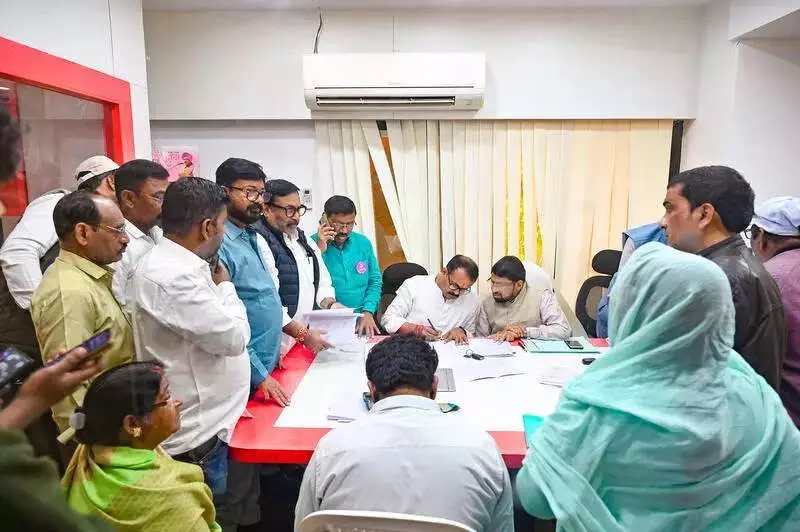
The final day for filing nominations for civic body elections in Maharashtra's Vidarbha region was marred by widespread violence and intense protests. Party cadres from both the Shiv Sena and the Bharatiya Janata Party (BJP) revolted openly after being denied tickets, leading to clashes and high-tension confrontations with leadership.
Clashes and Chaos in Amravati and Akola
In Amravati, the situation turned volatile at a hotel where Shiv Sena (Shinde faction) workers had gathered for the distribution of AB forms. The protest erupted when several party aspirants discovered that their preferred candidates had been left out of the final list. The disagreement quickly escalated into shouting matches and sloganeering, forcing senior leaders to step in to control the situation. Party officials defended the process, stating that candidate selection was transparent and based on multiple criteria.
Meanwhile, in Akola, tensions flared outside the residence of BJP election in-charge and former mayor Vijay Agrawal. Party workers staged a demonstration to protest the denial of tickets. The agitation was spearheaded by BJP woman office-bearer Shakuntala Jadhav, who had hoped to contest from an SC-reserved ward in the Akot Phail area. However, the ward was allocated to the Ajit Pawar-led NCP as part of the alliance's seat-sharing agreement, a move that sparked deep resentment among local BJP cadres.

Jadhav and her supporters confronted party leaders, accusing them of ignoring loyal workers to accommodate alliance partners. The protest took an emotional turn when Jadhav's health reportedly deteriorated, causing her to collapse, which heightened concerns among the gathered workers. Police personnel were subsequently deployed outside Agrawal's residence as a precautionary measure.
Allegations of Bias and Internal Rifts Surface
Similar scenes of discontent unfolded outside the residence of Dr. Nitin Dhande, the BJP's Amravati city president, which served as another distribution point for AB forms. Large crowds of aspirants gathered, with initial celebrations by successful candidates soon replaced by anger and despair among those left out. Several long-serving party workers accused the leadership of bias, alleging that newly inducted members were being favoured over them. Party leaders countered these claims, asserting that the final selection was based on comprehensive survey reports.
The ticket distribution process also brought to light internal conflicts within the BJP in Chandrapur. A political tug-of-war emerged between former BJP minister Sudhir Mungantiwar and his party colleague Kishor Jorgewar. Jorgewar publicly questioned the allocation of tickets to certain individuals, alleging that some selected candidates had police cases registered against them. "One has over 20 cases registered, another is rumoured to have earlier worked against the party," he stated, highlighting the internal discord.
Fallout and Political Implications
The widespread protests underscore the significant challenges political parties face in managing aspirations and maintaining discipline within their ranks during alliance-based seat-sharing. The incidents in Amravati, Akola, and Chandrapur reveal a palpable sense of betrayal among grassroots workers who feel sidelined for electoral calculations. These events threaten to disrupt local campaign harmony and could impact the parties' performance in the upcoming civic polls. The deployment of police at leaders' residences indicates the seriousness of the unrest, as parties now scramble to contain the damage and placate their agitated cadres before voting begins.






