Women to Hold Reins in Chandrapur and Akola Civic Bodies Following Maharashtra's Mayoral Reservation Announcement
In a significant development for urban governance in Maharashtra, the state government announced mayoral reservations for municipal corporations on Thursday. While Amravati will have its mayor elected from the general category, the civic bodies of Chandrapur and Akola are set to be led by women from the Other Backward Classes (OBC) category. This move underscores a continued push for greater female representation in local administration across the state.
Amravati: BJP Emerges as Single-Largest Party with Strategic Alliances
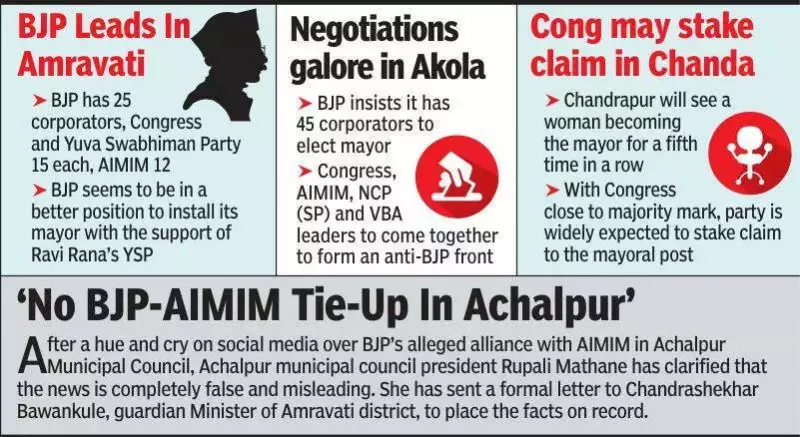
In the Amravati Municipal Corporation, the Bharatiya Janata Party (BJP) has emerged as the single-largest party with 25 corporators. The Congress and Yuva Swabhiman Party (YSP) each hold 15 seats, while the All India Majlis-e-Ittehadul Muslimeen (AIMIM) has 12. The Nationalist Congress Party (NCP) under Ajit Pawar has 11 corporators, with Shiv Sena (Shinde) and the Bahujan Samaj Party (BSP) each having three. Shiv Sena (UBT) holds two seats, and the Vanchit Bahujan Aghadi (VBA) completes the tally with one corporator.
With the support of Ravi Rana's YSP, the BJP appears to be in a favorable position to install its mayor. Rana has claimed to have secured the backing of Shinde Sena's three corporators, Uddhav Sena's two, BSP's three, and the VBA corporator in his camp. According to political circles, the BJP's mayoral choice is likely to be Surekha Lungare, indicating a strategic consolidation of alliances to secure the top post.

Chandrapur: A Legacy of Women Leadership with Congress Poised for Power
Chandrapur stands out as one of the few cities in Maharashtra with a history of women at the helm. Over the past four terms, the mayoral post has been reserved twice for OBC women and twice for women from the general category. Following recent elections, the Congress is close to achieving a majority, making it widely expected to stake claim to the mayoral position.
Within the Congress, three names are circulating as potential candidates. Sunanda Dhobe, a first-time corporator considered close to MP Pratibha Dhanorkar, is viewed as a strong contender. Dhobe belongs to the Kunbi community, a significant OBC group in the region. Sangeeta Amrutkar brings prior mayoral experience to the table, while Sangeeta Bhoyar, a long-serving corporator with deep grassroots connections, is regarded as a leader who has risen from a socially and economically weaker ward.
Despite being numerically behind, the BJP is considering candidates such as Sangeeta Khandekar and Sarita Sandurkar, indicating a competitive political landscape in Chandrapur.
Akola: A Tight Contest with No Clear Majority and Emerging Kingmakers
In Akola, no single party enjoys a clear majority, shifting the battle for power from mere numbers to strategic negotiations and meetings. VBA chief Prakash Ambedkar has challenged the BJP's claim of having a "comfortable majority," highlighting the fluidity of the political situation.
While the BJP and Congress remain the principal contenders, Shiv Sena (UBT) and VBA have emerged as potential kingmakers despite their limited numbers. This dynamic adds a layer of complexity to the mayoral election, with alliances likely to play a crucial role in determining the outcome.
Probable BJP candidates for the mayor election include Neetu Jagtap, Pallavi More, Rashmi Avchar, Vaishali Shelke, and Kalpana Gotfode. From Shiv Sena (UBT), Surekha Kale is a likely candidate, while Jayashree Bahadurkar represents the VBA.
In a strategic move to prevent the BJP from retaining control of the civic body, leaders from Congress, AIMIM, NCP (Sharad Pawar), and VBA held a meeting with Ambedkar. The presence of Ashish Pavitrakar, a BJP rebel, added significant weight to the deliberations, underscoring the intense political maneuvering underway in Akola.
The announcement of mayoral reservations marks a pivotal moment for Maharashtra's municipal corporations, with women set to take on leadership roles in Chandrapur and Akola. As political parties navigate alliances and strategies, the focus remains on ensuring effective governance and representation in these key urban centers.