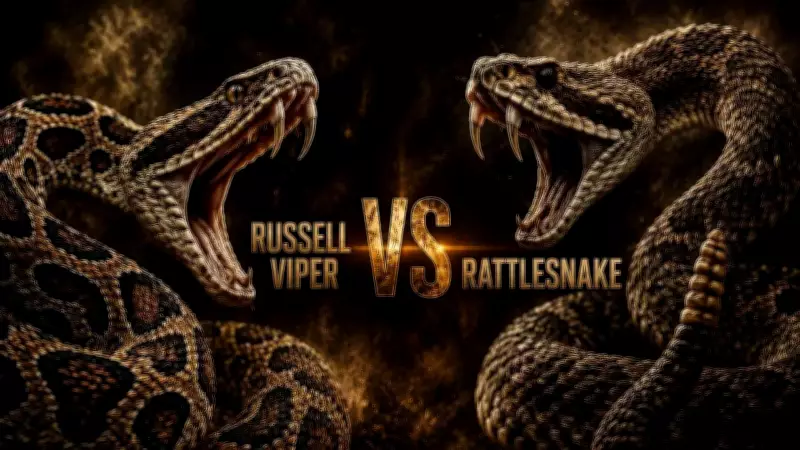
Venomous snakes often inspire a mixture of fascination and caution, but not all of them are built in the same way. The Russell's viper and the rattlesnake are good examples. Both belong to the viper family and rely on venom to subdue prey, yet they evolved on different continents and adapted to very different environments. One is widely distributed across South Asia and is frequently associated with agricultural landscapes and rural settlements. The other is native to the Americas and is recognised around the world for the distinctive rattle at the end of its tail. Their appearances, hunting methods and defensive behaviours may differ, but each occupies an important place in the ecosystems it inhabits.
Russell's Viper vs Rattlesnake: What sets these venomous snakes apart
| Parameter | Russell's viper | Rattlesnake |
|---|---|---|
| Scientific name | Daboia russelii | Crotalus and Sistrurus species |
| Geographic range | South Asia | North and South America |
| Average length | 1–1.7 metres | 0.6–2.4 metres depending on species |
| Body build | Thick and heavily built | Muscular and robust |
| Distinctive feature | Chain-like oval markings | Tail rattle |
| Habitat | Grasslands, scrublands and farmland | Deserts, forests, grasslands and rocky areas |
| Hunting style | Ambush predator | Ambush predator |
| Venom type | Primarily haemotoxic | Mostly haemotoxic, though some species possess neurotoxic components |
| Heat-sensing pits | Absent | Present |
| Main prey | Rodents, lizards and small mammals | Rodents, birds, rabbits and small mammals |
| Defensive behaviour | Loud hissing and rapid strikes | Rattling warning display |
| Activity pattern | Mostly nocturnal | Mostly nocturnal or crepuscular |
| Reproduction | Live-bearing | Mostly live-bearing |
| Human encounters | Common near settlements and farms | Common in rural and wilderness areas |
| Conservation status | Least Concern | Varies by species |
Russell's Viper vs Rattlesnake: From venom to behaviour, how they differ
Size and physical build
Both snakes have thick bodies compared with many other species, though they achieve their size in slightly different ways. Russell's vipers tend to appear especially heavy for their length, with broad heads and stout bodies that give them a powerful appearance. Rattlesnakes vary considerably because the term refers to dozens of species. Some remain relatively small, while others can grow well beyond two metres. Even so, most share a muscular build suited to striking quickly and overpowering prey before it can escape.
Habitat and distribution
The Russell's viper is found across much of the Indian subcontinent and neighbouring regions. It is remarkably adaptable and can live in open countryside, agricultural land, scrub vegetation and areas close to villages. This proximity to people has made it one of the best-known venomous snakes in Asia. Rattlesnakes occupy an enormous range stretching from southern Canada to parts of South America. Depending on the species, they may inhabit deserts, forests, grasslands, rocky slopes or semi-arid landscapes. Few venomous snake groups are as geographically diverse.

Appearance and identification
Russell's vipers are instantly recognisable because of the large dark oval markings that run along their bodies. These patterns often resemble a chain of linked spots and help break up the snake's outline against dry vegetation and soil. Rattlesnakes are more varied in colour and pattern, but all possess their famous tail rattle. Made from interlocking segments of keratin, the structure produces a buzzing sound when shaken rapidly. It serves as one of the most distinctive warning signals in the animal kingdom.

Hunting strategy
Neither snake spends much time chasing prey. Instead, both rely on patience. A Russell's viper may remain motionless for long periods before launching a sudden strike at an unsuspecting rodent or small animal. Its camouflage allows it to blend surprisingly well into its surroundings. Rattlesnakes employ a similar approach. Many species position themselves near trails or feeding areas used by rodents and wait for an opportunity. Once prey comes within range, the strike is often over in a fraction of a second.
Venom and bite
The venom of a Russell's viper is considered among the most medically significant in Asia. It primarily affects the blood and circulatory system, though serious complications can extend far beyond the initial bite. Rattlesnake venom varies between species. Most possess venom that damages tissue and affects blood clotting, while a few species contain stronger neurotoxic elements. In both cases, venom evolved primarily for hunting and digestion rather than defence.
Sensory abilities
One of the clearest differences between these snakes involves how they detect prey. Rattlesnakes belong to the pit viper group and possess specialised heat-sensing organs located between the eyes and nostrils. These structures allow them to detect the body heat of warm-blooded animals, even in near darkness. Russell's vipers do not possess these obvious heat-detecting pits. Instead, they rely more heavily on scent, vibration and visual cues when navigating their surroundings and locating prey.
Defensive behaviour
When threatened, Russell's vipers often react with a loud, prolonged hiss. The sound can be surprisingly forceful and serves as a warning before the snake decides whether to strike. Rattlesnakes use a different strategy. Their tail rattle acts as an advanced warning system, alerting larger animals before physical contact occurs. In many situations, this allows both the snake and the potential threat to avoid a dangerous encounter.
Relationship with humans
Human encounters occur regularly with both snakes, though the circumstances differ. Russell's vipers are frequently encountered in farming regions where rodents are abundant. Their tendency to live close to cultivated land increases the likelihood of accidental encounters. Rattlesnakes are often found in wilderness areas, though expanding development has brought people into closer contact with them in many regions. Most bites occur when snakes are accidentally stepped on, disturbed or deliberately approached.
Conservation status
Russell's vipers remain widespread across much of their range and are generally not considered globally threatened. Local pressures such as habitat change and persecution can still affect populations in certain areas. The conservation picture for rattlesnakes is more complex. Some species remain common, while others face pressures from habitat loss, road mortality and human persecution. Their status depends largely on the species and location involved.
Russell's viper vs rattlesnake: The ultimate venomous snake match-up
A confrontation between a Russell's viper and a rattlesnake exists only as a hypothetical scenario. These snakes evolved on separate continents and would never naturally encounter one another in the wild. The outcome would depend heavily on the rattlesnake species involved, as sizes vary greatly across the group. Russell's vipers possess powerful venom, sturdy bodies and a reputation for rapid defensive strikes. Rattlesnakes bring their own advantages, including specialised heat-sensing organs and, in some species, a larger overall size. In reality, neither snake evolved to battle rivals of comparable size. Their strengths lie in ambush hunting and survival rather than combat. If such an encounter somehow occurred, factors such as size, positioning and timing would probably matter more than any single advantage. The comparison ultimately highlights two highly successful predators that arrived at similar solutions through different evolutionary paths.