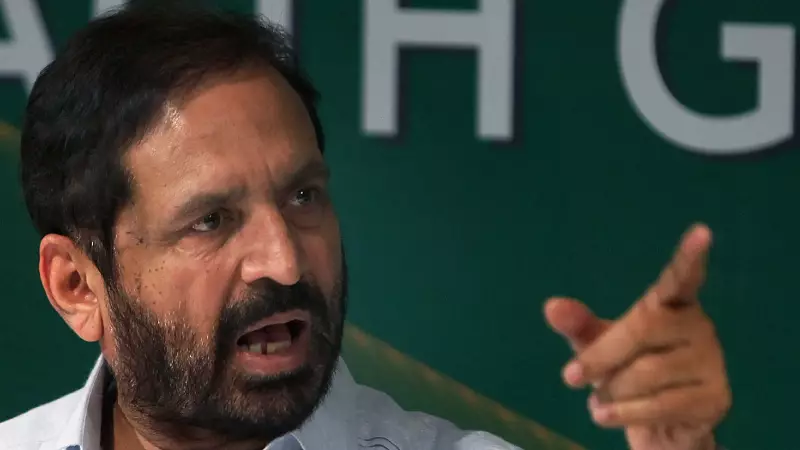
Suresh Kalmadi, a towering yet deeply controversial figure in Indian sports administration, passed away in Pune on Tuesday at the age of 81. His death marks the end of an era for an administrator who was both a visionary pioneer and a central figure in one of India's biggest sporting scandals.
From Air Force Officer to Sports Czar
Kalmadi's journey in sports governance began in earnest in 1987 when he was elected President of the Athletics Federation of India (AFI), a position he held for an impressive 19 years. His influence expanded significantly in 1996 when he took over as the chief of the Indian Olympic Association (IOA), beginning a 15-year uninterrupted tenure. Holding both powerful positions simultaneously, he wielded unprecedented control over Indian sport for nearly two decades.
A former Indian Air Force officer (1964-1974) and a multiple-term Lok Sabha and Rajya Sabha MP, Kalmadi used his political acumen to elevate India's sporting profile. As AFI president, he orchestrated a series of eight major international track and field events in New Delhi between 1989 and 1998. This included bringing the Asian Athletics Championships to India for the first time in 1989 and launching the Asian Grand Prix in 1990.
His most notable coup was convincing global icon Carl Lewis to compete in India, paying substantial appearance fees to boost the sport's visibility. He also later served as the President of the Asian Athletics Association.
The Builder and the Visionary
Colleagues and contemporaries often described Kalmadi as a resourceful and hard-driving administrator. Lalit Bhanot, who served as Secretary General of the 2010 Commonwealth Games Organising Committee under Kalmadi's presidency, called him a "visionary."
"He brought about positive changes in Indian sport, including the hosting of the Commonwealth Games, the Afro Asian Games and the National Games regularly," Bhanot told The Indian Express. "He was a hard taskmaster, ensuring work was completed on time."
Kalmadi is credited with reviving the National Games, which had stalled for six years after 1987. Under his stewardship, the Games were held at regular intervals in cities like Pune, Bengaluru, Chandigarh, Hyderabad, and Manipur. This initiative was not just about competition; it forced the creation of sporting infrastructure in regions, including disturbed areas like Manipur and Assam, leaving a physical legacy for future athletes.
His tenure also saw India host multi-disciplinary spectacles like the 2008 Commonwealth Youth Games in Pune and the crowning event, the 2010 Commonwealth Games in New Delhi. On the field, the 2010 Games were India's most successful ever, with the nation winning a record 101 medals, including 38 gold.
The Irrevocable Stain of Scandal
However, the spectacular success of the 2010 Games was soon overshadowed by allegations of massive corruption, financial irregularities, and organisational failures within the Kalmadi-led Organising Committee. What was meant to be his greatest achievement rapidly became his downfall.
The scandal left a legal quagmire so vast that, a decade after the Games, more than 50 related cases were still pending in various courts and arbitration. Kalmadi was arrested in April 2011 and spent nine months in prison before being released on bail.
The controversy forever stained his earlier contributions, making him a divisive symbol of both sporting ambition and administrative graft. In a significant turn, the Enforcement Directorate filed a closure report in the case in April 2025, giving him a clean chit, though the court of public opinion had long delivered its verdict.
Suresh Kalmadi's legacy is thus permanently split. He was the administrator who recognized the potential of Olympic sport in India, built foundational events, and brought world champions to Indian shores. Yet, he is also indelibly linked to the 2010 Commonwealth Games scandal, a episode that exposed deep flaws in India's sporting governance. His story remains a complex parable of ambition, achievement, and the profound consequences of scandal.