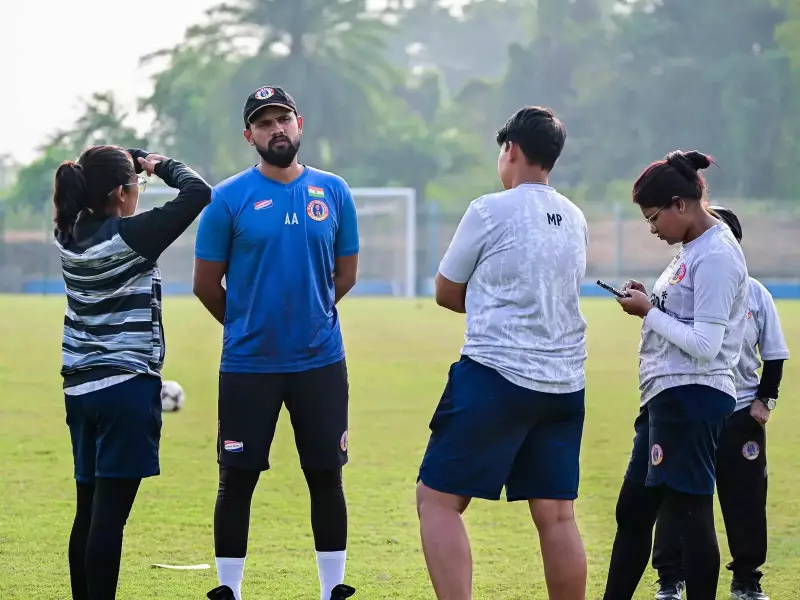
For Anthony Andrews, the young coach of East Bengal FC's women's team, the final whistle of their AFC Women's Champions League group stage campaign brought a whirlwind of conflicting emotions. His team had just scripted history by becoming the first Indian club to win a match in the competition's group stage. Yet, a stoppage-time goal conceded against PFC Nasaf cruelly dashed their dreams of a quarterfinal berth, leaving the squad and its leader in a state of proud anguish.
A Landmark Season and a Bitter-Sweet Continental Debut
Speaking to TOI over a video call, Andrews reflected on the monumental journey. "There are a lot of mixed feelings, but I'm happy for what we have achieved in our first year at the club," he stated. The 29-year-old coach, who was signed from Gokulam Kerala FC after a protracted six-month negotiation involving a transfer fee—a first for Indian women's football—has delivered spectacularly. In his debut season, East Bengal clinched the Indian Women's League (IWL) and the Kanyashree Cup, navigated the Champions League preliminary rounds, and finished as the ninth-best team in Asia.
"It was not an easy task for all of us to do this in the first year," Andrews emphasised, acknowledging the scale of the achievement. The continental campaign served as a stark reality check on the gulf between Indian clubs and Asia's elite, a gap Andrews had experienced firsthand. In 2023, his Gokulam Kerala side conceded eight goals to Japan's Urawa Red Diamonds. This context made East Bengal's measured expectations—aiming for third in their group—seem pragmatic.

The Rollercoaster Ride in the Group of Death
East Bengal's campaign ignited with a stunning 3-1 victory over Iran's Bam Khatoon FC, a historic result that announced their arrival on the big stage. A subsequent 0-2 loss to defending champions Wuhan Jiangda Women's FC from China was expected. The final matchday scenario was clear: a defeat by no more than two goals against Uzbekistan's PFC Nasaf would see them through to the knockout stages alongside Wuhan.
For large parts of the crucial clash, East Bengal held firm, inching towards a historic qualification. However, football can be brutally unforgiving. In stoppage time, Nasaf found a third goal, shattering East Bengal's dream at the death. That single moment was the thin line between a historic quarterfinal and a heart-wrenching exit.
Lessons Learned and the Road Ahead
Andrews was analytical in his post-mortem, pointing to areas needing development. "Honestly, this is the quality that we have. We lack in a lot of areas, which we cannot deny," he admitted, highlighting decision-making and game management under pressure. "The regret will linger... It's just that the players lack experience (of playing such big games)."
He specifically rued the final eight minutes against Nasaf, where attempts at defensive substitutions and time-wasting couldn't prevent the decisive blow. However, the coach sees this painful experience as a vital catalyst for growth. The team is now focusing on defending their IWL title, with Andrews pledging to integrate better game management into training routines.
"These results will push us to do better because the tournament provided us with a reality check not only for the players but also the coaching staff, including me," Andrews concluded. He expressed pride in the culture and environment built at the club, vowing that if they return to the Asian stage next season, they will be better equipped. For Indian women's football, East Bengal's bittersweet campaign has set a new benchmark, proving that with the right support and structure, competing on the continent is no longer a distant fantasy.