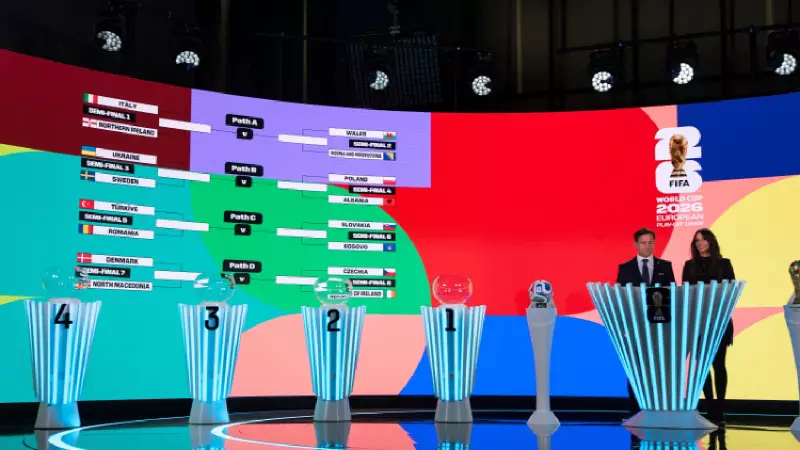
The stage is set for the grandest spectacle in football history. The FIFA World Cup 2026, to be jointly hosted by the United States, Mexico, and Canada, will feature an unprecedented 48 teams, promising a global festival of the sport. With six months to go before the action kicks off, the immediate focus is on the official draw, a complex procedure that will shape the tournament's initial phase.
The Mechanics of the Mega Draw
The draw ceremony, akin to the UEFA Champions League model, will see the qualified nations divided into four pots of 12 teams each. These pots are based primarily on the latest FIFA world rankings. Each of the 12 groups—labeled A through L—will be formed by randomly selecting one team from each pot, ensuring a balanced distribution of seeding.
Pot 1 contains the top seeds, which include the three host nations—USA, Mexico, and Canada—alongside the highest-ranked qualified teams. This seeding means the hosts will avoid early clashes with powerhouses like Argentina, England, France, and Brazil, who are also in Pot 1. As of the draw, 42 teams have officially booked their tickets, leaving six spots to be decided in the playoffs scheduled for March 2026.

The Unresolved Playoff Picture and Pot 4
The biggest storyline heading into the draw is the identity of the six remaining teams. Four-time champions Italy stand as the most notable name yet to qualify, placed in the high-stakes UEFA Playoff A bracket alongside Northern Ireland, Wales, and Bosnia-Herzegovina. In total, four European slots will be filled via UEFA playoffs, while two additional global spots will be decided in separate FIFA playoffs.
Consequently, Pot 4 will feature six placeholder balls labeled "UEFA Playoff A," "UEFA Playoff B," "UEFA Playoff C," "UEFA Playoff D," "FIFA Playoff 1," and "FIFA Playoff 2." The actual names of these teams will only be known after the playoff matches conclude in March. The playoff contenders include nations like Ukraine, Sweden, Poland, Denmark, Jamaica, and Iraq, all fighting for a last-gasp entry.
Group Stage Rules and Tournament Structure
FIFA has instituted specific rules to ensure geographic diversity in the group stage. No group can contain more than two European teams. Furthermore, for all other confederations (like AFC, CAF, CONCACAF), no two teams from the same confederation can be drawn together. This means Brazil cannot face Uruguay, nor can Japan be grouped with Uzbekistan in the initial stage.
The expanded format means the top two teams from each of the 12 groups will automatically advance to the knockout stage. They will be joined by the eight best third-placed teams, determined by points, goal difference, and goals scored. This creates a 32-team knockout bracket, featuring a Round of 32, followed by Round of 16, quarterfinals, semifinals, and the final.
The draw is also designed to keep the top four ranked teams—currently Spain, Argentina, France, and England—apart until the later stages of the tournament. Fans hoping for epic clashes between these titans in the group stage will have to wait for the knockout rounds.
The confirmed pots for the draw are as follows:
Pot 1: Spain, Argentina, France, England, Brazil, Portugal, Netherlands, Belgium, Germany, United States, Mexico, Canada.
Pot 2: Croatia, Morocco, Colombia, Uruguay, Switzerland, Japan, Senegal, Iran, South Korea, Ecuador, Austria, Australia.
Pot 3: Norway, Panama, Egypt, Algeria, Scotland, Paraguay, Tunisia, Ivory Coast, Uzbekistan, Qatar, Saudi Arabia, South Africa.
Pot 4: Jordan, Cape Verde, Ghana, Curaçao, Haiti, New Zealand, plus the six playoff winners.
This new 48-team format guarantees a wider representation, with nations like Curaçao and Haiti making historic appearances, setting the scene for a truly unique and unpredictable World Cup in North America.