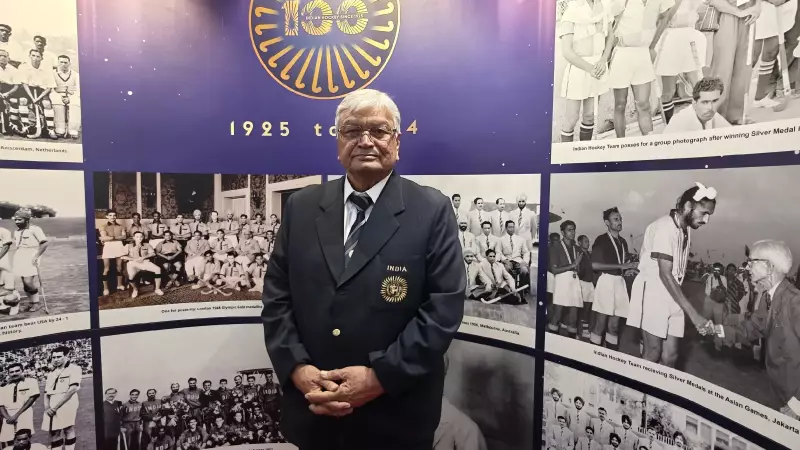
As the centenary celebrations of Indian hockey unfolded at New Delhi's Dhyan Chand Stadium, hockey legend Aslam Sher Khan found himself transfixed by a historic photograph - the 1936 gold medal-winning team that included his father, Ahmed Sher Khan. For Khan, this wasn't just a moment frozen in time, but a living connection to family history and one of Indian sport's most legendary achievements.
The Berlin Olympics: Where History Was Made
The 1936 Berlin Olympics hold a special, almost mythical place in Indian hockey's 100-year journey. August 15, 1936, marked a defining moment when the Indian hockey team, already two-time consecutive Olympic champions, faced host nation Germany in a waterlogged final before 20,000 spectators and Adolf Hitler himself.
Aslam Sher Khan, himself a 1975 Hockey World Cup winner, shared fascinating insights passed down from his father. "The 1936 Olympics were a crazy one as compared to others," Khan recalled. "My father would term it as 'voltage' and tell me that Germany wanted to show the world that they are superior and hosting the Olympics was one of the ways of exerting that soft power."

The Road to Gold: Challenges and Triumphs
India entered the Berlin Games as firm favorites, having won gold at the 1928 Amsterdam and 1932 Los Angeles Olympics. The star-studded squad featured legendary names including captain Dhyan Chand, Sayed Jaffar, Edward Goodsir-Cullen, Roop Singh, Ahmed Sher Khan, Carlyle Tapsell, and Mirzapur Masood.
However, the title defense didn't begin smoothly. The team suffered surprising losses in practice matches, including a 4-1 defeat to Delhi XI before departure and another 4-1 loss to a German XI upon arrival. Khan revealed how these setbacks galvanized the team: "My father said that the loss hit a nerve among his teammates and they decided to fully commit to the game with strict meals and bedtime routine in that era when the concept of workload management didn't even exist."
The Indian team quickly found their rhythm, bulldozing through the group stage with impressive victories:
- 4-0 against Hungary
- 7-0 against United States
- 9-0 against Japan
After decimating France 10-0 in the semi-final, India set up a climactic final against hosts Germany.
The Legendary Final: Dhyan Chand's Barefoot Brilliance
The final, originally scheduled for August 14, was postponed due to incessant rain, forcing many spectators to remain around the stadium overnight. What unfolded the next day became part of sporting folklore.
With the pitch waterlogged and India leading just 1-1 at halftime, captain Dhyan Chand made a tactical decision that would define the match. He removed his spiked shoes and stockings and returned to the field barefoot. The transformation was immediate and spectacular.
Khan clarified the actual goal scorers in the historic 8-1 victory:
- Dhyan Chand: 3 goals
- Ali Dara: 2 goals
- Roop Singh: 1 goal
- Carlyle Tapsell: 1 goal
- Sayed Jaffar: 1 goal
"Such was the class of the man," Khan reflected. "One of the reasons he is the greatest is that, apart from skills, he was the student of the game who knew what to do in different situations. Knowing that the ground was damp, he improvised, and India scored seven goals once he did that."
Contemporary reports highlighted Germany's determination, noting that the German team had undergone two years of assiduous practice specifically to challenge India's dominance. The Malaya Tribune reported an attendance of 20,000 spectators, while Reuters described the stadium as "filled to its capacity."
A Legacy of Commitment
As Aslam Sher Khan gazed at the historic team photograph during the centenary celebrations, he reflected on the enduring legacy passed down by that legendary team. "All they gave us in legacy was commitment," he sighed, "and we tried our best to honour it."

The 1936 gold medal represented India's third consecutive Olympic gold and the last before Independence, making it a pivotal moment in both sporting and national history. The stories passed from father to son, from generation to generation, continue to inspire new chapters in Indian hockey's rich tradition.