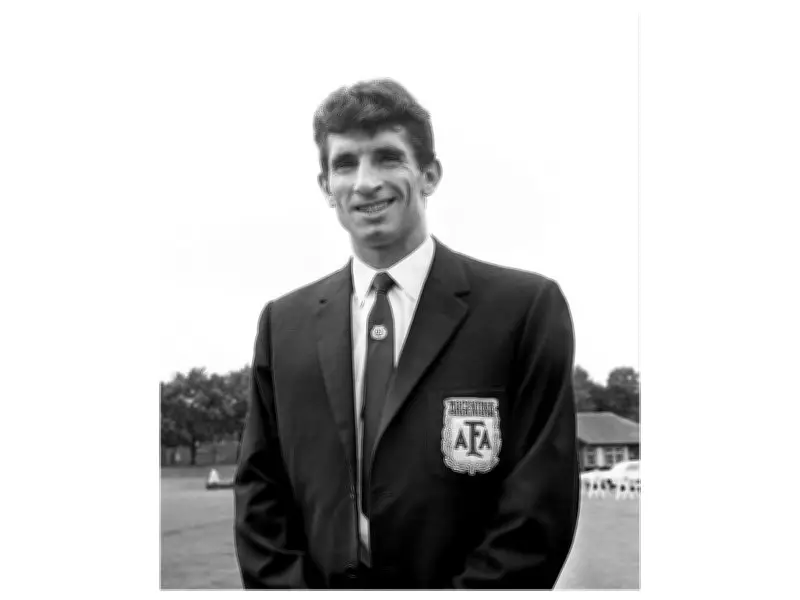
Antonio Rattin, the former Argentina international midfielder and Boca Juniors legend, died on Saturday at the age of 89, the Argentine club announced. Rattin is widely regarded as one of Argentina's finest midfielders and a symbol of Boca Juniors, where he spent his entire club career.
Boca Juniors Mourns the Loss of an Idol
Boca Juniors expressed their grief in a post on X, stating, "With great sorrow, we mourn the passing of Antonio Ubaldo Rattin, an idol and symbol of our institution. We stand with his family and loved ones at this difficult time. Farewell, Rata." The club's tribute highlighted his status as a revered figure in Argentine football.
Rattin made 382 appearances for Boca Juniors between 1956 and 1970, scoring 28 goals. During his tenure, he helped the club secure four Argentine league titles and played a pivotal role in Boca's run to the 1963 Copa Libertadores final.

International Career and World Cup Controversy
At the international level, Rattin represented Argentina from 1959 to 1969, featuring in the 1962 and 1966 FIFA World Cups. He is perhaps best remembered for one of the most controversial moments in World Cup history during Argentina's 1-0 quarterfinal defeat to hosts England at the 1966 tournament.
After being sent off by German referee Rudolf Kreitlein, Rattin refused to leave the field immediately, arguing that he did not understand the referee's decision as it was not communicated in Spanish. As he exited the pitch, he crumpled an England corner flag and sat briefly on a red carpet reserved for Queen Elizabeth II. This gesture became one of the defining images of the tournament, according to Reuters.
Post-Retirement Life
After retiring as a player, Rattin had a brief spell as Boca's coach in 1980 before serving as a member of Argentina's lower house of Congress for a centre-right political party. His legacy as a footballer and public figure remains significant in Argentine sports history.
Rattin's death marks the end of an era for Argentine football, as he was one of the last surviving icons from the golden age of Boca Juniors and the national team.