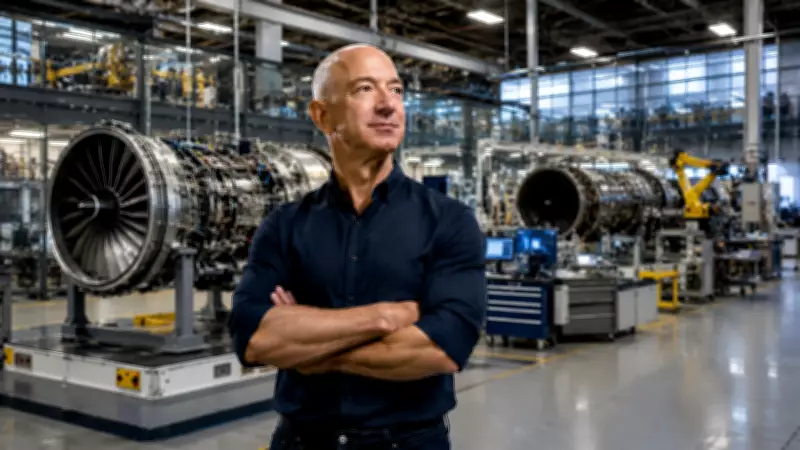
Jeff Bezos is making one of the biggest bets in artificial intelligence history, and it has little to do with chatbots. On 11 June 2026, the Amazon founder and scientist-entrepreneur Vikram 'Vik' Bajaj brought their startup Prometheus out of stealth mode with a blockbuster $12 billion funding round that valued the company at roughly $41 billion.
What is Prometheus?
Prometheus is a new AI startup co-founded by Bezos and Bajaj, a former Google Life Sciences executive and biotechnology entrepreneur. Unlike many AI companies focused on digital assistants and content generation, Prometheus is targeting the physical world. The company wants to develop an 'artificial general engineer', or AGE, capable of assisting with every stage of product development, including design, testing, manufacturing and optimisation of highly complex systems. The vision is to create AI that understands not only information but also the real-world constraints of physics, materials, production processes and engineering requirements.
Why Bezos is Betting on Engineering
The AI industry has been dominated by companies building chatbots, search assistants and content-generation tools. Bezos believes a much larger opportunity exists in applying AI to engineering and manufacturing. Prometheus hopes its technology can help accelerate the development of products that traditionally take years to design and build. Potential applications include aircraft engines, medical equipment, industrial machinery, consumer electronics, infrastructure projects and even future spacecraft. The company sees AI as a tool that can dramatically shorten development timelines while helping engineers solve increasingly complex problems.

Bezos on AI and Jobs
One of the most widely discussed aspects of the launch was Bezos's view on jobs. While many economists and technology leaders have warned that AI could replace millions of workers, Bezos argued that the technology could ultimately have the opposite effect. 'I don't think we're going to have enough people,' he said during interviews surrounding the announcement. According to Bezos, AI will make workers significantly more productive, allowing companies to create more products and services. Rather than eliminating work, he believes AI could increase economic activity and create demand for more workers. To explain the idea, Bezos compared AI to giving workers a bulldozer instead of a shovel. The technology, he argued, will amplify human capabilities rather than simply replace them.
Bezos on AI Regulation
Bezos also weighed in on one of the biggest debates in technology: how AI should be regulated. Using a simple analogy, he compared AI to a knife, noting that the same tool can be used for both beneficial and harmful purposes. He argued that policymakers should focus on regulating harmful applications rather than attempting to restrict the infrastructure that powers AI systems. In Bezos's view, AI should be governed in a way similar to other powerful technologies, with oversight focused on how it is used rather than on preventing its development altogether.
The $12 Billion Funding Round
Prometheus's funding announcement immediately made it one of the most valuable private AI companies in the world. The $12 billion raise reflects strong investor confidence in the company's long-term vision, despite the fact that it has not yet publicly demonstrated its technology. The funding also highlights how fiercely competitive the AI race has become as investors search for the next breakthrough beyond chatbots and large language models. For Bezos, the investment represents a belief that the next major AI revolution may happen in factories, laboratories and design studios rather than on smartphone screens.
What's Next for Prometheus?
Prometheus remains highly secretive, and many details about its technology have yet to be revealed. The company has not publicly demonstrated its artificial general engineer or provided a timeline for when such a system might become available. Still, the startup's ambitions are enormous. If Prometheus succeeds, it could reshape how products are designed, tested and manufactured across industries ranging from aerospace and healthcare to construction and advanced manufacturing.