

Every time Class 12 student Tashvi Berry opened her English literature book to study American poet Adrienne Rich's 12-line metaphor-drenched rage against patriarchy, the famous opening lines made absolutely no sense. For the 17-year-old with learning disabilities, who had the poem for her CBSE Class 12 boards, the struggle with poetic devices like juxtaposition, symbolism, and irony felt like a losing battle.
AI as a Personal Tutor
Classroom teaching did little to break down the poem, and even private tutors couldn't help. But Tashvi turned to ChatGPT as a last resort, and it was an eye-opener. The AI explained the entire poem line by line, teaching her symbolism through action. It revealed that Aunt Jennifer was sewing tigers on cloth, embroidery being her mode of self-expression as a woman trapped in marriage. ChatGPT explained each metaphor, the importance of words like 'Uncle', how questions could be framed in exams, and what answers should look like.
Once she cracked it, Tashvi used AI for 'The Third Level', a short story on escapism. The AI helped her make notes in simple language and bullet points. She kept turning to AI for conceptual doubts, such as painting theory and Rajasthani art. The Delhi-based student cleared CBSE Class 12 with 87%, a big improvement from her Class 10 score of 70%.

AI as a Supplement to Classroom Learning
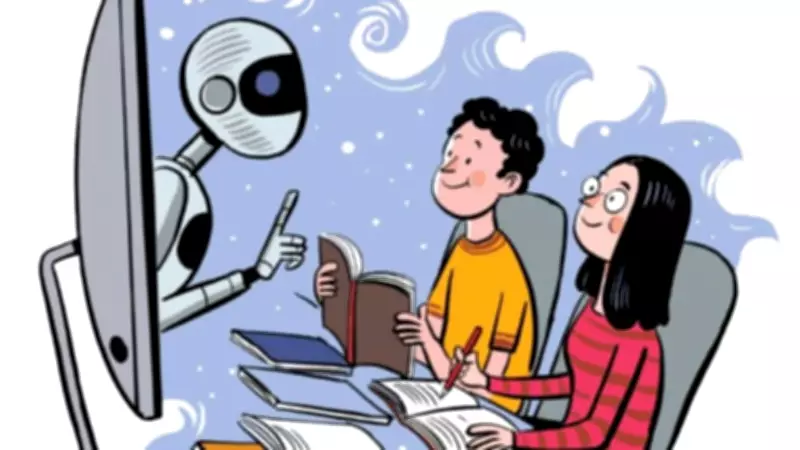
Since the AI boom, its use in schools has been controversial, especially when students used it as shortcuts or copied AI-generated answers. But the latest CBSE batch shows examples of AI being used well—as a mentor to supplement classroom learning and improve exam performance.
Aditi Mishra, scoring 99.2%, said AI played a supporting role by summarizing long chapters. 'Classroom teaching is irreplaceable,' she said, 'but AI can be used for assistance and revision.' Priya Singh, daughter of a bus driver, scored 97% without resources for tuitions or reference books. 'AI became my reference book and tutor,' she said. She used ChatGPT to research the Mandal Commission for political science, getting the full picture and its importance in reservation. She also prompted AI to explain history and home science topics like a teacher would to a beginner.
Nisha Solanki, scoring 98.2%, used AI to understand why voting patterns change and how electoral verdicts reflect social and political shifts. Gemini explained trends with examples and comparisons, making her answers better. She also used it to understand Sigmund Freud's theories for psychology. Nisha cautioned that meaningful AI use requires foundational understanding: 'Teachers build that basic foundation. AI only works if you know how to give the right prompts.'
AI for Mathematics and Exam Practice
Aarya Jain, who scored 60 in Class 11 maths, used AI to master integral calculus. AI solved problems step by step, showed alternative methods, and explained mistakes, helping her improve to 85 at the boards. Gunjan Chauhan used AI to create and evaluate mock tests, uploading answers for suggestions on structure and weaknesses. Aishwarya Pandey used AI to generate a structured daily timetable by entering school hours, study time, rest, and hobbies.
Shreyash Srivastava, scoring 98.4%, used AI for organic chemistry. AI explained reactions visually and logically, providing quick explainers with examples. 'To stand out, you need extra conceptual clarity,' he said.
Educators' Perspective
Educators welcomed meaningful AI use but cautioned against over-reliance. Aditi Basu, president of All India Principals Association, said AI tools support learning but shouldn't replace teachers. She advised cross-checking information due to potential inaccuracies. Ritu Srivastava, principal of Sri Chaitanya School, noted AI helps teachers create mock tests and lesson plans quickly, but warned about lack of 'human touch' in student answers. Seema Jerath of DLF Public School observed improved confidence in students using AI, but stressed the need for teacher guidance.






