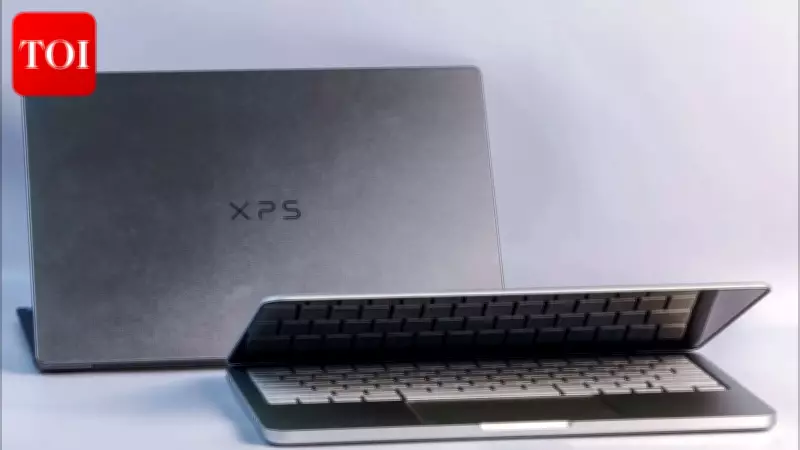
The new Dell XPS 13 weighs a kilogram. When you pick it up, your wrist over-corrects because the brain expects more resistance. The chassis is 12.7mm thin, made of CNC aluminum—a construction Dell has used for years. Four screws on the base. Parting lines so precise you have to angle the lid against the light to find them. It is the XPS as you know it, but now starting at $699 (approximately Rs 65,000).
Why the Price Drop?
You may ask: what? That is how I and everyone I have told about it have reacted. But why an XPS at one-third of the previously cheapest XPS? Because of Apple. Enter the MacBook Neo, and every Windows laptop in this price range starts to look like a compromise. The Neo is not doing much different, other than having an iPhone chip—that has been its headliner—plus the aluminum shell, colors, and macOS. All the Apple shenanigans at a lower price point.
That is the point. The MacBook Neo brings the "Apple experience" to a shelf that has never had it. The $600-to-$800 laptop has been Windows by default for as long as laptops have been a category. Apple's cheapest had never been Windows-cheap. People still buy Windows laptops at this price—they have been, they will. But whatever has been on the shelf in the past three months could not survive a side-by-side with the Neo. Most had crept up enough that they were not really at this price anymore.

That is the market Computex opened into this week. The biggest show on the calendar, Taipei all week, and Dell has brought its new XPS 13 to it. Not because it is an XPS, but because of where it sits on the shelf now.
Design and Build
The lid tapers a little tighter than past XPS models. The keyboard deck sits lower into the chassis. The slots on the bottom edge double as both intake vents and downward-firing speaker grilles. There are four screws on the base where there would usually be more. Parting lines are pulled in tight enough that you have to angle the lid against the light to find them. The design does not draw attention to itself—which at this price usually means there is not much to draw attention to. Here, it means Dell did not need to.
Two colors are available: Sky, a cool pale silver that drifts off-white under warm light, and Storm, graphite with some warmth running through it. Sky photographs better, but Storm is the one I would actually carry out.
Lift the lid. The display is 13.4 inches, 2.5K resolution, 30 to 120Hz variable refresh rate, 500 nits brightness, full DCI-P3 color gamut, touch support, and anti-glare coating. The number that lands first in use is 120Hz. Windows ultraportables at this price have been stuck at 60Hz for so long that even basic scrolling on this panel reads as a category jump.
Keyboard and Trackpad
The keyboard has gone back to a traditional islanded chiclet design, after two generations of Dell pushing zero-lattice across the line. I did not mind the lattice, but plenty of people did. The new layout has 0.8mm of key travel, real spacing between the keys, and a backlight that reads ambient light and adjusts automatically. It types soft and quiet. Whether you will prefer it over the lattice depends on what you got used to, but the chiclet is the safer call at a price where buyers are least likely to want to learn a new keyboard.
Below it, the trackpad is glass, multi-touch, and windowed—a visible boundary around the pad rather than the seamless surface on the bigger XPS models. It uses a diving-board click instead of haptic feedback. At this price, that is fair. Which is when you notice the MacBook on the same table.
Comparison with MacBook Neo
The MacBook Neo weighs 2.7 pounds. The XPS weighs 2.2 pounds—half a pound difference. Sounds like nothing, but hold both in succession and it stops sounding like nothing. The Neo on its own is light. The Neo after the XPS feels like a laptop. The XPS is a notebook someone slipped into your bag without telling you.
Optics do the rest. The numbers say both laptops are about the same thickness. The eye says otherwise. The XPS hides its hinge better and the deck sits lower. That is the kind of design work that does not show up on a spec sheet but shows up in the hand.

The displays widen the gap. The Neo is 60Hz with no touch. Pull up the same webpage on both. Your eyes find the 120Hz first. Then they find the bezels, which on the Neo are not bad until the XPS is sitting next to them.
The smaller things stack. The XPS keyboard is backlit; the Neo's at this tier is not. Face unlock works on the XPS but not on the Neo. Touch ID is a $100 upgrade. The trackpad on both is a diving-board click—the haptic pad you get on pricier MacBooks is not here—and the XPS's larger windowed glass surface is nicer to use. The XPS supports Wi-Fi 7, while the Neo supports Wi-Fi 6E.
None of these wins a comparison alone. Stacked, they are the difference between a Windows laptop that looks smaller next to a MacBook and one that does not.
What the MacBook Neo Still Offers
macOS is a big one. Nothing on the XPS argues with it, and nothing on the XPS is built to. The OS still gets the app it wants first—every serious creative tool, every productivity suite, every developer workflow has a macOS build that is either the lead version or near enough. The system itself asks for less. No driver updates that ask permission three times. No background processes you have to learn the names of. You open it and use it.
Then there is the rest of the kit. An iPhone or iPad already in the bag means files, calls, messages, and Wi-Fi passwords land where you need them without anyone asking. The ecosystem is not a feature list; it is an absence of friction. The XPS lives in the Windows version of all of this, which works, but works the way Windows works—you do some of the lifting.
And the Neo is still a Mac. Aluminum, apple on the lid, the whole thing. Whatever the price says, what you are carrying around is a MacBook, and that does work in a classroom or coffee shop in a way no Windows laptop does. None of which has anything to do with what is actually inside either machine.
About the 8GB RAM
The base configuration ships with 8GB of RAM and a six-core Intel Core 5 320 from the Wildcat Lake family. On Windows 11 in 2026, 8GB is the kind of number that gets a laptop priced, not the kind that gets it used. A few Chrome windows, Slack open, a Teams call running, and you will feel the laptop deciding which app gets to be alive next.
8GB is also what the Neo gives you, with no option to step up. Only storage scales. It is not generous there either, but macOS handles memory more tightly than Windows 11 does, and 8GB on a Mac feels different from 8GB on a Windows machine. The XPS does not get that cushion. The 16GB step-up is the configuration to actually buy. The 8GB is what they advertise. The 16GB is what you buy.
The chip itself is a separate question. Wildcat Lake is Intel's low-power family, efficient rather than muscular, built for thin-and-light bodies that do not want to deal with heat. That is the base. Step up the XPS and the chip changes too. The higher configurations get Intel's Core Ultra 7 355, and the laptop scales with it. The Neo does not have that range. It sits on a single chip.
The A18 Pro on the Neo is not an M-series chip. It is the silicon that ran last year's iPhone Pro before Apple put it in a laptop. Same architectural family as the M-series, and the track record to show for it. Still a phone chip, though, on an entry-level laptop. Neither it nor the XPS (the $699 one) is going to feel slow on day-to-day work. The XPS has two fans. The Neo does not.
Ports and Connectivity
The ports are tier-dependent, which is mildly irritating. The Intel Core variant gets two USB-C ports with DisplayPort 2.1 and power delivery. The Intel Core Ultra 7 355 variant gets the same two ports as Thunderbolt 4. Same hole, different speed, depending on what you spent. No headphone jack. No SD slot. No HDMI. All of which is downstream of one thing.
The Shelf, Three Months Later
For three months, the Windows side did not have an answer worth taking to a press table. The XPS 13 is the first laptop to walk up to the table Apple set in March and put something on it that does not look out of place. $599 for students, $699 for everyone else, in a band that used to belong to Windows by default. That is $100 over the Neo, and the XPS does enough to justify it. Which is not the same argument as winning a MacBook buyer over.
It is not a Mac killer. Nobody buying a MacBook is probably getting talked out of it by a thinner aluminum shell and a 120Hz panel. They are buying macOS and an ecosystem. None of that has changed. Microsoft is building a Windows ecosystem of its own. The MacBook buyer is not waiting for it.
What has changed is that the answer to "what is the best laptop at this price" is not automatic anymore. In a segment Windows used to own, it is a question again. And Dell is not the only one. A run of $699 Windows laptops is on the way, all chasing the same shelf.