

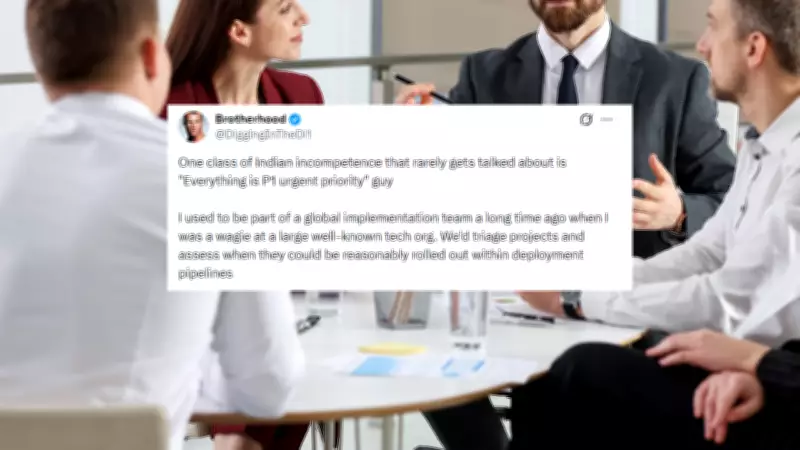
As digital discussions surrounding race and professional capability intensify across social platforms, a software engineer based in New York has taken a firm stand against what he describes as unfounded stereotypes directed at Indian professionals within the technology sector.
Engineer Counters Anonymous Allegations on Social Media
John Freeman, a software engineer employed at the prominent hedge fund Citadel, publicly came to the defense of his Indian colleagues following an anonymous post on the platform X. The post, originating from an account named "Brotherhood," made sweeping accusations against Indian employees, labeling them as incompetent and manipulative in workplace settings. Freeman's rebuttal, shared on the same platform, swiftly garnered significant attention for its direct and unequivocal contradiction of these claims.
The Controversial Claims and Immediate Pushback
The anonymous post alleged that Indian professionals often exaggerate the urgency of tasks, routinely classifying standard assignments as "super-urgent," and resort to tactics such as intimidation or name-dropping to achieve outcomes. Freeman dismissed this narrative entirely, stating that it starkly contrasted with his personal experiences in the tech industry.

"Let's talk about Indian competence. My team lead is Indian. My boss is Indian. His boss, who hired both of us, is Indian," Freeman wrote in his response on X. He emphasized that Indian professionals are not only present but deeply integrated into leadership positions at Citadel, noting that the firm's former chief technology officer, Umesh Subramanian, who served in that role for seven years before stepping down recently, is also Indian.
Highlighting Competence and Leadership
Freeman elaborated on the qualities he has observed, praising his colleagues' sharp business acumen, collaborative nature, and linguistic proficiency. "They're all pretty sharp! They know this business inside and out. They work well with others. Everyone is super friendly. They all speak English very well," he remarked. This perspective serves to challenge the stereotype by providing concrete examples of success and integration within a high-stakes financial environment.
Questioning the Basis of Stereotypes
Beyond defending his colleagues, Freeman cast doubt on the authenticity of the original post's claims, suggesting they might be exaggerated or entirely fabricated. "I've been here a year and never met an 'everything is P1 urgent priority' guy, of any race. My last boss at my previous company was Indian and he was pretty good too," he wrote, underscoring his consistent positive experiences across different workplaces.
He concluded his response with a pointed critique aimed at the anonymous critic: "If everyone you run into at your company is incompetent, then maybe your company just hires incompetents." This statement redirects the focus from broad racial generalizations to potential issues within specific organizational contexts.
Broader Context and Social Media Reactions
This exchange occurs against a backdrop of ongoing conversations about discrimination faced by Indian professionals in the United States, particularly within the technology and corporate sectors. Reactions on social media have been largely supportive of Freeman's stance.
- One user commented, "This mirrors what we see at scale: Indian origin CEOs often rise internally, meaning they understand both the business and the people. Turns out competence is correlated with competence. Shocking."
- Another noted, "Good to see someone not hating Indians here for a change."
- A third added, "This is what reality looks like when you stop inventing stereotypes. Competent people get promoted; incompetent ones get loud on Twitter. If your whole worldview collapses because Indians keep running things well, that is a you problem, not an India problem."
These responses highlight a growing recognition of the contributions and leadership of Indian professionals, while also critiquing the persistence of harmful stereotypes in online discourse.






