

Sifting through extensive document collections is often a laborious task, even when the content holds significant public interest. This has been particularly true for the emails associated with Jeffrey Epstein, which have been available to the public as scanned PDFs, plain text files, and images released through court proceedings and official disclosures.
A Revolutionary Web Project Enhances Accessibility
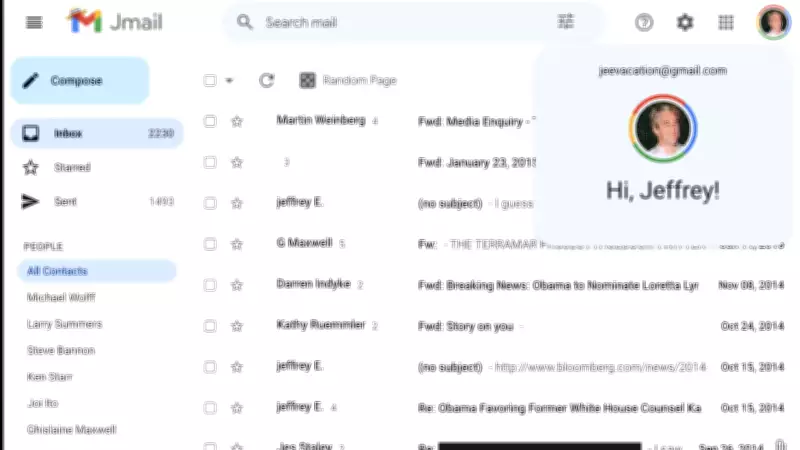
A recent web-based initiative completely transforms this experience. Instead of requiring users to navigate between multiple files, it presents the emails within a familiar, Gmail-style interface. This approach makes the archive feel like an actual inbox, converting a chaotic assortment of documents into a much more manageable, searchable, and comprehensible resource.
Introducing Jmail: Usability Over Revelation
The project, known as Jmail, replicates the appearance and functionality of Google's email service while utilizing only publicly available material. There is no inclusion of new data or access to private information. The primary goal is to enhance usability rather than uncover new revelations: to render existing records readable without the need for specialized tools or extensive manual sorting efforts.

Creators and Their Vision for Jmail
Jmail was developed by Riley Walz, described by Wired as a prankster and internet artist, in collaboration with web developer Luke Igel. Rather than treating the Epstein emails solely as raw evidence to be mined for new discoveries, the duo approached them as both a technical challenge and a cultural issue. Their central inquiry was not about the content of the emails, but how the presentation of information influences who engages with it and who does not.
The creators have positioned Jmail as an experiment in accessibility. They argue that public records are often technically accessible but practically unusable, buried in fragmented files that deter thorough examination. By reconstructing the archive in a familiar format, they aimed to highlight the disparity between transparency in theory and transparency in practice.
How the Inbox Interface Transforms the Reading Experience
The interface mirrors the conventions of a standard email client. Messages are clearly categorized into sent and received folders, conversations are organized into threads, and a search bar enables users to instantly look up names, dates, and keywords. These thoughtful design choices significantly alter how the material can be navigated. Instead of skimming isolated documents, users can effortlessly follow patterns of correspondence and timelines with minimal effort.
Benefits for Journalists and General Readers
For journalists and researchers, this reduces the time spent on basic organization and increases the time available for in-depth analysis. For general readers, the familiar layout eliminates the intimidation factor often associated with large document dumps, making engagement more likely and accessible.
Although the presentation may seem provocative, Jmail functions primarily as a research aid rather than a mere stunt. It does not introduce new information or private data, nor does it claim to reveal hidden material. Its significance lies in demonstrating how interface design can impact whether public records are ignored, misunderstood, or meaningfully examined.






