

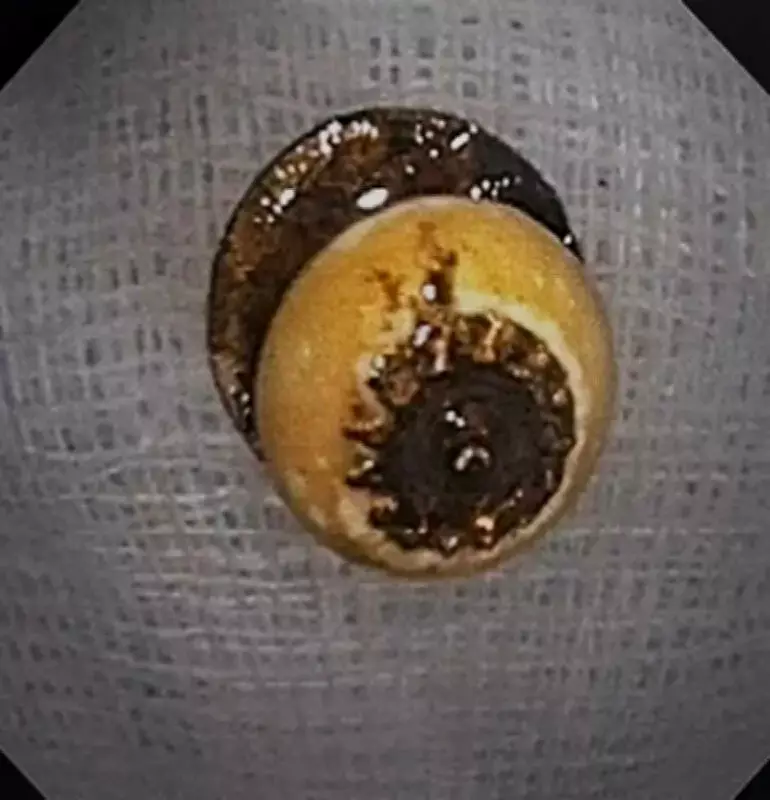
A 79-year-old man from Patna, who had been suffering from a persistent chest infection, sepsis, and severe pneumonia, has shown remarkable improvement after doctors at a Kolkata private hospital extracted a kurta button lodged in his lung. The patient, a survivor of vocal-cord carcinoma, was unaware that he had accidentally swallowed the button while asleep.
Medical Journey
The man had been treated at multiple hospitals without significant improvement before being admitted to ILS Hospitals in Dum Dum on Thursday. Despite receiving multiple intravenous antibiotics, his condition did not improve. Suspecting non-resolving pneumonia, the pulmonology team decided to perform a bronchoscopy.
Discovery During Bronchoscopy
During the procedure, doctors discovered an impacted foreign body—a button—lodged in his left lower lobe bronchus. The medical team successfully removed the button using a foreign body forceps through bronchoscopy. The patient's son later identified it as a missing button from his father's kurta.

Dr. Mrinmoy Mitra, consultant pulmonologist at ILS Hospital, Dum Dum, who conducted the procedure, explained the challenges: "Removal of an impacted foreign body from inside the lung is always challenging for interventional pulmonologists. It requires planning and proper execution. The whole process of intervention was done by light sedation. I first identified the button inside the left lower lobe through proper negotiation with a bronchoscope, then held it firmly with a foreign-body forceps and removed it gradually from the lung through the airway."
Importance of Timely Diagnosis
Dr. Mitra emphasized that this case highlights the importance of timely diagnosis and advanced interventional pulmonology in managing complex cases of non-resolving pneumonia. The patient is currently recovering in the ICU under continued medical supervision.
Risks of Foreign Objects in Lungs
A foreign object lodged in the lungs, known as pulmonary aspiration, is a serious medical situation that can lead to various immediate and long-term complications. The severity depends on the size, material, and depth of the object. Immediate risks include airway obstruction, shortness of breath, wheezing, violent coughing, lung deflation or collapse, and hypoxia, which can lead to cyanosis and loss of consciousness in extreme cases.
This case serves as a reminder of the potential dangers of accidental aspiration and the effectiveness of modern interventional techniques in resolving such critical conditions.






