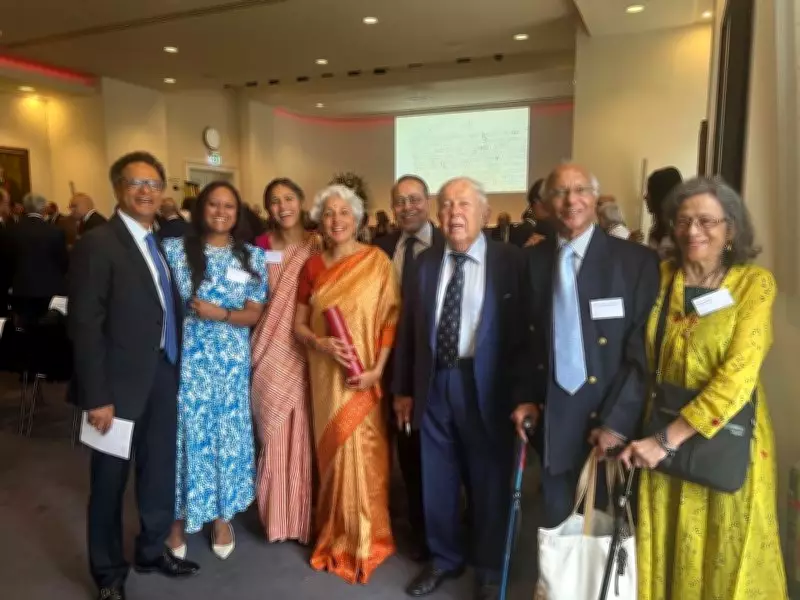
Indian scientist Soumya Swaminathan was formally inducted as a Fellow of the Royal Society of London on Saturday, following in the footsteps of her father, the legendary agricultural scientist and Bharat Ratna MS Swaminathan. At her induction ceremony, she signed the same historic register that bears her father's signature from 1973, as well as that of eminent scientist Isaac Newton.
Historic Induction Ceremony
Speaking about the occasion, Soumya said, “Honoured to be inducted into the Royal Society today, the oldest Science Academy in the world. Was nice to meet the 2026 cohort, listen to the great science being done in all parts of the world, and see the page from the register in 1973 where my father signed.” The Royal Society, founded in 1660, is the oldest scientific academy in the world and has counted figures such as Newton, Charles Darwin, and Albert Einstein among its Fellows.
Career and Contributions
Soumya Swaminathan is a former Chief Scientist at the World Health Organisation (WHO) and former Director General of the Indian Council of Medical Research (ICMR). Currently, she serves as principal advisor to the National Tuberculosis Elimination Programme in India, where she is shaping policy and strategy to accelerate the country's efforts to eliminate tuberculosis. Her work focuses on evidence-based approaches to combat the disease, which remains a major public health challenge in India.

Only Second Indian Woman Elected
On May 20, Soumya became only the second Indian woman scientist to be elected a Fellow of the Royal Society in its 400-year history. The first was vaccinologist Gagandeep Kang, who was elected in 2019. This milestone highlights the growing recognition of Indian women scientists on the global stage.
Legacy of the Swaminathan Family
Her father, MS Swaminathan, was a renowned agricultural scientist who played a key role in India's Green Revolution. He was elected a Fellow of the Royal Society in 1973. Soumya's induction continues the family's legacy of scientific excellence. The register she signed contains the signatures of many of history's greatest scientific minds, including Newton, who served as President of the Royal Society from 1703 to 1727.