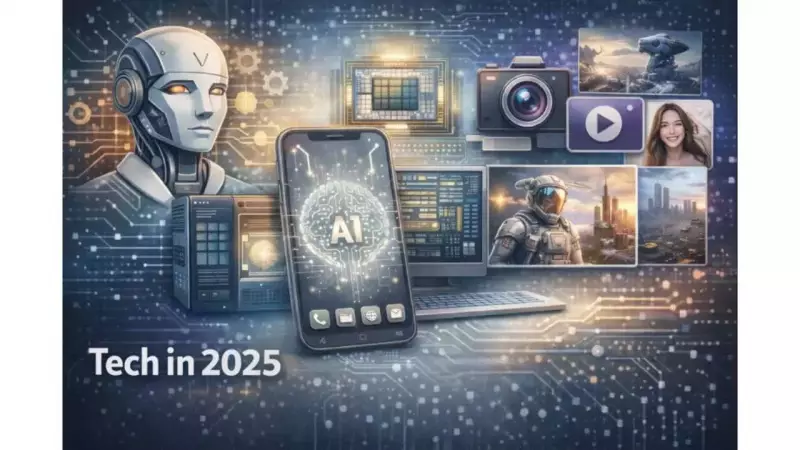
The year 2025 will be remembered not for incremental tech upgrades, but for a fundamental rewiring of how technology functions. Artificial Intelligence shed its novelty tag to become an embedded, operational force across Indian industries and personal devices. This was the year AI transitioned from a tool we use to an intelligent layer that works alongside us.
The Rise of the Autonomous Co-Worker: Agentic AI
If earlier years were defined by chatbots, 2025 witnessed the real-world deployment of Agentic AI. These advanced systems moved beyond generating text to taking actions, managing complex tasks, and making decisions autonomously within business workflows. Enterprises began leveraging them for real-time data processing, customer query resolution, and system monitoring.
Vivek Ganesh, Regional Vice President at OutSystems India, called this the most critical shift in enterprise technology for 2025. He stated it was the year organizations moved from concept to operationalizing agentic AI at scale. "This has unlocked a new level of productivity," he explained, with automation handling mundane tasks and freeing teams for strategic work.

However, this power brought new priorities. Ganesh emphasized that with AI's growing autonomy, governance, security, and compliance became as crucial as innovation itself. The central question for companies evolved from 'How fast can we adopt AI?' to 'How do we adopt it responsibly and securely?'
Amit Agrawal, President of Techno Digital, highlighted how Indian enterprises are re-architecting their digital foundations for AI. He pointed to a decisive shift in compute placement, driven by needs for performance, latency, and data sovereignty, pushing workloads closer to the point of creation. This is enabling millisecond-level responsiveness in sectors like smart manufacturing and logistics.
AI Gets Personal: From Smartphone Apps to the Operating System
The integration of AI into daily life deepened remarkably, moving from standalone apps into the very operating systems of devices. Whether it was Google Gemini in Android, AI in Apple's iPhone 17 lineup, or native assistants in Windows, AI became a persistent, context-aware layer.
Chitranshu Mahant, CEO and co-founder of Primebook India, told TOI that 2025 marked AI's shift from a tool users open to "an always-present layer across operating systems, devices and workflows." This transition, he believes, will redefine personal computing for the next decade, moving us from manual commands to systems that understand context and automate multi-step tasks.
A Realme spokesperson echoed this, noting AI evolved from an optional feature to a core part of smartphone functionality. Intelligence moved on-device, working in the background to power smarter imaging, adaptive performance, and personalised experiences. The focus shifted from novelty to removing everyday friction, with features like AI Edit Genie and AI Party Mode.
Mainstream AI PCs and The Hardware Conundrum
2025 also saw AI PCs becoming mainstream in India, fueled by demands for faster processing, enhanced privacy, and offline intelligence. Vineet Gehani, Senior Director – Personal Systems, HP India, observed that technology moved from adoption to acceleration, with AI becoming deeply practical for India's workforce.
He highlighted that on-device AI reduced reliance on constant connectivity, improved data privacy, and unlocked smarter workflows, making advanced computing more accessible from metro cities to Tier 2 towns.
This software shift coincided with a major hardware leap. Nvidia's Blackwell chips became the symbol of AI acceleration, intensifying the AI chip race. While Intel faced challenges, Google developed its Tensor Processing Units (TPUs) as a credible alternative to Nvidia's dominance.
Mahant of Primebook warned that massive global investment in AI infrastructure "distorted the memory and storage ecosystem." High-end hardware was absorbed by large AI data centers, tightening availability for consumer devices and increasing costs without proportional gains for everyday users, especially in price-sensitive markets.

Security and Governance Take Center Stage
As AI integration deepened, so did the focus on robust security frameworks. Pratik Shah, Managing Director, India & SAARC, F5, noted that with agentic AI integrating into workflows, APIs would become the primary control layer, necessitating continuous behavioral security. He also predicted an acceleration in post-quantum cryptography planning to counter future threats.
Vijender Yadav, CEO & Co-founder of Accops, stated that 2025 taught enterprises that fragmented security stacks were no longer viable. The need shifted to platform-agnostic, crypto-agile architectures ensuring data residency while enabling hybrid work.
In digital advertising, Dhiraj Gupta, CTO & Co-founder of mFilterIt, said fraud began mimicking genuine user behavior, making traditional metrics insufficient. The solution lay in AI-ML driven, full-funnel visibility to block low-quality traffic and optimize campaigns based on real value.
As the year closes, the convergence of these trends—autonomous AI, ubiquitous generative media, deeply integrated assistants, and powerful new hardware—has created a new era. Technology is no longer just something we use; it's an intelligent, embedded infrastructure powering devices, industries, and everyday life in India. The question is no longer about what AI can do, but how we harness it responsibly as it becomes our constant co-pilot.