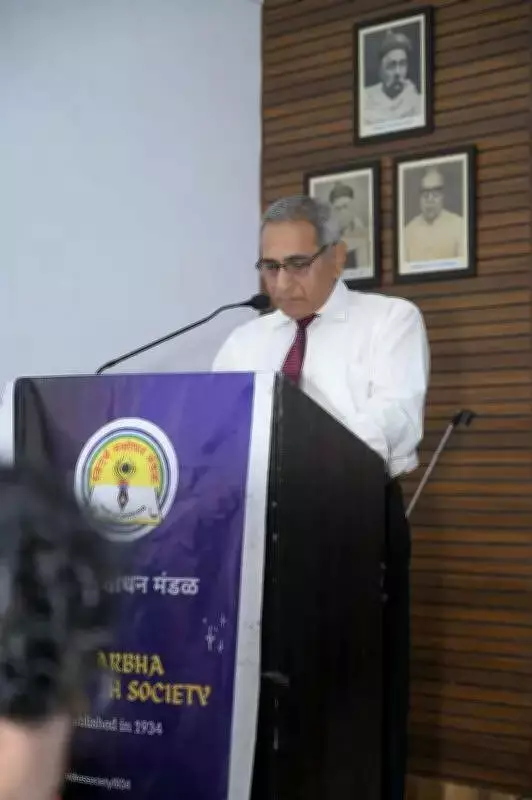
Nagpur: Vidarbha has the potential to become India's solar thermal capital due to its abundant sunshine, favourable geography, and growing industrial demand for clean energy, said Anil Misra, secretary of the Solar Energy Society of India (SESI). Speaking at a conference on "Empowering Vidarbha through Renewable Energy" organized by the Vidarbha Research Society (VRS) on Saturday, Misra highlighted that districts such as Nagpur and Chandrapur, known for their clear skies and high temperatures, are well-suited for large-scale solar thermal projects.
Solar Thermal Technology for Industrial Decarbonisation
Misra explained that solar energy can be harnessed through two major technologies: photovoltaic systems that generate electricity and solar thermal systems that directly produce heat. "While solar photovoltaics received significant attention, solar thermal technology offers substantial opportunities for industrial decarbonisation," he said. He added that Vidarbha receives 5.6 to 6.2 kilowatt-hours of solar radiation per square metre daily and enjoys nearly 300 days of bright sunshine annually, making it ideal for solar thermal applications.
VRS Plans to Engage Youth in Research
Parag Pandharipande, working president of VRS, emphasized that Vidarbha possesses immense potential across multiple sectors, but realizing that potential requires sustained effort, innovation and public participation. He stressed the need to take VRS's research beyond academic circles and actively engage youth in scientific inquiry and problem-solving. Pandharipande announced that the society plans to organize a major research presentation event in December, coinciding with the shortest day of the year. He also revealed that VRS is collaborating with several colleges and educational institutions to encourage student participation.

India's Renewable Energy Targets and Green Hydrogen
Renewable energy expert Sivaramakrishnan Ganesan Iyer, an empanelled chartered engineer with the Ministry of New and Renewable Energy (MNRE), said India is on course to achieve complete self-sufficiency in green hydrogen production by 2030. Describing green hydrogen as the new mantra of the energy sector, he noted that India is currently in the activation phase of hydrogen adoption and is expected to enter the acceleration phase by 2027. Under the Viksit Bharat roadmap, renewable energy is projected to contribute 25% of India's emission reductions by 2050, while green hydrogen is expected to contribute 10%. Iyer said the Centre has set ambitious targets of 100 GW each of wind power and pumped storage hydro (PSH) capacity by 2030. He also highlighted the government's plans to achieve 100 GW of nuclear power generation by 2040, noting that Bharat Reactors are under development and several tenders have already been floated as part of the expansion programme.
Agrivoltaics as a Solution to Land Scarcity
Gulab Singh Girase, founder and director of Gro Solar Energy Ltd, said India's solar ambitions would require vast land resources in the coming decades. He argued that dual land-use models such as agrivoltaics offer a practical solution. "Solar potential is virtually infinite, but land availability will become a major challenge. Agrivoltaics allows us to produce food and electricity simultaneously," Girase explained. This approach could help address the competing demands for land between agriculture and solar energy.