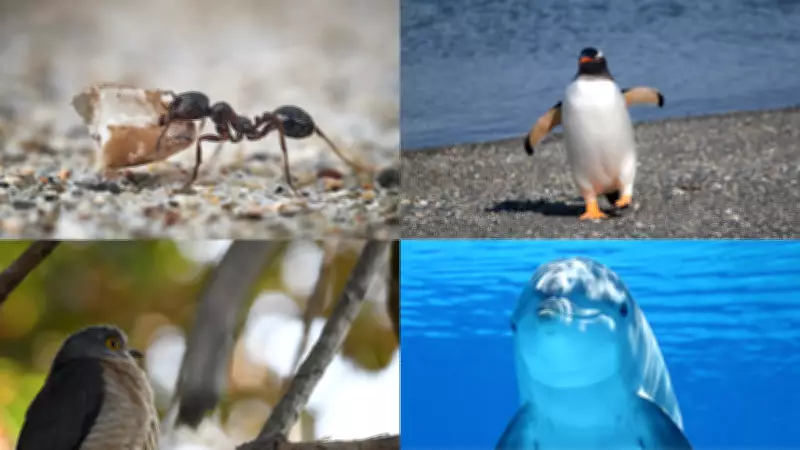
Nature is full of behaviors that challenge our understanding of the animal world. While humans associate kidnapping and abduction with crime, several species have evolved behaviors that appear remarkably similar. Across oceans, forests, and underground colonies, animals have been observed stealing eggs, larvae, chicks, and even infants from their rivals. These acts are not driven by cruelty or revenge. Instead, they are often strategies shaped by millions of years of evolution, helping individuals gain workers, increase breeding success, or improve their chances of survival. Scientists have documented these unusual behaviors for decades, revealing that what seems shocking to us can sometimes be a surprisingly effective survival tactic. From organized ant raids to birds that secretly place their offspring in another species' nest, here are five of the most fascinating examples of animal abduction ever recorded.
What appears shocking through a human lens is often an evolutionary solution to a biological challenge. Slave-making ants acquire a workforce without raising workers themselves. Cuckoos avoid the enormous energy costs of parental care. Some penguins and dolphins may be responding to powerful parental instincts, while other species simply exploit opportunities created by their environment.
From Slave-Making Ants to Cuckoos: Five Animals Known for Stealing Offspring in Nature
Slave-Making Ants Conduct Organized Raids and Abduct Young from Rival Colonies
Perhaps the closest equivalent to organized kidnapping in the animal kingdom occurs among slave-making ants. Species such as Protomognathus americanus and Polyergus breviceps launch coordinated attacks on neighboring colonies, targeting developing larvae and pupae. Once inside a host nest, raiding ants seize immature brood and carry them back to their own colony. When the stolen ants mature, they begin working for their captors, gathering food, tending larvae, and maintaining the nest. Researchers from the Museum and Institute of Zoology, Polish Academy of Sciences, described this extraordinary behavior in the journal Enslaved ants: not as helpless as they were thought to be: "Slave-making ant queens invade host colonies and kill or eject all adult host ants." The behavior, known scientifically as dulosis, has evolved multiple times in ants and represents one of the most sophisticated forms of social parasitism known to science.

Cuckoos Trick Other Birds into Raising Their Stolen Offspring
The common cuckoo is famous for one of nature's most deceptive reproductive strategies. Rather than building its own nest and caring for its chicks, a female cuckoo secretly lays an egg in the nest of another bird species. The unsuspecting host parents incubate the foreign egg and later feed the chick as though it were their own. In many cases, the newly hatched cuckoo pushes the host's eggs or chicks out of the nest, eliminating competition for food. According to Egg mimicry by cuckoos Cuculus canorus in relation to discrimination by hosts, a landmark study published in Nature, researchers found that cuckoo eggs closely mimic the appearance of their host's eggs, helping them avoid detection. The authors noted: "Hosts are selected to recognize and reject parasitic eggs." This evolutionary arms race between cuckoos and their hosts has fascinated ornithologists for generations and remains one of the best examples of brood parasitism in the natural world.

Dolphins Have Been Observed Carrying and Taking Calves from Other Mothers
Bottlenose dolphins are among the most intelligent animals on Earth, but their social behavior can sometimes be surprisingly complex. Researchers studying dolphin populations have documented instances in which females interacted intensely with calves that were not their own. Some observations suggest temporary calf abductions, where young dolphins become separated from their mothers and are accompanied by unrelated adults. Scientists remain cautious about assigning motives, but the behavior has been recorded in several populations. A study published in the National Library of Medicine described cases involving alloparental care and calf-directed interactions that occasionally resulted in prolonged separation from biological mothers. Researchers emphasize that these events are rare and not fully understood, but they demonstrate the complexity of dolphin social structures and maternal behavior.
Emperor Penguins Occasionally Steal Chicks During the Breeding Season
The harsh environment of Antarctica creates intense competition among breeding emperor penguins. Researchers have occasionally observed adults attempting to take or care for chicks that are not their own. When parents lose their own offspring, some individuals may attempt to adopt or even seize unattended chicks. Although these interactions are usually brief, they can involve aggressive encounters between adults competing over a young penguin. Research titled Kidnapping of chicks in emperor penguins: a hormonal by-product documented these unusual behaviors and suggested they may stem from strong parental instincts rather than deliberate attempts to steal offspring. The findings illustrate how powerful reproductive drives can influence behavior, particularly in extreme environments where breeding opportunities are limited.
Ant-Following Birds Steal Prey from Army Ant Raids
Not all forms of animal theft involve offspring. In tropical forests throughout Central and South America, army ants conduct massive hunting raids that flush insects, spiders, and small vertebrates from hiding. Several bird species have evolved to follow these ant swarms closely. Rather than hunting independently, the birds capture prey that are attempting to escape the advancing ants. Biologists describe this behavior as kleptoparasitism and opportunistic theft. Although the birds do not steal young directly, they exploit the work of another species to secure food with minimal effort. Research titled Ant-following behaviour is correlated with plumage traits in African understory birds has shown that many bird species depend heavily on these raids and may struggle to survive without access to army ant swarms.