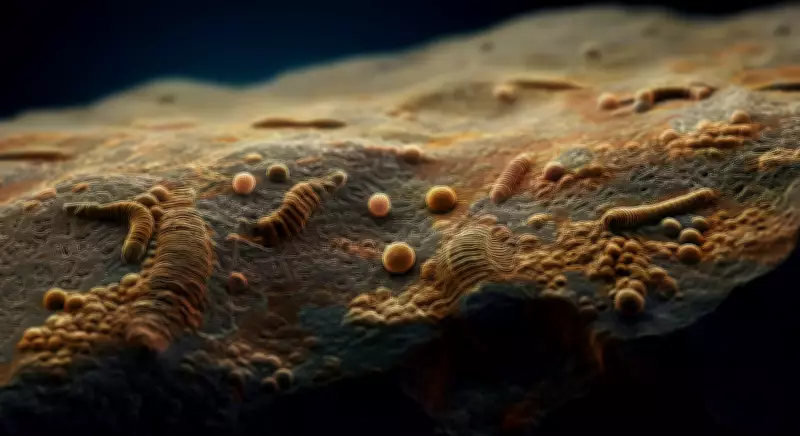
Ancient Sponge Fossils in Canada Could Rewrite Animal Evolution Timeline
Imagine for a second the first animals to appear on our planet. Most likely, your imagination conjures the image of the so-called Cambrian explosion, a mysterious period in prehistory populated by bizarre-looking trilobites, armoured marine animals, and even more bizarre predators swimming in the primaeval seas. School books have long taught that this marked the definitive beginning of animal evolution. However, high above the rough terrains of northwestern Canada, a bunch of minuscule squiggles found inside fossilised reef rocks may prove otherwise.
The tiny patterns are so small that you can literally walk past them without noticing. Yet they have sparked an enormous scientific controversy that might shift the date of origin of animals by as much as 350 million years back. If these discoveries are confirmed, it would mean that animal life thrived on Earth millions of years ago, when the present continental configuration had yet to emerge.
The Microscopic Ghost in the Reef
It all started when scientists analysed rock samples collected from 890-million-year-old microbial reefs in Canada. These reefs were formed by gigantic bacterial colonies, well before the existence of modern coral reefs. When scientists studied thin sections under the microscope, they found no traces of usual animal remains such as bones, teeth, or shells. Instead, they discovered complex web-like structures.

In their study Possible poriferan body fossils in early Neoproterozoic microbial reefs, published in the journal Nature, scientists made an amazing claim: the microscopic organisms are a perfect fit for the physical skeletons of today's keratose sponges. Sponges are among the most primitive living things on the tree of life and are believed to be the ancestors of the animal kingdom. If these tiny organisms turn out to be fossilised sponges, they would be the oldest body fossils of animals known to date.
The context of the discovery makes the tale even more compelling. The potential fossils were not deposited on an ordinary seafloor full of life but were entirely contained within ancient bacterial colonies. Rather than being replaced by animals, it seems that the first animals coexisted with bacteria, finding a precarious niche in low-oxygen oceans. These structures, resembling the skeletons of modern sponges, challenge the traditional view of the Cambrian explosion as the definitive start of animal evolution, suggesting early animals coexisted with bacteria in low-oxygen environments.
When Geology Imitates Biology
Extraordinary as the discovery may seem, it has left the scientific community completely divided. The crux of the issue is that when looking back into deep time—almost a billion years ago—the distinction between organic biology and common geology becomes very hard to make. Nature is a wonderful artist, and under certain environmental stresses, it is not difficult to shape common rocks into organic forms.
This scepticism is a major focus of an analysis published in Nature titled Sponge-like fossil could be Earth’s earliest known animal. Many palaeontologists urge caution, pointing out that rock-forming processes can create deceptive look-alike textures under the right conditions. Because soft-bodied creatures like sponges do not possess hard shells, they rarely leave a clean footprint in the geological record. Deciphering whether these Canadian rock patterns are genuine animal remains or just a clever trick played by minerals is a massive challenge.
What this discovery does pull off beautifully is bridging the gap between two different fields of science. For years, geneticists tracking evolution through molecular clocks have argued that animals must have emerged around 900 million years ago, but palaeontologists could never find the physical fossils to prove it. These tiny Canadian squiggles land exactly in that missing time frame.

Whatever the final verdict on whether they qualify as actual fossils or just an illusion of nature’s work, what is certain is that they have succeeded in changing our outlook. They teach us that history was not created solely by the huge bones of dinosaurs, but also by the invisible marks left in stones. The rocks in Canada have shown that the truth about our beginnings can be found right under our feet.